
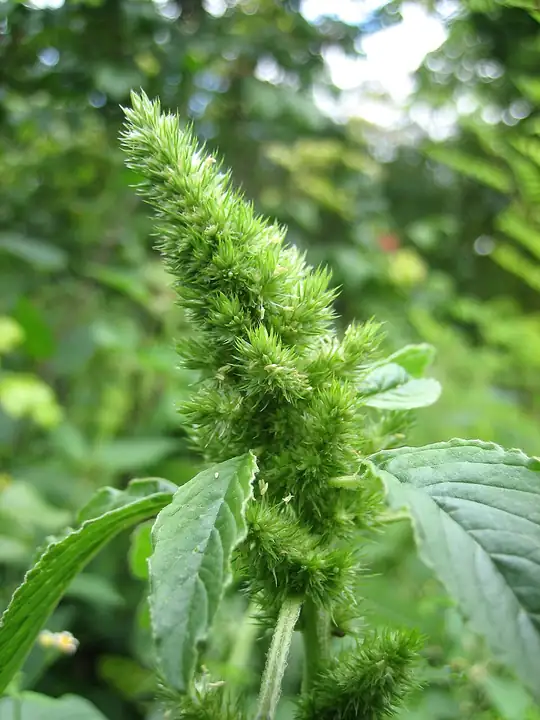
Redroot pigweed
Amaranthus retroflexus
| Type | Broadleaf |
|---|---|
| Life cycle | Summer annual |
| Family | Amaranth family (Amaranthaceae) |
| Origin | Native to the US |
| Most common in | Northeast, Southeast, South Central, Midwest, Great Plains, Mountain West, Southwest, Pacific Northwest, California |
About
Redroot pigweed is a coarse, upright summer annual that loves hot weather and rich garden soil. It grows fast, can reach 6 feet, and a single plant can drop tens of thousands of seeds.
Also called pigweed, redroot amaranth
How to identify it
Look for
Look for a pink to red taproot and hairy upper stems. Leaves are oval to diamond shaped with wavy edges, often reddish underneath, and seedlings have narrow seed leaves with red undersides. Tiny green flowers form stiff, bristly, crowded spikes at the top.
Look-alikes
Smooth pigweed also has hairy stems but flatter, egg-shaped leaves; Palmer amaranth and waterhemp have smooth, hairless stems, and Palmer's leaf stalks are as long as or longer than the leaf blade.
Where it grows
Vegetable gardens, crop fields, new beds, roadsides and any sunny, disturbed ground.
When
Sprouts from late spring through summer once the soil is warm; it flowers from about June to November, and late sprouts can flower in as little as three weeks.
How it spreads
Seed only: typically 25,000 to 120,000 seeds per plant, and sometimes over a million.
Most common in
| Northeast | Very common here |
|---|---|
| Southeast | Very common here |
| South Central | Very common here |
| Midwest | Very common here |
| Great Plains | Very common here |
| Mountain West | Very common here |
| Southwest | Very common here |
| Pacific Northwest | Very common here |
| California | Very common here |
| Alaska | Occasional here |
| Hawaii | Occasional here |
What to do, gentlest first
Start at the top. Weed killers are a last step; always read and follow the label.
Stop seed set Prevent
Pull or cut plants before the spikes ripen. A few years of good control shrinks the seed bank a lot.
Plants that have flowered can still ripen seed after being cut, so bag them; don't compost them.
Pull or hoe while small By hand
Hoe seedlings when they are tiny, or pull larger plants by the base to get the red taproot.
Mulch heavily Barrier
Straw and other mulches work well; lay them thick or pack them down, because pigweed can push through a thin layer.
Corn gluten meal pre-emergent Organic spray
Iowa State lists pigweed among the weeds corn gluten meal can stop as they sprout. Spread it before the weed seeds germinate (about 20 pounds per 1,000 square feet) and water it in lightly; it does nothing to plants that are already up.
It also stops seeds you sow, so don't use it where you plan to plant seeds soon. Heavy rain right after spreading weakens it.
Burn down seedlings with a contact spray Organic spray
Horticultural vinegar (acetic acid), fatty-acid soap, pelargonic acid or clove-oil sprays burn what they touch within hours. They work best on young seedlings in warm, sunny weather, and you will need to repeat, because they don't move into roots and bigger plants regrow.
They kill any plant they touch, so shield crops. Strong vinegar can burn skin and eyes; wear goggles and gloves and follow the label.
Spot spray or use a garden-labeled pre-emergent Conventional spray
Glyphosate can be spot sprayed on weeds away from garden plants, and pre-emergents such as trifluralin or pendimethalin are labeled for some beds. In many farm areas, pigweeds resist some common herbicides.
Read and follow the label. Many lawn weed killers also kill or damage vegetables and flowers, so keep spray and drift off garden plants.
Uses, wildlife and pets
For wildlife
Mice, ground beetles and crickets eat many of the fallen seeds (SARE).
Pets
Not listed by the ASPCA. Its leaves can hold enough nitrate to poison livestock that eat a lot of it.
Sources
- ipm.ucanr.edu
- sare.org
- crops.extension.iastate.edu
- plantsservices.sc.egov.usda.gov
- yardandgarden.extension.iastate.edu
- ipm.ucanr.edu
- ucanr.edu
Photo: Photo: Lynk media / Wikimedia Commons, CC BY-SA 3.0 (CC BY-SA 3.0). Photo resized for the web.

Planting dates and advice are general guidance; check with your local Cooperative Extension office for your area.