
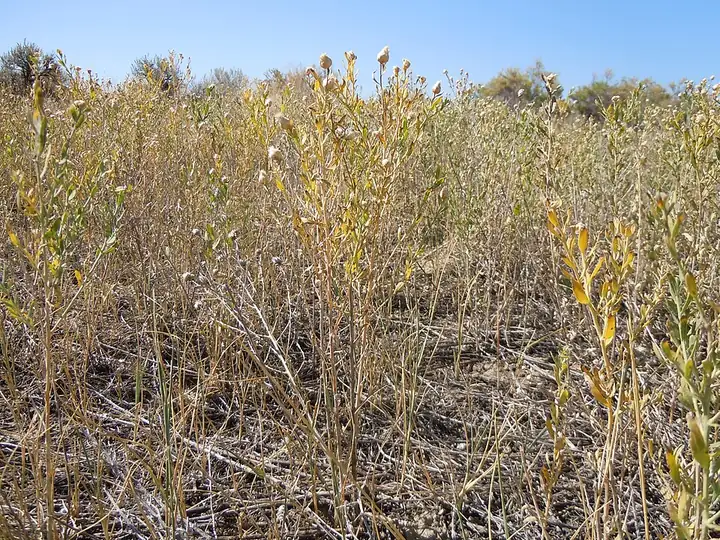
Russian knapweed
Rhaponticum repens
| Type | Broadleaf |
|---|---|
| Life cycle | Perennial |
| Family | Aster family (Asteraceae) |
| Origin | Introduced from elsewhere |
| Most common in | Mountain West |
About
Russian knapweed is a creeping perennial from Central Asia that forms dense patches in western fields, ditches and rangeland. Its deep, spreading roots make it very hard to kill, and it is poisonous to horses.
Also called hardheads, Turkestan thistle
How to identify it
Look for
Upright, branched stems grow 1 1/2 to 3 feet tall, whitish and woolly when young. Lower leaves are gray-green and lobed, upper leaves small and smooth-edged. Small urn-shaped pink to lavender flower heads sit on bracts with broad, papery tips, and the roots are black or dark brown and scaly.
Look-alikes
Spotted knapweed has black-fringed bracts and a taproot. Russian knapweed's papery-tipped bracts and dark, creeping roots set it apart.
Where it grows
Pastures, hayfields, orchards, vineyards, irrigation ditches, roadsides and disturbed ground across the West.
When
Shoots come up in early spring, bolt in May or June and flower through summer into fall; in late summer the roots set buds for next year.
How it spreads
Mostly by creeping roots, which can cover about 12 square yards in two seasons and reach over 8 feet deep; root pieces regrow after tilling, and it spreads less often by seed.
Most common in
| Northeast | Not found here |
|---|---|
| Southeast | Not found here |
| South Central | Occasional here |
| Midwest | Occasional here |
| Great Plains | Common here |
| Mountain West | Very common here |
| Southwest | Common here |
| Pacific Northwest | Common here |
| California | Common here |
| Alaska | Not found here |
| Hawaii | Not found here |
Where it is regulated
Listed as a Class B noxious weed in Washington and California, and prohibited in Wisconsin.
What to do, gentlest first
Start at the top. Weed killers are a last step; always read and follow the label.
Reseed with tough perennial grasses Prevent
After any treatment, seed competitive perennial grasses so it can't take back the ground. Keep horses away from patches.
Pull or mow before seed, again and again By hand
Pull young plants before seed set and mow repeatedly at the bud stage. This only suppresses it; it regrows strongly from roots.
Don't till; root pieces start new plants.
Grazing and a gall-forming nematode Natural enemies
Sheep or goats can graze it down, and a nematode (Subanguina picridis) forms galls on it. Ask Extension what's available locally.
Don't let horses graze it.
Fall systemic herbicide Conventional spray
Colorado State lists clopyralid (alone or with 2,4-D), aminopyralid, picloram and chlorsulfuron, at bud-to-flower stage or in late fall when roots are storing food. Glyphosate failed in their trials.
Read and follow the label. Many lawn weed killers also kill garden plants, so keep spray and drift off beds and vegetables. Picloram is restricted-use, for certified applicators only.
Uses, wildlife and pets
Pets
Not listed by the ASPCA. It is poisonous to horses and can cause 'chewing disease,' a brain disorder (Washington State Noxious Weed Control Board; UC IPM).
Sources
- nwcb.wa.gov
- ipm.ucanr.edu
- extension.colostate.edu
- dnr.wisconsin.gov
- plantsservices.sc.egov.usda.gov
- aspca.org
Photo: Photo: Matt Lavin / Wikimedia Commons, CC BY-SA 2.0 (CC BY-SA 2.0). Photo resized for the web.

Planting dates and advice are general guidance; check with your local Cooperative Extension office for your area.