
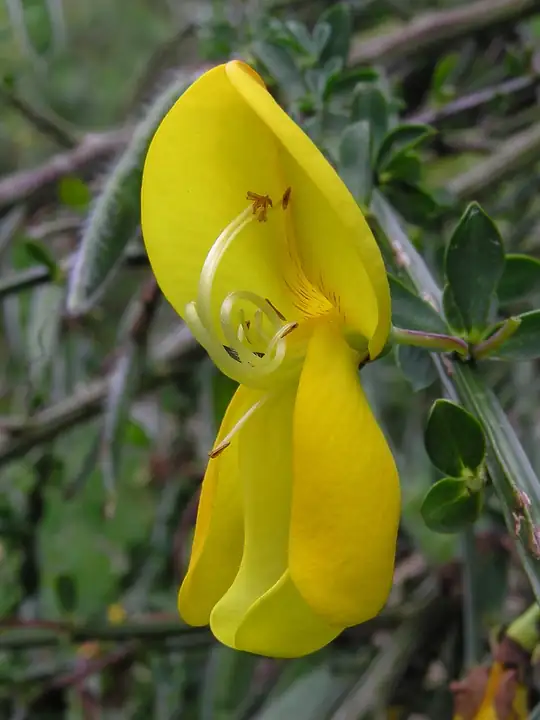
Scotch broom
Cytisus scoparius
| Type | Shrub or tree |
|---|---|
| Life cycle | Perennial |
| Family | Pea family (Fabaceae) |
| Origin | Introduced from elsewhere |
| Most common in | Pacific Northwest, California |
About
A European shrub with bright yellow pea flowers that has taken over roadsides, pastures and open ground, especially from Washington to central California. It makes thousands of long-lived seeds, crowds out other plants, and creates a serious fire hazard; its seeds, leaves and stems are poisonous if eaten.
Also called common broom, English broom, broom
How to identify it
Look for
A 4- to 8-foot shrub with many stiff green stems that have 5 ridges (star-shaped in cross section) and stay green all year. Leaves are few and small: three leaflets on lower stems and single leaflets higher up, and they often drop early. Bright yellow pea-like flowers about three-quarters of an inch long open in spring, followed by flat pods, hairy only along the edges, that turn brown-black and snap open.
Look-alikes
French broom has 8 to 10 stem ridges and evergreen leaves, Spanish broom has round stems with simple leaves, and gorse is covered in sharp spines. All are invasive.
Where it grows
Roadsides, pastures, clearings, dry scrubland, vacant lots and disturbed ground in full sun.
When
Blooms mainly in spring (about April to June), sometimes again in summer, and the pods then ripen and pop open to scatter seed.
How it spreads
By seed only: a big plant can make thousands of seeds a year that shoot several feet from bursting pods, and seeds can stay alive in the soil for decades.
Most common in
| Northeast | Occasional here |
|---|---|
| Southeast | Occasional here |
| South Central | Not found here |
| Midwest | Occasional here |
| Great Plains | Not found here |
| Mountain West | Occasional here |
| Southwest | Not found here |
| Pacific Northwest | Very common here |
| California | Very common here |
| Alaska | Not found here |
| Hawaii | Occasional here |
Where it is regulated
Hawaii, Idaho and Oregon list it as a noxious weed, California as a List C noxious weed, and Washington as a Class B noxious weed.
What to do, gentlest first
Protect yourself first. Weed killers are a last step; always read and follow the label.
Pull seedlings for years afterward Prevent
Seeds last for decades, so check cleared areas at least yearly and pull seedlings before they flower in their second or third year.
Pull or lever out small plants when the soil is moist By hand
Pull small plants in early spring or late fall when the soil is moist; a weed wrench helps with bigger ones. Pulling in dry soil snaps stems and leaves roots behind.
Gloves recommended.
Cut larger shrubs in late summer By hand
Cut stems near the ground when plants are drought-stressed in late summer; mowing alone gives poor control because plants recover within a couple of months.
Seed-eating insects and goats Natural enemies
A seed weevil, a seed beetle, a twig-mining moth and a gall mite are established and cut seed production, but none gives much control. Goats and sheep eat the resprouts.
Triclopyr or glyphosate Conventional spray
Spray leaves from about April to July, paint stumps right after cutting, or treat the lower bark with triclopyr in oil any time of year. Watch for regrowth for at least a year and retreat.
Read and follow the label. Many lawn and brush killers also harm garden plants, so keep spray and drift off anything you want to keep. Don't use triclopyr ester above 80 F.
Uses, wildlife and pets
For wildlife
Bees pollinate the flowers.
Pets
Not on the ASPCA toxic plant lists, but Washington's weed board says the seeds are toxic to livestock and horses, and UC IPM reports nervous-system effects in horses.
Sources
Photo: Photo: Tony Wills / Wikimedia Commons, CC BY 2.5 (CC BY 2.5). Photo resized for the web.

Planting dates and advice are general guidance; check with your local Cooperative Extension office for your area.