
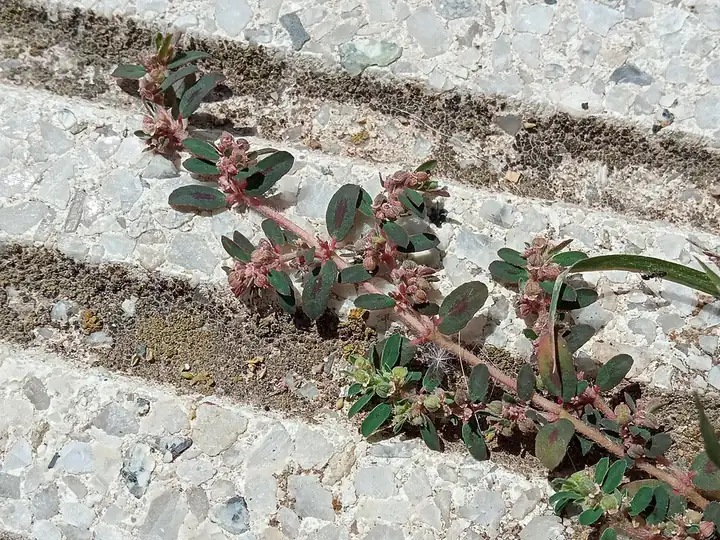
Spotted Spurge
Euphorbia maculata
| Type | Broadleaf |
|---|---|
| Life cycle | Summer annual |
| Family | Spurge family (Euphorbiaceae) |
| Origin | Native to the US |
| Most common in | Northeast, Southeast, South Central, Midwest, California |
About
Spotted spurge is a flat, fast-growing summer weed that spreads into lawns, cracks and beds and bleeds milky sap when broken. It can set seed within about five weeks of sprouting, and its sap irritates skin and eyes.
Also called spotted sandmat, milk purslane, spurge
How to identify it
Look for
Wiry, often reddish stems radiate from a taproot and hug the ground in a mat. Small oval leaves grow in pairs and usually have a dark maroon spot in the middle, and a broken stem oozes white, milky sap. Flowers are tiny and pinkish-white, and the little three-lobed seed capsules are hairy.
Look-alikes
Common purslane, an edible weed, has thick, fleshy leaves and no milky sap. Prostrate knotweed also mats but has no milky sap. Other spurges look similar; creeping spurge, for one, has no leaf spot and smooth seed capsules.
Where it grows
Sunny, thin or closely mowed lawns low in nitrogen, sidewalk and patio cracks, gardens, beds and nursery pots.
When
Seeds sprout once soil warms in spring and keep coming through summer (best at 75 to 85 °F); it flowers from about May to October.
How it spreads
Several thousand tiny seeds per plant, which need light to sprout and hitch rides on shoes, fur and mower tires.
Most common in
| Northeast | Very common here |
|---|---|
| Southeast | Very common here |
| South Central | Very common here |
| Midwest | Very common here |
| Great Plains | Common here |
| Mountain West | Common here |
| Southwest | Common here |
| Pacific Northwest | Common here |
| California | Very common here |
| Alaska | Not found here |
| Hawaii | Occasional here |
What to do, gentlest first
Protect yourself first. Weed killers are a last step; always read and follow the label.
Mow higher and feed the lawn Prevent
Raising the mowing height to 2 inches or more (in tall fescue or ryegrass) and fertilizing properly helps grass shade out seedlings, which need light to sprout.
Mowing itself won't remove it; it grows below the blade.
Pull before it seeds By hand
Pull plants while young, within a few weeks of sprouting; plants can seed about five weeks after coming up.
Wear gloves; the sap irritates skin and eyes.
Mulch or solarize Barrier
In beds, at least 2 inches of fine mulch (3 to 4 inches of coarse bark) blocks the light seeds need. In hot-summer areas, clear plastic laid over bare soil for 4 to 6 weeks in summer kills many seeds.
Vinegar on seedlings Organic spray
Horticultural vinegar can kill small seedlings; spray early, before plants spread.
Strong vinegar (over about 11% acetic acid) can burn skin and eyes, so wear gloves and eye protection. It browns any leaves it touches, grass included.
Spring pre-emergent, then spot sprays Conventional spray
A pre-emergent such as pendimethalin, dithiopyr, oryzalin or trifluralin, put down before the soil warms, stops seedlings. For young plants in lawns, spot-treat with triclopyr or a 2,4-D/MCPP/dicamba mix; large plants often shrug off 2,4-D mixes.
Read and follow the label. Many lawn weed killers also harm vegetables, flowers and shrubs, so don't let spray drift into beds, and keep dicamba products off the root zones of trees and shrubs.
Uses, wildlife and pets
For wildlife
Bees and wasps pollinate it, and mourning doves, bobwhite quail and sparrows eat the seeds.
Pets
Not listed by name by the ASPCA; the ASPCA does list other Euphorbia species, such as poinsettia and pencil cactus, as toxic. UC IPM describes the sap as poisonous, so keep pets from chewing it.
Sources
- turffiles.ncsu.edu
- ipm.ucanr.edu
- ipm.ucanr.edu
- plants.ces.ncsu.edu
- ipm.ucanr.edu
- extension.umn.edu
- extension.umd.edu
- npgsweb.ars-grin.gov
- plantsservices.sc.egov.usda.gov
- aspca.org
Photo: Photo: Josep Gesti / Wikimedia Commons, CC BY-SA 4.0 (CC BY-SA 4.0). Photo resized for the web.

Planting dates and advice are general guidance; check with your local Cooperative Extension office for your area.