
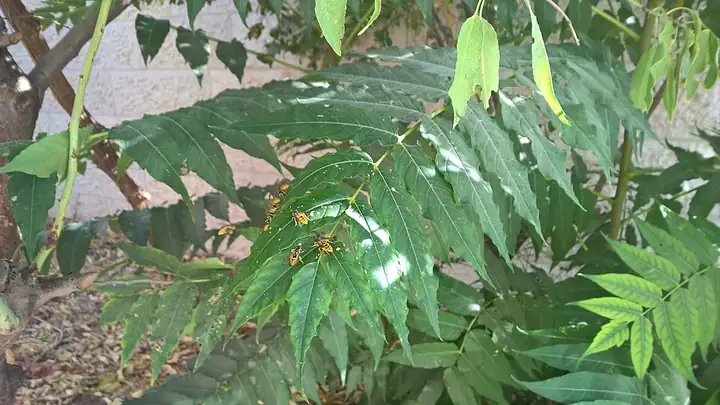
Tree of heaven
Ailanthus altissima
| Type | Shrub or tree |
|---|---|
| Life cycle | Perennial |
| Family | Quassia family (Simaroubaceae) |
| Origin | Introduced from elsewhere |
| Most common in | Northeast, California |
About
A fast-growing Chinese tree that pops up in cracks, yards, roadsides and woods and forms dense thickets from root suckers. It's also the favorite host of the spotted lanternfly, so removing it matters wherever that pest is present.
Also called tree-of-heaven, ailanthus, stink tree, stinking sumac, Chinese sumac
How to identify it
Look for
Leaves are 1 to 4 feet long and compound, with 10 to 40 leaflets that have smooth edges except for one or two glandular bumps near the base. Crushed leaves and twigs have a strong, unpleasant smell, and twigs have large heart-shaped leaf scars. Female trees carry big clusters of twisted, papery winged seeds; young bark is smooth and brownish-green, and older bark looks like cantaloupe skin.
Look-alikes
Staghorn sumac, black walnut and hickory have similar long leaves, but their leaflets are toothed along the edges and don't smell foul when crushed.
Where it grows
Sidewalk cracks, alleys, fence lines, vacant lots, roadsides, rail lines, yards and forest openings; it needs sun.
When
Flowers from about April to July, and seeds ripen and drift off from fall through winter.
How it spreads
A female tree can make more than 300,000 winged seeds a year, and roots send up suckers as far as 50 feet away; cut trees answer with dozens of stump and root sprouts.
Most common in
| Northeast | Very common here |
|---|---|
| Southeast | Common here |
| South Central | Occasional here |
| Midwest | Common here |
| Great Plains | Occasional here |
| Mountain West | Occasional here |
| Southwest | Occasional here |
| Pacific Northwest | Common here |
| California | Very common here |
| Alaska | Not found here |
| Hawaii | Not found here |
What to do, gentlest first
Protect yourself first. Weed killers are a last step; always read and follow the label.
Pull seedlings right away Prevent
Seedlings are easy to confuse with sumac or walnut, so check leaflet edges and sniff. Removing trees also takes away the spotted lanternfly's favorite food.
Hand-pull young seedlings, roots and all By hand
Pull seedlings while small, getting the whole root. Don't cut or mow bigger trees on their own; that triggers a flush of root suckers.
Gloves help protect against sap irritation.
Hack-and-squirt, basal bark or foliar treatment in mid to late summer Conventional spray
From July until fall color, make downward cuts evenly around the trunk and squirt in herbicide, spray the lower 12 to 18 inches of bark on stems under 6 inches thick, or spray the leaves of small trees. Glyphosate and triclopyr are common choices, and repeat treatments are often needed.
Read and follow the label. Many lawn and brush killers also harm garden plants, so keep spray and drift off anything you want to keep. Cut-stump treatments don't stop root suckers, so they aren't recommended here. Avoid imazapyr and other soil-active brush killers in home landscapes. Consider a licensed applicator for large trees.
Uses, wildlife and pets
For wildlife
Honey bees, flies and beetles visit the flowers.
Pets
Not listed as toxic by the ASPCA
Sources
Photo: Photo: Hexafluoride / Wikimedia Commons, CC BY-SA 4.0 (CC BY-SA 4.0). Photo resized for the web.

Planting dates and advice are general guidance; check with your local Cooperative Extension office for your area.