
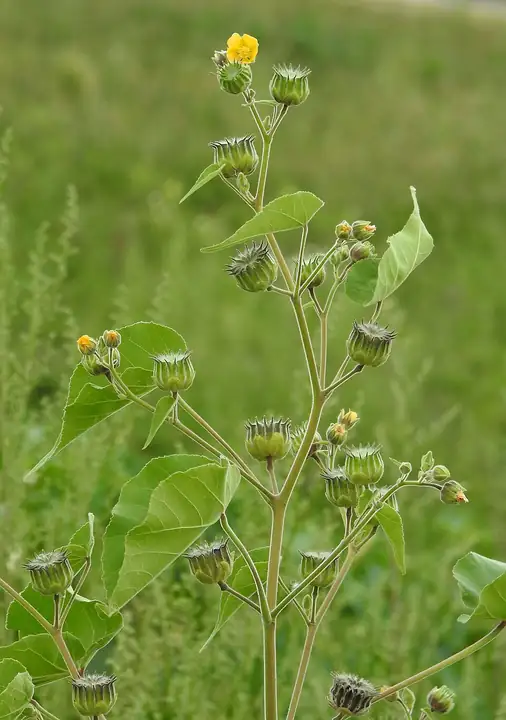
Velvetleaf
Abutilon theophrasti
| Type | Broadleaf |
|---|---|
| Life cycle | Summer annual |
| Family | Mallow family (Malvaceae) |
| Origin | Introduced from elsewhere |
| Most common in | Northeast, Midwest |
About
Velvetleaf is a tall annual from Asia, brought over in colonial times as a fiber crop, that became a major weed of corn and soybeans. Its seeds can live in the soil for decades, so one missed plant can cause years of trouble.
How to identify it
Look for
Big heart-shaped leaves, up to about 8 to 10 inches long, are covered in soft, velvety hairs, and so are the stems. Plants grow 2 to 7 feet tall and smell strong when crushed. Yellow five-petaled flowers about an inch wide turn into a round pod about an inch across, made of 12 to 15 woody segments.
Look-alikes
Venice mallow seedlings look similar, but its seed leaves are rounder and shinier and its later leaves are 3- to 5-lobed.
Where it grows
Gardens, crop fields (especially corn and soybeans), nursery beds, roadsides and other disturbed ground.
When
Sprouts mostly in mid-spring with a few later flushes; flowers about 11 to 12 weeks later in midsummer and drops seed from late summer until frost kills it.
How it spreads
Seed only: about 1,000 seeds on a crowded plant and up to 10,000 on an open-grown one, each pod holding dozens, and seeds can persist for decades.
Most common in
| Northeast | Very common here |
|---|---|
| Southeast | Common here |
| South Central | Common here |
| Midwest | Very common here |
| Great Plains | Common here |
| Mountain West | Occasional here |
| Southwest | Occasional here |
| Pacific Northwest | Occasional here |
| California | Occasional here |
| Alaska | Not found here |
| Hawaii | Not found here |
What to do, gentlest first
Start at the top. Weed killers are a last step; always read and follow the label.
Never let one plant go to seed Prevent
Seeds can be viable about two weeks after flowering starts, so pull plants as soon as you spot them. A single plant can seed a garden for decades.
Pull or shallow-hoe By hand
Very shallow hoeing kills tiny seedlings well; older plants pull fairly easily from moist soil.
Bag plants with pods; don't compost them.
Mulch, then pull what comes through Barrier
Mulch helps, but velvetleaf can push up through even thick organic mulch, so check mulched beds and pull any that break through. Solarizing only slightly reduces its seeds.
Burn down seedlings with a contact spray Organic spray
Horticultural vinegar (acetic acid), fatty-acid soap, pelargonic acid or clove-oil sprays burn what they touch within hours. They work best on young seedlings in warm, sunny weather, and you will need to repeat, because they don't move into roots and bigger plants regrow.
They kill any plant they touch, so shield crops. Strong vinegar can burn skin and eyes; wear goggles and gloves and follow the label.
Spot spray or lawn broadleaf herbicide Conventional spray
In beds, spot spray glyphosate on the weed only; in lawns, a broadleaf herbicide such as 2,4-D.
Read and follow the label. Many lawn weed killers also kill or damage vegetables and flowers, so keep spray and drift off garden plants.
Uses, wildlife and pets
For wildlife
Mice, ground beetles, slugs and cutworms eat many of the fallen seeds (SARE).
Pets
Not listed by the ASPCA.
Sources
- ipm.ucanr.edu
- sare.org
- crops.extension.iastate.edu
- plantsservices.sc.egov.usda.gov
- ipm.ucanr.edu
- ucanr.edu
Photo: Photo: Robert Flogaus-Faust / Wikimedia Commons, CC BY 4.0 (CC BY 4.0). Photo resized for the web.

Planting dates and advice are general guidance; check with your local Cooperative Extension office for your area.