
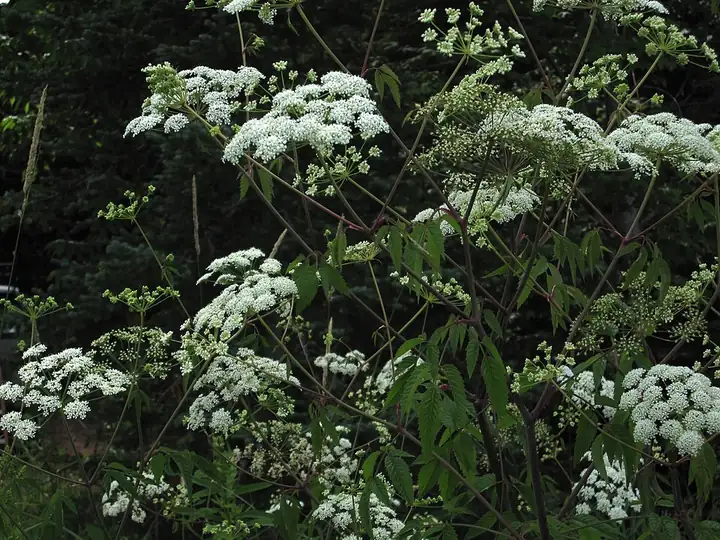
Water hemlock
Cicuta maculata
| Type | Broadleaf |
|---|---|
| Life cycle | Perennial |
| Family | Carrot family (Apiaceae) |
| Origin | Native to the US |
About
A native wetland plant in the carrot family and among the most violently poisonous plants in North America. A piece of root the size of a walnut can kill a cow or horse, and western water hemlock (Cicuta douglasii) is just as dangerous.
Also called spotted water hemlock, cowbane, spotted cowbane, beaver poison, western water hemlock
How to identify it
Look for
Hollow stems, often streaked or mottled purple, grow 2 to 8 feet tall and carry umbrella-shaped clusters of small white flowers. Leaves are divided two or three times into narrow, toothed leaflets, and the side veins run to the notches between the teeth, not to the tips. The thick base of the root is split inside into hollow chambers that ooze a brown or straw-colored poisonous liquid.
Look-alikes
It is easily mistaken for poison hemlock, wild parsnip, wild carrot (Queen Anne's lace) and edible wild herbs. Check for leaf veins that end in the notches and a chambered root base (wild carrot has densely hairy stems), and never eat any wild carrot-family plant.
Where it grows
Wet ground: stream and pond banks, marshes, wet meadows, wet pastures and ditches.
When
One of the first plants up in spring; flowers from late spring through summer, and seed forms later in summer.
How it spreads
Spreads by seed, which can stay alive in the soil for a few years, and regrows each year from its root clusters.
Most common in
| Northeast | Common here |
|---|---|
| Southeast | Common here |
| South Central | Common here |
| Midwest | Common here |
| Great Plains | Common here |
| Mountain West | Common here |
| Southwest | Occasional here |
| Pacific Northwest | Common here |
| California | Common here |
| Alaska | Occasional here |
| Hawaii | Not found here |
What to do, gentlest first
Protect yourself first. Weed killers are a last step; always read and follow the label.
Know it and fence animals out Prevent
Learn to recognize it before working in wet spots. Keep livestock out of wet areas where it grows, especially in spring, and wear gloves when handling it.
Take care not to expose or scatter roots when cleaning ditches or clearing land.
Dig out the whole plant in moist soil By hand
When the soil is moist, pull or dig out the entire plant, including every root, while patches are still small.
Wear rubber gloves and bag everything for the trash. Never burn it. Wash gloves and tools afterward.
Spot-treat young plants with 2,4-D or glyphosate Conventional spray
Treat young plants in late spring or early summer. Repeat in later years, and keep animals away from treated plants for about three weeks.
Read and follow the label. Many lawn and brush herbicides also kill garden plants, so keep spray and drift off anything you want to keep. Within about 50 feet of water, use only products labeled for aquatic use.
Uses, wildlife and pets
For wildlife
Bees, wasps, butterflies and moths visit the flowers, and it is a host plant for black swallowtail caterpillars.
Pets
Toxic to dogs, cats and horses (ASPCA); signs include seizures, tremors, severe belly pain and breathing trouble, and it can kill.
Sources
- plants.ces.ncsu.edu
- ars.usda.gov
- extension.oregonstate.edu
- extension.psu.edu
- plantsservices.sc.egov.usda.gov
- aspca.org
Photo: Photo: Williammehlhorn / Wikimedia Commons, Public domain. Photo resized for the web.

Planting dates and advice are general guidance; check with your local Cooperative Extension office for your area.