
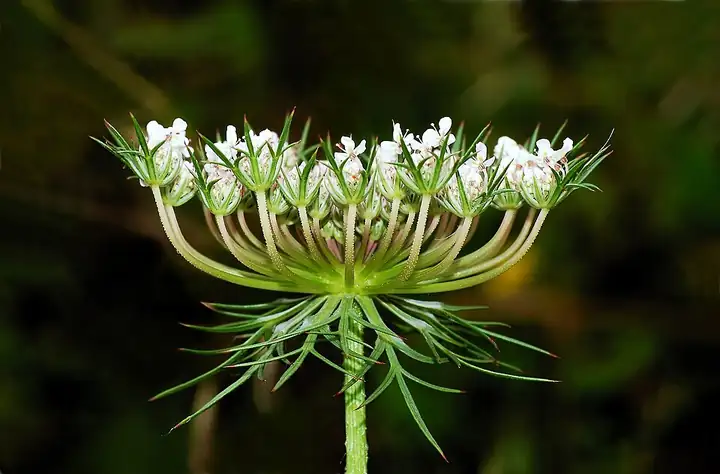
Wild carrot
Daucus carota
| Type | Broadleaf |
|---|---|
| Life cycle | Biennial |
| Family | Carrot family (Apiaceae) |
| Origin | Introduced from elsewhere |
| Most common in | Northeast, Southeast, Midwest, Pacific Northwest |
About
Wild carrot, or Queen Anne's lace, is a wild relative of the garden carrot, with lacy white flower heads on roadsides and in old fields. It spreads readily by seed, its sap can irritate skin, and it closely resembles deadly poison hemlock and water hemlock.
Also called Queen Anne's lace, bird's nest, bee's nest plant, devil's plague
How to identify it
Look for
Stems are hairy (bristly) and usually 1 to 4 feet tall, with finely divided, feathery leaves. Flat white flower clusters 2 to 4 inches wide often have one dark purple or red floret in the center, and they curl up into a 'bird's nest' as seeds ripen. The long taproot smells like carrot.
Look-alikes
Deadly poison hemlock has smooth, hairless stems with purple or red blotches, often grows 3 to 6 feet tall and has a musty smell; water hemlock, found in wet places, has smooth, hollow stems with purple streaks and leaf veins that end in the notches between teeth. If the stem is not hairy all over, do not touch or taste it.
Where it grows
Pastures, old fields, prairies, roadsides, rail lines and other open ground in sun or part shade, especially in well-drained soil.
When
Forms a rosette its first year, then flowers from midsummer to mid-fall in its second year and dies after setting seed.
How it spreads
By seed only: up to 40,000 bristly seeds per plant that stick to fur and clothing, and dried seed heads can tumble in the wind.
Most common in
| Northeast | Very common here |
|---|---|
| Southeast | Very common here |
| South Central | Common here |
| Midwest | Very common here |
| Great Plains | Common here |
| Mountain West | Common here |
| Southwest | Occasional here |
| Pacific Northwest | Very common here |
| California | Common here |
| Alaska | Not found here |
| Hawaii | Not found here |
Where it is regulated
Listed as a restricted noxious weed in Minnesota (sale and propagation prohibited).
What to do, gentlest first
Protect yourself first. Weed killers are a last step; always read and follow the label.
Don't let it seed Prevent
Mow or cut flower heads before seeds ripen to shrink the seed bank; keep repeating until the seed bank runs out.
Mowing alone won't kill the plants.
Dig out the taproot By hand
Dig rosettes and young plants, getting the whole taproot. Bag any plants with seed heads.
Wear gloves and long sleeves; the sap plus sun can burn skin. Be sure it's not hemlock before handling.
Foliar herbicide for large patches Conventional spray
For big infestations, a foliar broadleaf herbicide can be used; ask your county Extension office which product fits your site.
Read and follow the label; many lawn and brush herbicides also kill garden plants.
Uses, wildlife and pets
Edible?
Its root looks like a garden carrot, and NC State notes the young roots, leaves, flowers and seeds are edible, but Minnesota's agriculture department advises against harvesting it because it looks so much like deadly poison hemlock. Only eat it if an expert confirms the ID, and never from sprayed roadsides.
Not 100% sure? Don't eat it. Never pick from ground that may have been sprayed, or along roads and railways.
For wildlife
The flowers draw bees, butterflies and other pollinators.
Pets
Not listed by the ASPCA; mild toxicity to livestock has been reported.
Sources
- mda.state.mn.us
- plants.ces.ncsu.edu
- extension.psu.edu
- plants.ces.ncsu.edu
- poison.org
- poison.org
- mda.state.mn.us
- plantsservices.sc.egov.usda.gov
- aspca.org
- aspca.org
Photo: Photo: Alvesgaspar / Wikimedia Commons, CC BY-SA 3.0 (CC BY-SA 3.0). Photo resized for the web.

Planting dates and advice are general guidance; check with your local Cooperative Extension office for your area.