
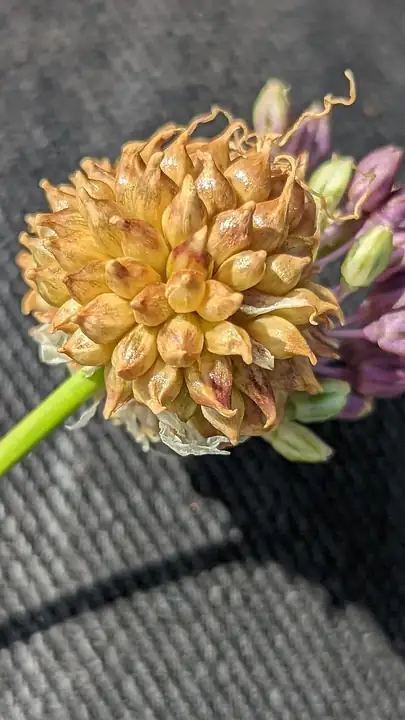
Wild garlic
Allium vineale
| Type | Broadleaf |
|---|---|
| Life cycle | Perennial |
| Family | Lily family (Liliaceae) |
| Origin | Introduced from elsewhere |
| Most common in | Northeast, Southeast |
About
A cool-season perennial from Europe that pops up in lawns in late fall and winter as clumps of waxy, grass-like leaves that smell strongly of garlic. It grows from bulbs that can wait in the soil for years, so it takes several seasons to beat.
Also called field garlic, crow garlic, onion grass, stag's garlic
How to identify it
Look for
Slender, round, hollow leaves like chives, with a strong garlic smell when crushed. Plants grow from small bulbs with offsets, and in late spring the stalks carry a cluster of small aerial bulblets, sometimes mixed with white to purplish flowers.
Look-alikes
Wild onion has flat, solid leaves. Toxic star-of-Bethlehem and death camas look similar but have no onion or garlic smell, so crush a leaf: if it doesn't smell of onion or garlic, don't eat it.
Where it grows
Lawns, especially thin or short-mowed ones, plus fields, roadsides, beds and woodland edges.
When
Comes up from bulbs in late fall, grows through winter and spring, forms aerial bulblets, and dies back in early summer.
How it spreads
Spreads by underground bulbs and offsets, by aerial bulblets and by some seed, and bulbs can stay dormant in soil for several years.
Most common in
| Northeast | Very common here |
|---|---|
| Southeast | Very common here |
| South Central | Common here |
| Midwest | Common here |
| Great Plains | Occasional here |
| Mountain West | Occasional here |
| Southwest | Occasional here |
| Pacific Northwest | Occasional here |
| California | Occasional here |
| Alaska | Occasional here |
| Hawaii | Not found here |
What to do, gentlest first
Start at the top. Weed killers are a last step; always read and follow the label.
Mow regularly and keep the lawn thick Prevent
Mowing won't kill it but weakens plants and stops aerial bulblets from forming. Mow at the right height and fertilize so turf stays dense.
Dig out clumps with the bulbs By hand
Dig clumps with a thin trowel when soil is moist, lifting out the bulbs. Pulling usually snaps off the leaves and leaves bulbs behind.
Bulbs can stay dormant for years, so expect to repeat for several seasons.
Spray in late fall and again in early spring Conventional spray
No pre-emergents work. Spray a lawn broadleaf mix of 2,4-D, MCPP and dicamba, or metsulfuron, in late fall after shoots appear and again in February or March; in bermuda, zoysia and centipede lawns, imazaquin also works. Mowing just before spraying helps the waxy leaves take it up, then don't mow for 2 weeks.
Read and follow the label. Many lawn herbicides kill garden plants, so keep spray and drift off beds and vegetables. Don't spray dicamba over tree and shrub roots, and avoid spraying warm-season lawns as they green up.
Uses, wildlife and pets
Edible?
Leaves, flowers and bulbs are edible and can be used like chives or garlic, though they are tougher. Only eat plants that clearly smell of garlic, from ground that hasn't been sprayed, and note that large amounts can upset the stomach.
Not 100% sure? Don't eat it. Never pick from ground that may have been sprayed, or along roads and railways.
Pets
The ASPCA lists garlic and onion (Allium) as toxic to dogs, cats and horses; they can damage red blood cells. Wild garlic is in the same group, so keep pets from eating it.
Sources
- extension.psu.edu
- hgic.clemson.edu
- extension.umd.edu
- content.ces.ncsu.edu
- plants.ces.ncsu.edu
- extension.usu.edu
- extension.oregonstate.edu
- plantsservices.sc.egov.usda.gov
- aspca.org
- aspca.org
Photo: Photo: Michel Langeveld / Wikimedia Commons, CC BY-SA 4.0 (CC BY-SA 4.0). Photo resized for the web.

Planting dates and advice are general guidance; check with your local Cooperative Extension office for your area.