
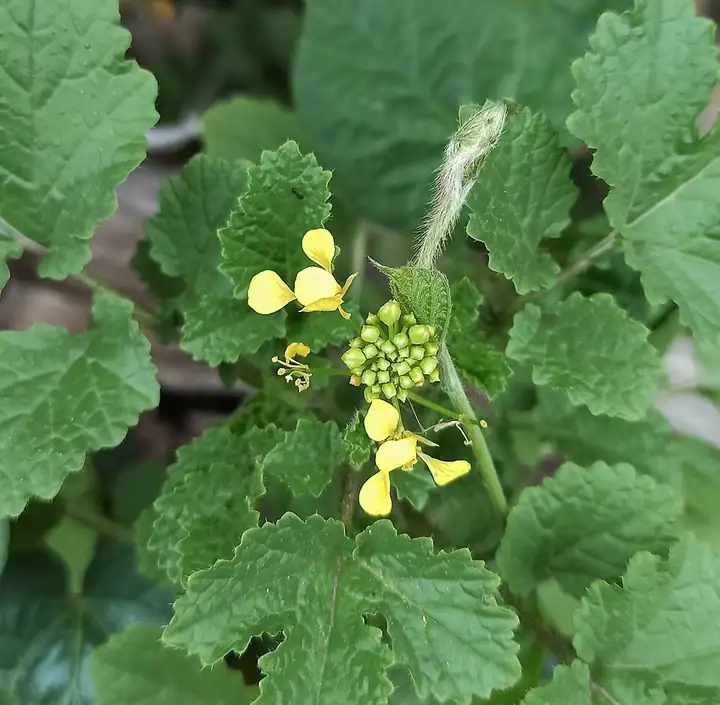
Wild mustard
Sinapis arvensis
| Type | Broadleaf |
|---|---|
| Life cycle | Annual |
| Family | Mustard family (Brassicaceae) |
| Origin | Introduced from elsewhere |
| Most common in | Northeast, Midwest, Great Plains |
About
A fast, branching mustard from Europe and Asia with bright yellow four-petal flowers, common in spring gardens, grain fields and vacant lots. It competes hard for nitrogen, and a few of its seeds can stay alive in the soil for decades.
Also called charlock, charlock mustard, field mustard, field kale, wild kale
How to identify it
Look for
Seedlings have kidney- to heart-shaped seed leaves. Plants grow about 1-3 feet tall with bristly stems (hairs often point downward, with reddish patches at the joints); lower leaves are lobed and coarsely toothed, and upper leaves are smaller and often stalkless. Yellow flowers are followed by slim, smooth pods.
Look-alikes
Wild radish has rougher, hairier leaves, flowers with dark veins, and beaded pods that snap into pieces. White mustard has stalked upper leaves and hairy pods.
Where it grows
Grain and vegetable fields, gardens, vacant lots, rail lines and other disturbed ground; it grows best on clay soils rich in nitrogen.
When
Sprouts mainly in spring once the soil passes about 40°F, with scattered flushes all season and a second peak in fall; it blooms 3-6 weeks after sprouting and ripens seed about 5-6 weeks later.
How it spreads
By seed only; plants in crop fields make about 200-3,500 seeds, and a few buried seeds can live up to 60 years.
Most common in
| Northeast | Very common here |
|---|---|
| Southeast | Common here |
| South Central | Common here |
| Midwest | Very common here |
| Great Plains | Very common here |
| Mountain West | Common here |
| Southwest | Occasional here |
| Pacific Northwest | Common here |
| California | Common here |
| Alaska | Occasional here |
| Hawaii | Occasional here |
Where it is regulated
It is a noxious weed seed under state seed laws in states including Arizona (prohibited) and Colorado and Kansas (restricted).
What to do, gentlest first
Start at the top. Weed killers are a last step; always read and follow the label.
Go easy on nitrogen Prevent
Wild mustard grows much bigger with extra nitrogen. Feed your crops close to the row after they are up and growing, rather than spreading fertilizer across the whole bed early.
Hoe or pull while small By hand
Small plants are easy to hoe or pull, and frequent early weeding pays off. Remove them before flowers open.
Plants close to blooming can re-root if left lying on moist soil, so carry them off.
Crowd it with a dense grain cover crop Natural enemies
Thick plantings of cereal grains, such as barley, suppress wild mustard well, even in rich soil.
Uses, wildlife and pets
Edible?
NC State Extension notes the young leaves (spicy), flowers and seeds are edible raw or cooked. Be completely sure of your ID, and never eat plants from roadsides or anywhere that may have been sprayed.
Not 100% sure? Don't eat it. Never pick from ground that may have been sprayed, or along roads and railways.
For wildlife
Bees and flies visit the flowers for nectar, and cabbage white and checkered white butterfly caterpillars feed on the leaves.
Pets
Listed by the ASPCA (as charlock, Brassica kaber) as toxic to horses, causing stomach irritation and colic; not listed as toxic to dogs or cats. The seeds are the riskiest part for livestock.
Sources
Photo: Photo: Juan Carlos Fonseca Mata / Wikimedia Commons, CC BY-SA 4.0 (CC BY-SA 4.0). Photo resized for the web.

Planting dates and advice are general guidance; check with your local Cooperative Extension office for your area.