
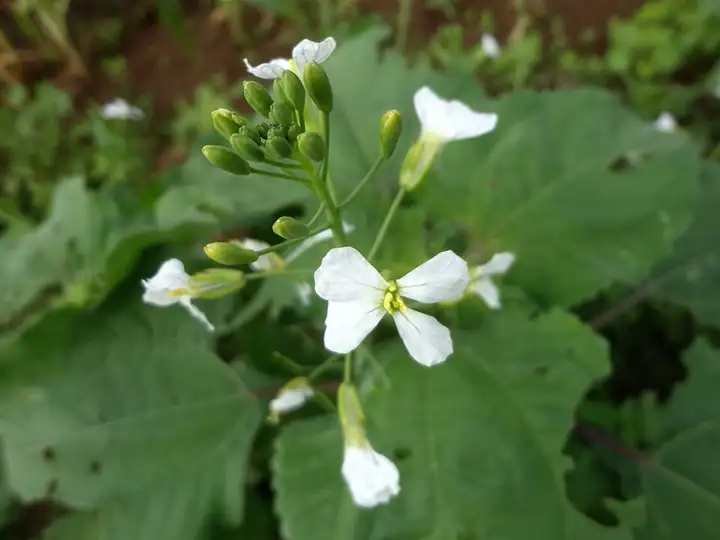
Wild radish
Raphanus raphanistrum
| Type | Broadleaf |
|---|---|
| Life cycle | Annual |
| Family | Mustard family (Brassicaceae) |
| Origin | Introduced from elsewhere |
| Most common in | Northeast, Southeast, Pacific Northwest, California |
About
A tall, bristly Mediterranean relative of garden radish with pale yellow, white or pinkish flowers marked with dark veins. It crowds out cool-season crops, hosts cabbage-family pests and diseases, and its seeds can last 15-20 years in the soil.
How to identify it
Look for
Seedlings have kidney- to heart-shaped seed leaves with a deep notch at the tip, and young stems are often purple with stiff hairs. Plants bolt from a rough rosette of lobed leaves to 1-4 feet. The four-petal flowers usually show purple or dark veins, and the pods pinch in between seeds like a string of beads and snap apart into segments.
Look-alikes
Wild mustard has smooth pods that split open and flowers without dark veins. Garden radish has pink to purple flowers and short pods with only 2-3 seeds, and yellow rocket has glossy, hairless leaves.
Where it grows
Crop fields, orchards, vineyards, neglected gardens, parks and roadsides; it favors acidic sandy soils and full sun.
When
In northern areas it sprouts mainly in spring and blooms 3-6 weeks later; in the South most seedlings come up in fall and winter. In California it flowers from about April through July.
How it spreads
By seed only, from a handful to about 10,000 per plant; some seeds stay alive in the soil for 15-20 years.
Most common in
| Northeast | Very common here |
|---|---|
| Southeast | Very common here |
| South Central | Common here |
| Midwest | Occasional here |
| Great Plains | Occasional here |
| Mountain West | Occasional here |
| Southwest | Occasional here |
| Pacific Northwest | Very common here |
| California | Very common here |
| Alaska | Not found here |
| Hawaii | Occasional here |
Where it is regulated
It is a restricted noxious weed seed under state seed laws in states including Alaska, Connecticut, Florida and Georgia.
What to do, gentlest first
Start at the top. Weed killers are a last step; always read and follow the label.
Lime acid soil and skip extra nitrogen Prevent
In a long-term study, raising soil pH from 6.0 to 6.8 with lime was a big reason wild radish declined. Avoid heavy nitrogen, which feeds it.
Rake out seedlings, pull before pods form By hand
Hoe or rake out seedlings while they are tiny. Pull bigger plants out by the root before pods form; cutting or mowing does little because the stems regrow quickly.
Don't compost plants with pods.
Uses, wildlife and pets
Edible?
NC State Extension notes the young leaves and seeds can be used in salads. Be completely sure of your ID, and never eat plants from roadsides or anywhere that may have been sprayed.
Not 100% sure? Don't eat it. Never pick from ground that may have been sprayed, or along roads and railways.
For wildlife
The flowers attract bees and other pollinators.
Pets
Listed by the ASPCA as toxic to horses (stomach irritation, colic) and non-toxic to dogs and cats. Livestock that eat large amounts, especially the seeds, can get sick.
Sources
- ipm.ucanr.edu
- cals.cornell.edu
- plants.ces.ncsu.edu
- plantsservices.sc.egov.usda.gov
- aspca.org
- ams.usda.gov
Photo: Photo: Juan Carlos Fonseca Mata / Wikimedia Commons, CC BY-SA 4.0 (CC BY-SA 4.0). Photo resized for the web.

Planting dates and advice are general guidance; check with your local Cooperative Extension office for your area.