
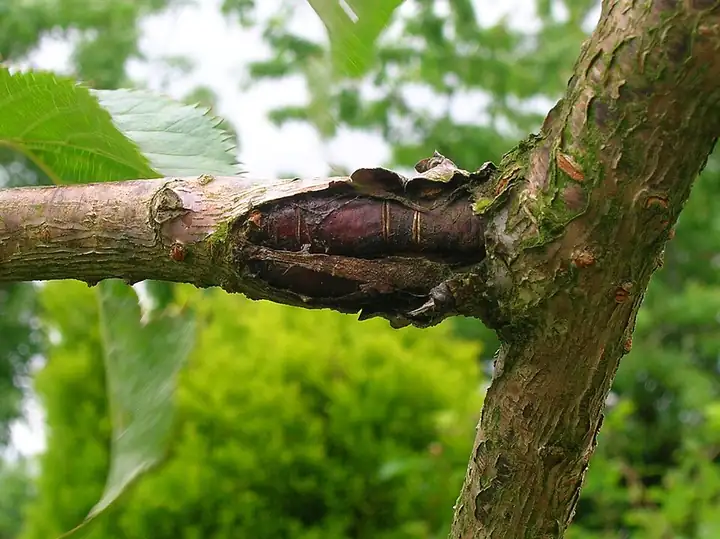
Bacterial canker
Bacterium (Pseudomonas syringae pv. syringae, and P. amygdali pv. morsprunorum on cherry)
| Type | Bacteria |
|---|---|
| Cause | Bacterium (Pseudomonas syringae pv. syringae, and P. amygdali pv. morsprunorum on cherry) |
About
A bacterial disease of stone fruits that kills buds and blossoms and makes gummy cankers on branches and trunks. It is most serious on sweet cherries, especially after frost or winter injury.
Also called bacterial canker, blossom blast
How to recognize it
Symptoms
Dark, sunken cankers appear on trunks and branches in early spring and often ooze amber gum; branches above a girdling canker die back. Buds may fail to open, and blossoms turn brown, shrivel and hang on (blossom blast). Leaves can get small brown spots that fall out, leaving holes.
Worse when
Cool, wet springs and frost or winter injury; the bacteria help ice form, which makes frost wounds worse.
How it spreads
The bacteria live on the surface of buds and leaves and in old cankers, and spread by splashing rain, wind, insects, infected budwood and nursery stock.
When
Late fall through spring, with cankers and blossom blast most visible in early spring.
Where
Especially important in the Pacific Northwest's wet springs.
What to do, gentlest first
Prevention works best; most sprays only protect healthy leaves and can't cure infected ones. Always read and follow the product label.
Choose tolerant cherries and rootstock Prevent
Corum, Regina, Rainier, Sam and Sue cherries are tolerant enough to grow commercially, and Mazzard F12-1 is a resistant rootstock. Bing, Lambert, Van and Royal Ann are quite susceptible.
Prune in dry weather Prevent
Prune in summer after harvest, or at least when no rain is expected for a week; avoid early dormant-season pruning.
Reduce stress and winter injury Prevent
Keep soil pH around 6.0 to 7.0, test for ring nematodes before planting, and paint young trunks with white latex paint or use trunk guards against winter sunscald.
Copper in fall and late winter Organic spray
Oregon State suggests copper during leaf fall before fall rains and again in early January before buds open.
Copper-resistant strains of the bacteria are common in the Pacific Northwest, so copper may not work well. Copper can build up in soil. Follow the label.
Plants it affects
Sources
Photo: Photo: Rosser1954, CC BY-SA 3.0, via Wikimedia Commons (CC BY-SA 3.0). Photo resized for the web.

Planting dates and advice are general guidance; check with your local Cooperative Extension office for your area.