
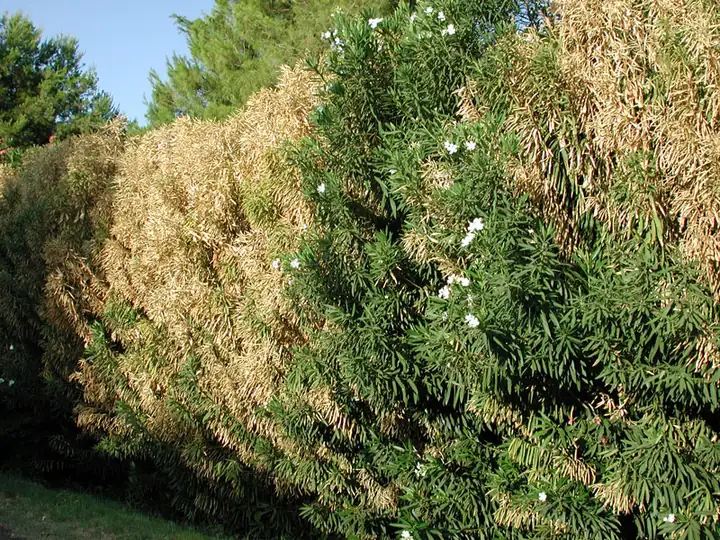
Bacterial leaf scorch
Bacterium (Xylella fastidiosa) carried by leafhoppers and spittlebugs
| Type | Bacteria |
|---|---|
| Cause | Bacterium (Xylella fastidiosa) carried by leafhoppers and spittlebugs |
About
Bacterial leaf scorch is a slow, incurable disease that clogs the water-carrying wood of shade trees such as pin and red oaks, elms, red maple, sycamore and mulberry. Trees scorch a little more each year and decline over several years.
Also called bacterial leaf scorch, Bacterial leaf scorch, BLS, Xylella leaf scorch, oak leaf scorch, elm leaf scorch
How to recognize it
Symptoms
In mid to late summer, leaf edges turn brown, often with a yellow or reddish band between the dead edge and the green center. It starts on one or a few branches and spreads to more of the tree each year, with early leaf drop, dieback and eventually death. On elm and mulberry it starts low and moves up the tree.
Often confused with
Leaf scorch from drought, heat, salt or root damage browns leaf edges evenly across much of the tree soon after the stress, on old and new leaves alike. Bacterial scorch shows up in late summer, branch by branch, often with a yellow band, and comes back worse each year. A lab test confirms it.
Worse when
Drought and other stress on the tree make it worse.
How it spreads
Sap-feeding leafhoppers, sharpshooters and spittlebugs carry the bacteria from plant to plant; the bacteria are common in wild plants, so removing one tree may not stop it.
When
Symptoms show from midsummer (late June on sycamore, mid-July on red maple) into fall and return every year.
Where
Throughout the eastern U.S. west to Texas, and especially bad on pin and red oaks in the Mid-Atlantic.
What to do, gentlest first
Prevention works best; most sprays only protect healthy leaves and can't cure infected ones. Always read and follow the product label.
Plant a mix of trees Prevent
Avoid planting more of the most affected trees, such as pin and red oak, where scorch is common, and plant a variety of species.
Keep trees vigorous Prevent
Keeping stress low is the best tool: water in droughts and avoid root damage and soil compaction.
Prune dead branches and remove failing trees By hand
Remove branches killed by scorch, and take down trees in severe decline before dead limbs become a hazard.
There is no cure. Pruning does not stop the disease.
Antibiotic trunk injection (arborist only) Conventional spray
Oxytetracycline injected by an arborist can ease symptoms for the year it is applied.
It must be repeated every year, does not cure the tree, and works poorly on trees already in advanced decline. Follow the label.
Plants it affects
Flowering dogwood, Mulberry (red and black), Oaks (white, red and pin oak), Red maple, Sugar maple
Sources
Photo: Photo: Pompilid / Wikimedia Commons, CC BY-SA 3.0 (CC BY-SA 3.0). Photo resized for the web.

Planting dates and advice are general guidance; check with your local Cooperative Extension office for your area.