
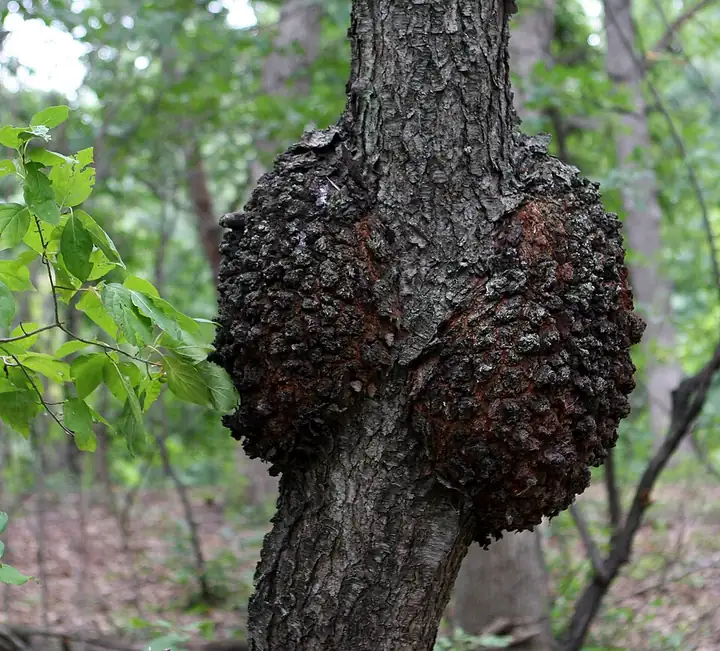
Black knot
Fungus (Apiosporina morbosa)
| Type | Fungus |
|---|---|
| Cause | Fungus (Apiosporina morbosa) |
About
A slow fungal disease of plums and cherries that makes hard, black, knobby swellings on branches. The knots keep growing year after year, and on susceptible trees the leaves on knotted branches die.
How to recognize it
Symptoms
Nothing shows for months after infection; then a branch swells with a velvety olive-green gall. By the second year the gall is hard, black and knobby, and it keeps growing along the stem. On susceptible trees, leaves on knotted branches wilt and die.
Worse when
Wet spring weather, especially rain with temperatures above about 60°F.
How it spreads
The fungus spends the winter in the knots and releases spores in wet spring weather that blow to new shoots; wild plums and chokecherries are a common source.
When
Infection in spring; knots are easiest to see and prune in late winter when branches are bare.
What to do, gentlest first
Prevention works best; most sprays only protect healthy leaves and can't cure infected ones. Always read and follow the product label.
Mind the neighbors and the variety Prevent
Where many wild plums or chokecherries nearby are covered with knots, avoid planting plums and cherries, or remove the infected wild trees if you can. American, Canadian, European (including Stanley) and Japanese plums are very susceptible; sour cherries are more tolerant, and apricots are rarely hit.
Prune out every knot in late winter By hand
In February or March, while it is below freezing, cut at least 4 inches below each knot and take the branches away to burn, bury or throw out.
Lime sulfur Organic spray
Lime sulfur is one listed protectant, starting when flower buds just begin to open and repeating per the label until shoots stop growing or weather turns dry.
Sprays protect new growth but do not remove existing knots; pruning is the main control. Follow the label.
Captan, chlorothalonil or thiophanate-methyl Conventional spray
Use on the same schedule, ideally just before a rain when temperatures are above 60°F.
These protect new growth; they do not cure existing knots. UC IPM rates chlorothalonil highly hazardous to fish and other aquatic life and its acute toxicity as high (DANGER signal word), so keep it out of water and wear gloves and eye protection. Follow the label and pre-harvest interval.
Plants it affects
American plum (wild plum), Beach plum, Cherry (sweet and tart), Chokecherry, Flowering cherry, Plum
Sources
Photo: Photo: Hardyplants, Public domain, via Wikimedia Commons. Photo resized for the web.

Planting dates and advice are general guidance; check with your local Cooperative Extension office for your area.