
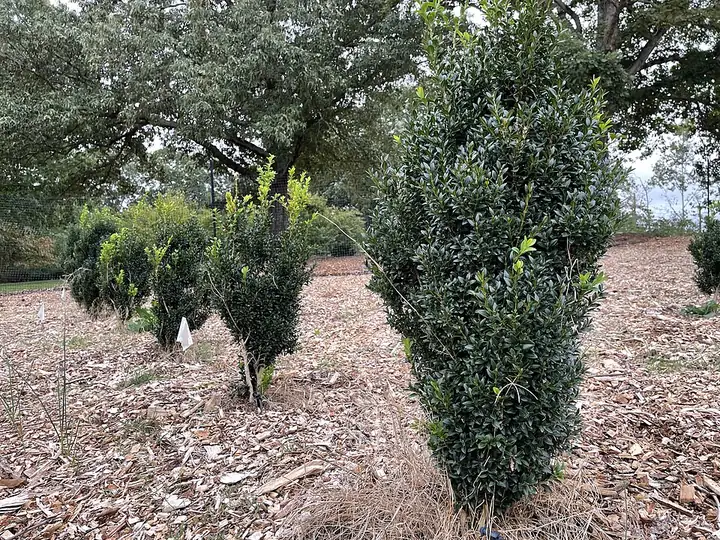
Boxwood blight
Fungus (Calonectria pseudonaviculata, formerly Cylindrocladium buxicola)
| Type | Fungus |
|---|---|
| Cause | Fungus (Calonectria pseudonaviculata, formerly Cylindrocladium buxicola) |
About
Boxwood blight is a fast-moving fungal disease that strips boxwoods of their leaves and can kill young plants. It also infects pachysandra and sweetbox, and it usually arrives on new plants, greenery or tools.
Also called boxwood blight, Boxwood blight, box blight, Calonectria blight, Cylindrocladium blight, boxwood leaf drop
How to recognize it
Symptoms
Tan to brown leaf spots with darker edges appear and quickly merge until whole leaves brown and fall, starting at the bottom of the plant and moving up. Narrow black streaks form on green stems, and in humid weather fuzzy white spore masses show on leaf undersides. Bare lower branches are often the first thing people notice.
Often confused with
Volutella blight turns leaves light green to tan that curl and hug the stem, with pink-orange waxy spore bumps and loose bark at branch bases, and often follows winter injury; boxwood blight has black stem streaks and fast leaf drop from the bottom up. A lab test is the sure way to tell.
Worse when
Wet leaves and high humidity when it is warmer than about 60°F, especially during long rainy spells.
How it spreads
Sticky spores splash in rain and irrigation and travel on infected nursery plants, holiday greenery, tools, clothes, shoes, animals and blown leaves; long-lived resting structures survive in soil and leaf debris for five years or more.
When
Spring through fall whenever it is mild and wet; symptoms are often most noticeable in late summer and fall.
Where
First confirmed in North America in 2011 (North Carolina and Connecticut) and now reported in more than 20 states, mostly in the East and Midwest.
What to do, gentlest first
Prevention works best; most sprays only protect healthy leaves and can't cure infected ones. Always read and follow the product label.
Buy clean plants and quarantine them Prevent
Buy from nurseries in a boxwood blight cleanliness or compliance program. Look inside the canopy for leaf spots and black streaks, and keep new boxwoods apart from your others for at least a month. Keep boxwood holiday greenery away from garden boxwood.
Nursery fungicides can hide symptoms, and tolerant cultivars can carry the fungus without showing it.
Choose tolerant boxwoods or a substitute Prevent
No boxwood is immune. Lower-risk choices include Buxus sinica var. insularis 'Nana', B. microphylla var. japonica 'Green Beauty', 'Wedding Ring' and 'Golden Dream'. English boxwood is extremely susceptible. Clemson suggests dwarf yaupon or Japanese holly as non-host replacements.
Keep leaves dry and tools clean Prevent
Avoid overhead watering, space plants for airflow, and do not prune or work in boxwood when it is wet. Disinfect tools, shoes and tarps with 1 part bleach to 9 parts water or a Lysol concentrate, giving tools at least 5 minutes of contact.
Bleach corrodes metal, so rinse and oil tools afterward.
Remove infected plants and all leaf litter By hand
Pull out infected plants and rake, sweep or vacuum up the fallen leaves. Double-bag everything for the landfill or bury it 2 feet deep. Do not compost it or put it out for brush pickup, and do not replant susceptible boxwood in that spot.
Removing debris lowers the risk but does not clear the fungus from the soil.
Preventive chlorothalonil (or fludioxonil) Conventional spray
Fungicides only protect healthy leaves. Spray every 7 to 14 days when it is above 60°F and rain is coming, pausing in steady summer heat above 80°F. Spraying plants that already have blight does not save susceptible boxwood.
Thorough coverage inside a dense shrub is hard. UC IPM rates chlorothalonil high in hazard to people and to fish and other water life: keep it out of water, wear gloves, long sleeves and goggles, and follow the label.
Plants it affects
Sources
Photo: Photo: m.borden / Wikimedia Commons, CC BY-SA 2.0 (CC BY-SA 2.0). Photo resized for the web.

Planting dates and advice are general guidance; check with your local Cooperative Extension office for your area.