
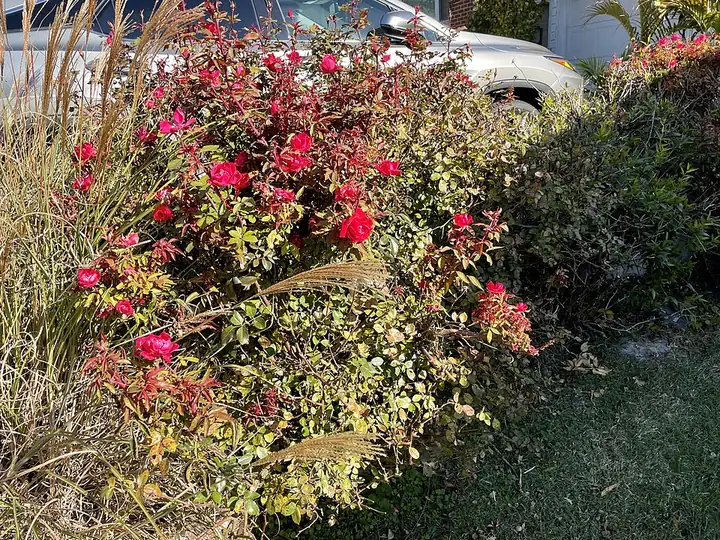
Rose rosette
Virus (rose rosette virus, an Emaravirus) spread by the tiny eriophyid mite Phyllocoptes fructiphilus
| Type | Virus |
|---|---|
| Cause | Virus (rose rosette virus, an Emaravirus) spread by the tiny eriophyid mite Phyllocoptes fructiphilus |
About
Rose rosette is an incurable virus disease of roses spread by microscopic mites that ride the wind. Infected roses usually die within a few years, so the infected plant must come out, roots and all.
Also called rose rosette, Rose rosette, rose rosette disease, rose rosette virus, RRD, RRV, witches' broom of rose
How to recognize it
Symptoms
New shoots grow fast and come out red, thick and fleshy, covered in far too many soft thorns. Shoots bunch into witches'-brooms, leaves are small, crinkled or mottled yellow, and flowers are deformed or few. Small plants often die in about two years; big ones can hang on for up to five.
Often confused with
Herbicide drift can look very similar: glyphosate can cause witches'-broom growth and 2,4-D can twist and shrink leaves. Rose rosette adds red, thick, extra-thorny shoots and keeps getting worse.
Worse when
Wild multiflora rose nearby, and roses planted close together so mites can crawl from bush to bush.
How it spreads
Mites carry the virus on the wind and on clothes, tools and leaf blowers, mostly from May through mid-July; they spend the winter on canes and in bud scales, and the virus also spreads by grafting.
When
Symptoms usually show from midsummer on, often July and August; spread happens mostly in late spring and early summer.
Where
Very destructive east of the Rocky Mountains and common across the Midwest and the Carolinas; it was confirmed in two places in Kern County, California, in 2018 (UC IPM).
What to do, gentlest first
Prevention works best; most sprays only protect healthy leaves and can't cure infected ones. Always read and follow the product label.
Start clean and remove wild multiflora rose Prevent
Buy only roses with no odd red, thorny growth. Remove wild multiflora rose (an invasive shrub) near your garden; Clemson suggests within about 100 yards, and Missouri Botanical Garden suggests keeping roses 300 feet or more from stands.
Space roses apart Prevent
Give roses room so mature canes and leaves do not touch, and mix other plants between them so mites cannot walk from rose to rose. Some roses have held up better in trials, such as the shrub rose 'Top Gun' and native Rosa setigera, R. carolina and R. virginiana.
Mass plantings of a single rose, such as Knock Out hedges, let the disease spread quickly.
Remove infected roses completely By hand
There is no cure and pruning out shoots does not work. Bag the plant, cut it at the base, dig out all the roots, and throw it out or burn it where allowed. Cut off any shoots that come back from left-behind roots. You can plant something that is not a rose there right away.
Clean pruners with rubbing alcohol or dilute bleach and change clothes before touching healthy roses. Do not replant roses there until every old root is gone.
Plants it affects
Sources
Photo: Photo: m.borden / Wikimedia Commons, CC BY-SA 2.0 (CC BY-SA 2.0). Photo resized for the web.

Planting dates and advice are general guidance; check with your local Cooperative Extension office for your area.