
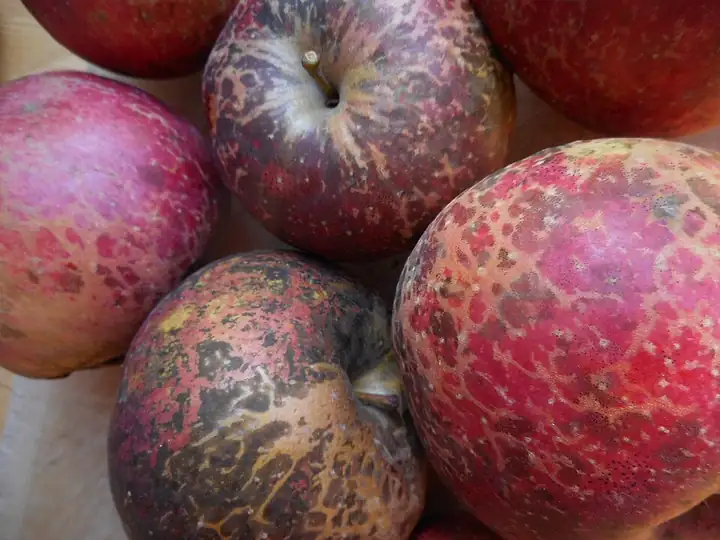
Sooty blotch and flyspeck
A group of fungi that grow only on the fruit's waxy skin
| Type | Fungus |
|---|---|
| Cause | A group of fungi that grow only on the fruit's waxy skin |
| When | Infection starts soon after fruit set; marks show in late summer to fall. |
About
Two harmless blemishes that often show up together on apples and pears in humid summers. The fruit is still good to eat; the marks are only skin deep.
Also called sooty blotch, flyspeck, sooty blotch and flyspeck, SBFS
How to recognize it
Symptoms
Sooty blotch makes dull gray, green, brown or black smudges on the skin, like charcoal. Flyspeck makes clusters of tiny, shiny black dots, often 10 to 50 together. Neither one rots the fruit.
Worse when
Warm, humid weather and long wet spells, crowded trees that dry slowly, and nearby woods or wild blackberries.
How it spreads
Spores blow and splash onto fruit from wild trees and brambles near the orchard, where the fungi live over winter.
When
Infection starts soon after fruit set; marks show in late summer to fall.
What to do, gentlest first
Prevention works best; most sprays only protect healthy leaves and can't cure infected ones. Always read and follow the product label.
Prune and thin Prevent
Prune to open the tree so fruit dries fast after rain, and thin to one fruit per cluster.
Cut back nearby brambles Prevent
Clear wild blackberries and brush near the trees and keep grass under them mowed.
Wipe and eat By hand
Sooty blotch rubs or washes off fairly easily; flyspeck doesn't, but the fruit is safe to eat. UMN says home gardens need no control.
Sulfur or lime sulfur Organic spray
Orchards that want spotless fruit find sulfur and liquid lime sulfur give some suppression in summer cover sprays.
Lime sulfur can russet fruit and stress leaves. Follow the label.
Captan, thiophanate-methyl or strobilurins Conventional spray
Orchards spray about every 2 to 3 weeks from early summer, renewing after heavy rain.
Rarely worth it for home trees, since the damage is cosmetic. Follow the label, including days to harvest.
Plants it affects
Sources
Photo: Photo: Wuerzele / Wikimedia Commons, CC BY-SA 4.0 (CC BY-SA 4.0). Photo resized for the web.

Planting dates and advice are general guidance; check with your local Cooperative Extension office for your area.