
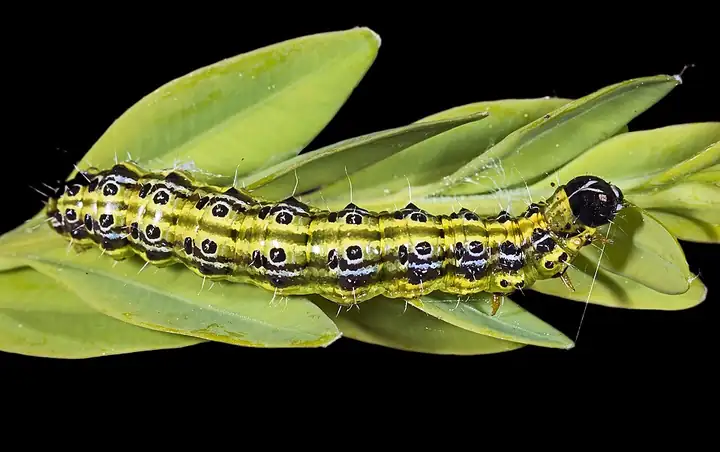
Box tree moth
Cydalima perspectalis
| Type | Insect |
|---|---|
| When | Caterpillars feed from spring through fall. |
| Pressure by region | Moderate: Northeast, Midwest |
About
An invasive moth from East Asia whose caterpillars can strip boxwoods bare and then chew the bark until the plant dies (USDA APHIS). It was first detected in the US in New York in 2021 and has since been confirmed in Delaware, Kentucky, Maryland, Massachusetts, Michigan, New York, Ohio, Pennsylvania, Virginia and West Virginia (USDA APHIS).
Spotting it
Damage
Caterpillars eat leaves down to the midrib and tie leaves together with webbing, leaving frass behind. Badly hit shrubs look brown, see-through or scorched; once the leaves are gone they eat twig bark, which can kill the plant (USDA APHIS, University of Delaware). After boxwoods are stripped they may move on to burning bush, Japanese euonymus and Ilex chinensis holly (University of Delaware).
How to find it early
Look inside the shrub for webbing, frass and chewed or skeletonized leaves. Young caterpillars are greenish-yellow with black heads; older ones are green with thick black stripes, thin white stripes and black dots. Adults have white wings with a wide brown border and fly at night (USDA APHIS, Morton Arboretum).
When
Caterpillars feed from spring through fall.
Life cycle
There are two to five overlapping generations a year, depending on climate; Delaware may see two or three (Morton Arboretum, University of Delaware). Partly grown caterpillars spend winter in webbed shelters among the leaves, start feeding again in spring, and the white adults live about two weeks and lay flat egg clusters on the leaves (Morton Arboretum).
What to do, gentlest first
Start at the top. Sprays are a last step; always read and follow the product label.
Inspect boxwoods and report Prevent
Check boxwoods often, especially new ones, and report suspected damage to your state's plant regulatory officials; let them inspect and set traps if asked (USDA APHIS).
Hand-pick, prune and bag By hand
Pick off caterpillars when there are only a few (Morton Arboretum). Cut out infested branches; for a heavy infestation, cut the plant to the ground, since it should regrow from the roots. Double-bag all boxwood debris in plastic and put it in the trash (USDA APHIS).
Bt for small caterpillars Organic spray
Bacillus thuringiensis (Bt) works well on small caterpillars (University of Delaware).
Bt carries no bee warning (PNW 591). Follow the label.
Spinosad for larger caterpillars Organic spray
For bigger caterpillars, the University of Delaware recommends spinosad.
Spinosad is toxic to bees (PNW 591); spray when boxwood is not in bloom and bees are not flying. Follow the label.
Pyrethroid as a last resort Conventional spray
The University of Delaware also lists pyrethroids such as bifenthrin for larger caterpillars.
Bifenthrin is highly toxic to bees (PNW 591) and kills natural enemies. Follow the label.
Plants it goes after
Pressure by region
A regulated pest: USDA APHIS lists confirmed states (see overview) and has quarantines in parts of its range, including Maryland and Pennsylvania (2026). If you suspect it anywhere, especially outside those states, report it to your state plant regulatory official or extension office (USDA APHIS).
| Northeast | Moderate |
|---|---|
| Southeast | Low |
| South Central | Not found here |
| Midwest | Moderate |
| Great Plains | Not found here |
| Mountain West | Not found here |
| Southwest | Not found here |
| Pacific Northwest | Not found here |
| California | Not found here |
| Alaska | Not found here |
| Hawaii | Not found here |
Ratings come from extension sources where available; some are estimates, as noted above.
Sources
Photo: Photo: Didier Descouens / Wikimedia Commons, CC BY-SA 4.0 (CC BY-SA 4.0). Photo resized for the web.

Planting dates and advice are general guidance; check with your local Cooperative Extension office for your area.