
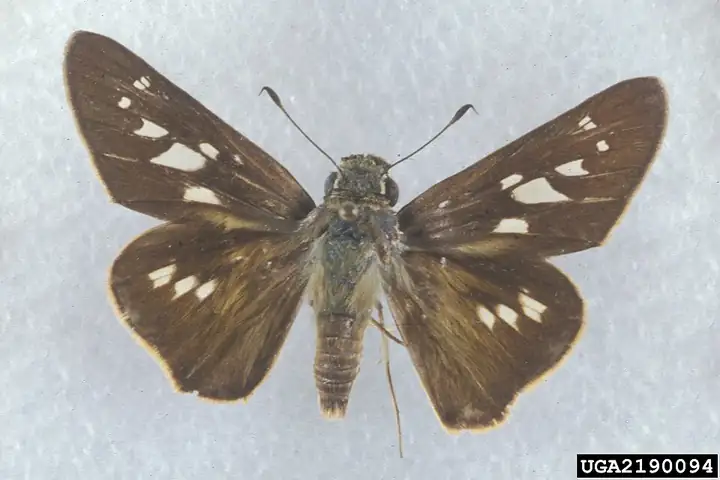
Larger canna leafroller (Brazilian skipper)
Calpodes ethlius
| Type | Insect |
|---|---|
| When | Late spring through fall. |
| Pressure by region | High pressure: Southeast |
About
The caterpillar of the Brazilian skipper, a brownish butterfly. The caterpillar is pale, see-through green with a dark orange head and a narrow neck, grows up to 2 inches long, and feeds on cannas and a few close relatives (NC State).
Spotting it
Damage
Caterpillars fold or roll leaves into shelters and chew large, ragged pieces out of them. When most leaves are hit, plants look tattered and bloom less, and new shoots are attacked quickly (NC State, UGA).
How to find it early
From May on, check cannas twice a week for folded or rolled leaves and unroll them to find caterpillars (UGA). Red-leaved cannas and those with red or orange flowers are favored (NC State).
When
Late spring through fall.
Life cycle
There are several generations a year: at least two in North Carolina, with egg laying starting in mid-May in Georgia (NC State, UGA). NC State says it cannot survive winters north of southern Florida, and farther north it shows up only as a stray (Connecticut Agricultural Experiment Station).
What to do, gentlest first
Start at the top. Sprays are a last step; always read and follow the product label.
Favor cannas without red leaves Prevent
Females lay more eggs on red-leaved cannas and on those with red or orange flowers, so other types may suffer less (NC State, UGA, Connecticut).
Remove rolled leaves By hand
Unroll leaves and squash the caterpillars, or cut off rolled leaf sections (NC State, UGA, Connecticut).
Bt for young caterpillars Natural enemies
Bt (Bacillus thuringiensis) works on smaller caterpillars; spray it onto the rolled parts of leaves (UGA, NC State).
Bt needs no bee precaution (PNW 591). Read and follow the label.
Spinosad Organic spray
Connecticut suggests spinosad for caterpillars about an inch long.
Spinosad is toxic to bees for 3 hours to a day after spraying (PNW 591), so never spray open flowers or plants where bees are working. Read and follow the label.
Pyrethroid spray Conventional spray
UGA lists bifenthrin, applied with plenty of water so it soaks into the rolled leaves.
Bifenthrin is highly toxic to bees for more than a day (PNW 591), so keep it off open flowers. UGA also mentions systemic insecticides; neonicotinoids harm pollinators, so skip them. Read and follow the label.
Plants it goes after
Pressure by region
UGA says it is well established in the southern US, including Georgia, and the Connecticut Agricultural Experiment Station reports it only as a stray in the Northeast. Ratings outside the Southeast are estimates.
| Northeast | Low |
|---|---|
| Southeast | High pressure |
| South Central | Moderate |
| Midwest | Low |
| Great Plains | Low |
| Mountain West | Low |
| Southwest | Low |
| Pacific Northwest | Low |
| California | Low |
| Alaska | Low |
| Hawaii | Low |
Ratings come from extension sources where available; some are estimates, as noted above.
Sources
Photo: Photo: Charles T. and John R. Bryson, Bugwood.org, CC BY 3.0 US, via Wikimedia Commons (CC BY 3.0 US). Photo resized for the web.

Planting dates and advice are general guidance; check with your local Cooperative Extension office for your area.