
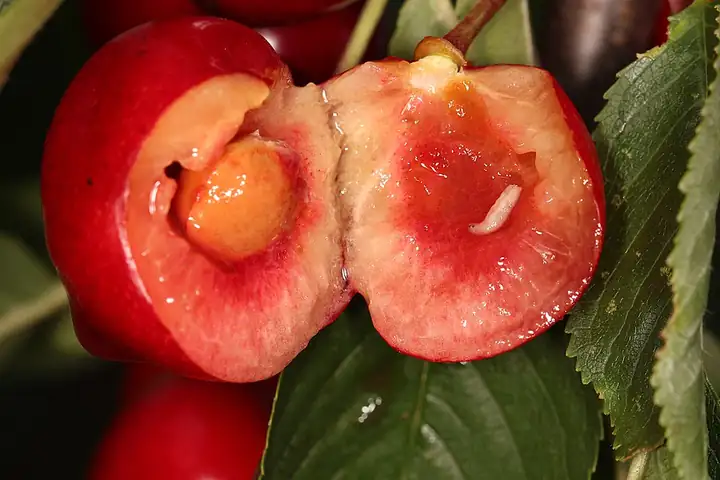
Cherry fruit fly
Rhagoletis cingulata (eastern cherry fruit fly), R. fausta (black cherry fruit fly) and R. indifferens (western cherry fruit fly)
| Type | Insect |
|---|---|
| Pressure by region | Moderate: Northeast, Midwest, Mountain West, Pacific Northwest |
About
Small flies, a bit smaller than a housefly, with dark bands on their wings. Their creamy white maggots, up to 5/16 inch long, feed inside cherries.
Spotting it
Damage
Infested cherries are shrunken and misshapen, ripen early and have exit holes where maggots left. The maggots are much larger than spotted wing drosophila larvae.
How to find it early
Hang yellow sticky traps with an ammonium lure in the canopy, clearing leaves and fruit 12 to 18 inches around each one (Penn State). Watch for adults from May to mid-July in Utah.
When
Late spring through midsummer; western cherry fruit fly peaks around harvest (WSU).
Life cycle
There is one generation a year. Maggots burrow a few inches into the soil to pupate and spend winter there; adults emerge from late spring into summer, and females lay eggs under the skin of ripening fruit for three to four weeks.
What to do, gentlest first
Start at the top. Sprays are a last step; always read and follow the product label.
Pick every cherry, and deal with neglected trees Prevent
WSU says few flies finish their life cycle if all fruit is picked and removed early in the harvest period. Removing unmanaged cherry trees nearby cuts the local population.
Yellow sticky traps for timing Trap
Use traps with an ammonium lure to see when flies first appear. Penn State starts protection about a week after the first fly is caught.
Traps show timing; they do not control the fly.
Spinosad fruit-fly bait Organic spray
WSU calls spinosad bait (a sugar bait with a small amount of spinosad) very effective and practical on home cherry trees, with a 0-day pre-harvest interval on its label.
Spinosad is toxic to bees for a few hours to a day (PNW 591); do not apply during bloom. Follow the label.
Carbaryl, malathion, esfenvalerate or permethrin Conventional spray
USU lists these for home cherry trees, applied from first fly catch through harvest at the label interval.
All are highly toxic to bees (PNW 591): never spray during bloom. Carbaryl has been a restricted-use pesticide in California since August 1, 2020 (UC IPM), so California home gardeners cannot buy it without an applicator license. USU notes not all products are registered for edible crops: check that cherry is on the label and follow the pre-harvest interval.
Plants it goes after
Pressure by region
The eastern species is sourced for Pennsylvania; the western species has been in the Pacific Northwest since the 1940s (WSU) and is a pest in Utah (USU). The Midwest rating, and the low ratings elsewhere, are estimates.
| Northeast | Moderate |
|---|---|
| Southeast | Low |
| South Central | Low |
| Midwest | Moderate |
| Great Plains | Low |
| Mountain West | Moderate |
| Southwest | Low |
| Pacific Northwest | Moderate |
| California | Low |
| Alaska | Low |
| Hawaii | Low |
Ratings come from extension sources where available; some are estimates, as noted above.
Sources
Photo: Photo: Holger Krisp, CC BY 4.0, via Wikimedia Commons (CC BY 4.0). Photo resized for the web.

Planting dates and advice are general guidance; check with your local Cooperative Extension office for your area.