
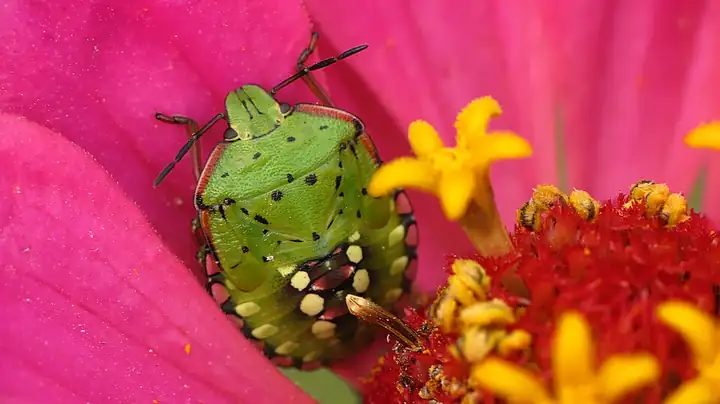
Chinch bugs (lawn chinch bugs)
Hairy chinch bug (Blissus leucopterus hirtus) in northern lawns; southern chinch bug (Blissus insularis) in St. Augustinegrass in the South
| Type | Insect |
|---|---|
| Pressure by region | High pressure: Southeast |
About
Tiny black-and-white bugs, about 1/6 inch long, that suck sap from lawn grass. The hairy chinch bug attacks cool-season lawns such as Kentucky bluegrass, fine fescue, ryegrass and bentgrass, and the southern chinch bug is Florida's most damaging lawn insect, mainly on St. Augustinegrass (Penn State, UF/IFAS).
Spotting it
Damage
Grass in sunny, dry spots turns yellow, then reddish brown, and dies in irregular patches that grow and merge, because the bugs inject a toxin as they feed. It looks a lot like drought, so damage is often blamed on dry weather (Penn State, CSU).
How to find it early
Check green grass at the edge of a yellow patch, not the dead middle. Push a can with both ends cut out a few inches into the soil, fill it with water, and count the bugs that float up over 5 to 10 minutes. Don't mistake big-eyed bugs for chinch bugs: those helpful predators have wide heads with bulging eyes (Penn State, CSU, UF/IFAS).
When
Summer, worst in hot, dry weather (usually July and August in the North); much of the year in Florida.
Life cycle
Adults spend winter in thatch and leaf litter and become active in spring. Hairy chinch bugs usually have two generations a year, with a partial third in long summers (Penn State); southern chinch bugs stay active through most Florida winters and can hurt lawns any time of year, especially in South Florida (UF/IFAS).
What to do, gentlest first
Start at the top. Sprays are a last step; always read and follow the product label.
Keep the lawn unstressed Prevent
Water evenly so grass doesn't go into drought stress, don't overdo nitrogen fertilizer, don't mow too short, and keep thatch thin (UF/IFAS, CSU). When you reseed a northern lawn, choose endophyte-enhanced perennial ryegrass, tall fescue or fine fescue, which chinch bugs avoid (Penn State, CSU).
Endophyte grass can sicken livestock, so don't use it where animals graze (Penn State). In Florida, 'Floratam' St. Augustinegrass was bred to resist chinch bugs, but within about 12 years some bug populations had adapted to it (UF/IFAS).
Protect big-eyed bugs and other predators Natural enemies
Big-eyed bugs are the main predator of chinch bugs, and ground beetles, earwigs and a fungus (Beauveria bassiana) help too, so save insecticides for real need (Penn State, CSU, UF/IFAS).
Natural enemies alone often don't keep numbers below damaging levels (UF/IFAS).
Spot-treat only after counting Conventional spray
Treat only if counts top about 15 to 25 bugs per square foot (Penn State, CSU), and spot-treat the damaged patch and its green edge. Small nymphs are easier to kill than adults (Penn State).
Southern chinch bugs have become resistant to many insecticides, so if you must treat again, switch to a product with a different mode of action (UF/IFAS). Pyrethroids and many other lawn insecticides are highly toxic to bees (PNW 591), so keep them off blooming clover and weeds. Follow the label.
Plants it goes after
Pressure by region
Southern chinch bugs damage lawns throughout the southern states, worst in central and southern Florida, with scattered infestations in the West (UF/IFAS). Hairy chinch bugs are common in northern lawns such as Pennsylvania's; in Colorado they are uncommon but known around Denver and on the West Slope (Penn State, CSU). Other ratings are estimates.
| Northeast | Moderate |
|---|---|
| Southeast | High pressure |
| South Central | Moderate |
| Midwest | Moderate |
| Great Plains | Low |
| Mountain West | Low |
| Southwest | Low |
| Pacific Northwest | Low |
| California | Low |
| Alaska | Low |
| Hawaii | Low |
Ratings come from extension sources where available; some are estimates, as noted above.
Sources
Photo: Photo: Rego Korosi / Wikimedia Commons, CC BY-SA 2.0 (CC BY-SA 2.0). Photo resized for the web.

Planting dates and advice are general guidance; check with your local Cooperative Extension office for your area.