
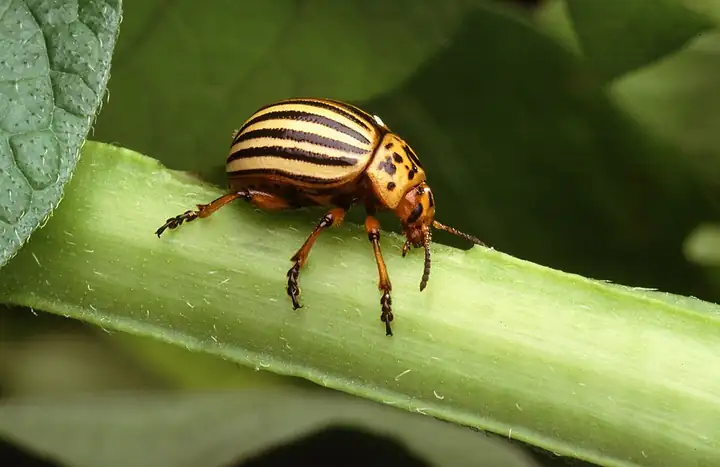
Colorado potato beetle
Leptinotarsa decemlineata
| Type | Insect |
|---|---|
| When | Late spring through summer. |
| Pressure by region | High pressure: Northeast, Midwest |
About
A rounded beetle about three-eighths of an inch long with a yellow-orange head shield and black-and-cream striped wing covers. Its humpbacked larvae start brick red and turn pink or salmon, with two rows of dark spots on each side.
Spotting it
Damage
Adults and larvae chew leaves down to the stems and can strip potato plants bare. Potatoes tolerate about 30 percent leaf loss before flowering but only about 10 percent while tubers are sizing up.
How to find it early
Check leaf undersides in late spring for clusters of yellow-orange eggs, and look for the red to pink larvae on new growth.
When
Late spring through summer.
Life cycle
Adults spend winter 5 to 10 inches deep in the soil and come out in spring; a female can lay up to 350 eggs. There are one to three generations a year depending on latitude, with two in central and southern Minnesota.
What to do, gentlest first
Start at the top. Sprays are a last step; always read and follow the product label.
Rotate and choose early varieties Prevent
Take a year off from potatoes or plant them as far as possible from last year's patch. Grow early varieties (under 80 days) and pull ground cherry and nightshade weeds nearby.
Hand-pick and crush eggs By hand
Knock adults and larvae into soapy water and crush the yellow-orange egg clusters on leaf undersides.
Floating row cover Barrier
Cover potatoes before beetles appear in spring, on ground that did not grow potatoes last year.
Protect predators Natural enemies
Native lady beetles and predatory stink bugs eat the eggs, and tachinid flies attack the beetles.
Bt labeled for Colorado potato beetle Natural enemies
UF/IFAS notes Bt strains active against this beetle work when applied to the first two larval stages.
Choose a Bt product whose label lists Colorado potato beetle, and spray while larvae are small.
Neem oil Organic spray
UMN says Bt and neem can work but need to be used while larvae are small.
Neem is short-lived and low risk to bees once dry, but spray in the evening, keep it off open flowers, and follow the label and pre-harvest interval.
Rotate insecticide groups Conventional spray
Use a labeled product only when defoliation is heading toward the limits above.
The beetle has resistance to over 50 active ingredients, so rotate groups and never rely on one product. Many are highly toxic to bees: do not spray potatoes or eggplant in bloom, and follow the label and pre-harvest interval.
Garden friends that go after it
Ground beetles, Spined soldier bug, Tachinid flies
Protect these helpers: skip broad sprays when they're around.
Plants it goes after
Eggplant, Ground cherry, Pepper (sweet and chili), Potato, Tomatillo, Tomato
Pressure by region
UF/IFAS lists it as absent from Alaska, California, Hawaii and Nevada, and California keeps a quarantine against it. It occurs in Florida but is not often a major pest there. South Central, Southwest and Pacific Northwest are rated low for lack of a regional source; those ratings are estimates, not proof it is rare.
| Northeast | High pressure |
|---|---|
| Southeast | Moderate |
| South Central | Low |
| Midwest | High pressure |
| Great Plains | Moderate |
| Mountain West | Moderate |
| Southwest | Low |
| Pacific Northwest | Low |
| California | Not found here |
| Alaska | Not found here |
| Hawaii | Not found here |
Ratings come from extension sources where available; some are estimates, as noted above.
Sources
Photo: Photo: Scott Bauer, USDA ARS, Public domain (USDA ARS), via Wikimedia Commons. Photo resized for the web.

Planting dates and advice are general guidance; check with your local Cooperative Extension office for your area.