
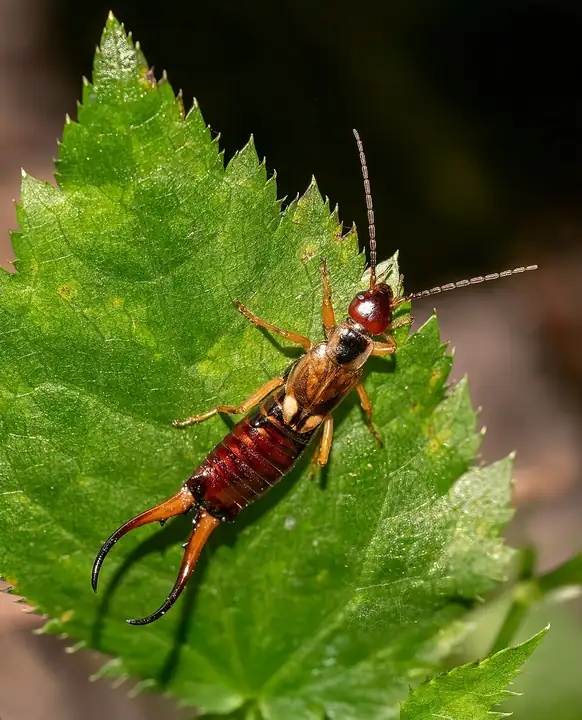
European earwig
Forficula auricularia
| Type | Insect |
|---|---|
| When | Late spring through fall. |
| Pressure by region | Moderate: Northeast, Mountain West, Pacific Northwest, California |
About
A reddish-brown insect about three-quarters of an inch long with pincers at the tail. It is both pest and helper: it eats aphids and insect eggs as well as plants.
Spotting it
Damage
Earwigs chew irregular holes in leaves, can strip seedlings, and hollow out soft fruit such as strawberries. On corn they eat the silks, causing poorly filled ears.
How to find it early
Search plants by flashlight after dark, or set rolled newspaper or corrugated cardboard traps overnight and check them in the morning.
When
Late spring through fall.
Life cycle
Females lay egg masses of 30 or more in soil chambers in fall or winter and guard them; nymphs mature by late summer. There is one generation a year, sometimes with two broods.
What to do, gentlest first
Start at the top. Sprays are a last step; always read and follow the product label.
Remove hiding places Prevent
Clear boards, debris, dense ground cover and thick mulch from around seedlings.
Newspaper and oil traps By hand
Set rolled newspaper, cardboard or low cans of oil near plants at dusk, and shake the earwigs into soapy water in the morning.
Sticky trunk bands Barrier
A sticky barrier on tree trunks keeps earwigs from climbing to fruit.
Tolerate some earwigs Natural enemies
On established plants, earwigs often do more good than harm by eating aphids and insect eggs.
Spinosad bait Organic spray
Where seedlings or fruit are being lost, use a spinosad-based bait.
Baits often do not work well where other food is plentiful (UC IPM). Keep bait away from pets and follow the label.
Perimeter insecticide Conventional spray
Penn State mentions exterior perimeter sprays in early summer for earwigs invading houses.
Rarely needed in the garden. Follow the label and keep sprays off flowering plants.
Plants it goes after
Pressure by region
It reached Seattle in 1907, then spread through New England, the mid-Atlantic and most western states, favoring moist areas; it is not established in Florida. Penn State notes the damage is usually minor. Regions without a source are rated low, so those ratings are estimates.
| Northeast | Moderate |
|---|---|
| Southeast | Low |
| South Central | Low |
| Midwest | Low |
| Great Plains | Low |
| Mountain West | Moderate |
| Southwest | Low |
| Pacific Northwest | Moderate |
| California | Moderate |
| Alaska | Low |
| Hawaii | Low |
Ratings come from extension sources where available; some are estimates, as noted above.
Sources
Photo: Photo: Rhododendrites, CC BY-SA 4.0, via Wikimedia Commons (CC BY-SA 4.0). Photo resized for the web.

Planting dates and advice are general guidance; check with your local Cooperative Extension office for your area.