
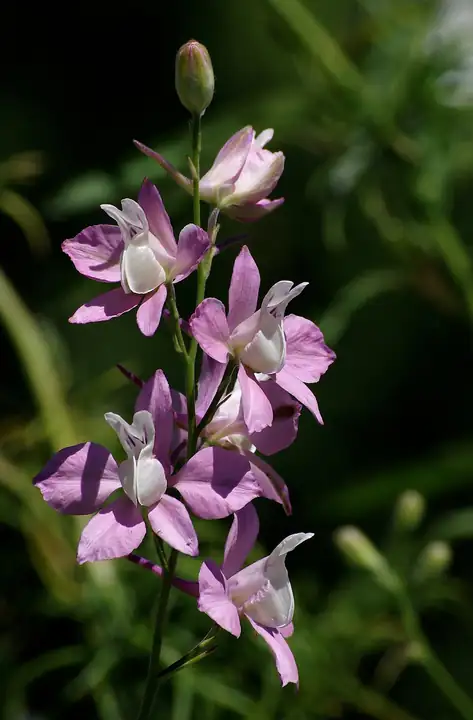
Larkspur (annual larkspur)
Consolida ajacis (rocket larkspur, formerly C. ambigua or Delphinium ajacis) and C. regalis (branched or field larkspur) · Buttercup family (Ranunculaceae)
| Hardiness zones | 3 to 9 |
|---|---|
| Sun | full sun |
| Water | moderate |
| Life cycle | annual |
| Frost | Hardy: takes frost |
| Spacing | 6 to 12 inches |
About Larkspur (annual larkspur)
Annual larkspur is a delphinium cousin that sends up tall spikes of blue, violet, pink or white flowers over lacy leaves in late spring. It's a classic cottage and cut flower that dries well and reseeds itself year after year (UACES, MSU). Every part is poisonous, especially the seeds, so keep it away from children, pets and livestock (NC State, NRCS).
A cool-season annual grown from seed: sow in September or October across the South for spring bloom, and in fall or very early spring farther north (UACES, MSU, USU). NC State's larkspur and delphinium page lists zones 3-9. It has escaped gardens along roadsides and fields from Nova Scotia to Montana and south to Texas (NRCS).
When to plant
Timing is counted from your average last spring frost (and first fall frost). Sow & Tell works out the actual dates for your ZIP code.
- Sow seeds outdoors: 2 to 3 weeks before the last frost
Sow seed directly where it will bloom: late summer to early fall in the South (MSU), or in spring at least 2-3 weeks before the last frost (USU). Seed sprouts best in cool soil, not above about 65 F (Cornell); for spring sowing, chill dry seed at 35-40 F for 3 weeks first (USU). Scatter thinly and don't bury it deeply; thin to 6-12 inches and support tall stems with netting (MSU, USU). It dislikes transplanting, though tiny seedlings can be moved in late winter (MSU). We found no sourced days-to-bloom count.
Soil
Fertile, well-drained soil kept evenly moist; soggy soil invites root rot (UACES, Cornell).
Loosen a fertile, well-drained bed and keep it evenly moist for sowing; the sources we found give no fertilizer rates, so follow a soil test.
Feeding
Sowing too late is the most common mistake: seed sprouts poorly in warm soil and late spring plantings make short, weak stems (MSU, Cornell). Poorly drained soil invites root rot (Cornell).
Harvest
Spikes open in late spring, peaking in May and June in the South and running into summer up north (UACES). For the vase, cut in the morning when a quarter to a third of the flowers on a spike are open; for drying, when about half are open, then hang upside down (USU, Iowa State).
Varieties (11)
Extension sources document these 11; Utah State tested nine of them side by side.
| Variety | Type | Days | Notes |
|---|---|---|---|
| Cannes Deep Blue | Cannes series (C. ajacis) | Violet-blue to indigo, mostly double; 3-5 ft. | |
| Cannes Lilac | Cannes series (C. ajacis) | Pastel purple, mostly double; 2-4.5 ft; high yielding. | |
| Cannes White | Cannes series (C. ajacis) | White, mostly double; 2-4.5 ft; moderate to high yield. | |
| Fancy Belladonna | Fancy series (C. ajacis) | Soft light pink single flowers; 2-4.5 ft. | |
| Fancy Purple Picotee | Fancy series (C. ajacis) | White flowers edged in purple, mostly double; low yielding. | |
| Fancy Smokey Eyes | Fancy series (C. ajacis) | Silvery white with lavender centers, mostly double; low yielding. | |
| Super Giant Imperial | Giant Imperial series | Cut-flower series Cornell names for high-tunnel growing. | |
| QIS Dark Blue | QIS series (C. ajacis) | Violet-blue to indigo, mostly double; 2-4.5 ft; high yielding. | |
| QIS Light Pink | QIS series (C. ajacis) | Muted pink, mostly double; 2-4.5 ft. | |
| QIS White | QIS series (C. ajacis) | White, mostly double; 2-4.5 ft. | |
| Sublime | Sublime series | Cut-flower series Cornell names for high-tunnel growing. |
Good neighbors
Rose (garden and landscape roses), Poppy (Oriental, Iceland, corn and breadseed poppies), Salvia (ornamental sage), Coreopsis (tickseed), Yarrow, Hollyhock
UACES and MSU suggest these as good-looking garden partners, such as larkspur in front of climbing roses; this is about design, not pest control.
Pests to watch for
Aphids, Cutworms, Cabbage looper, European earwig, Grasshoppers, Twospotted spider mite, Slugs, Brown garden snail
Diseases and problems
Powdery mildew, Root and crown rot
In the kitchen
Safety: Poisonous: NC State rates larkspur and delphinium as highly toxic, with alkaloids in the flowers, leaves, stems and seeds. Eating it can cause mouth burning, vomiting, muscle weakness, a weak pulse and breathing trouble, and it can kill. Seeds stay toxic even after the plant matures (NRCS).
Pets: Toxic to dogs, cats and horses (ASPCA, listed as larkspur, Delphinium species): its diterpene alkaloids paralyze muscles. In horses the ASPCA lists drooling, tremors, stiffness, weakness, colic, constipation and convulsions, and heart failure or breathing paralysis can be fatal. Toxicity drops as the plant matures, but the seeds stay toxic (NRCS).
Sources
- uaex.uada.edu
- extension.msstate.edu
- projects.sare.org
- blogs.cornell.edu
- nrcs.usda.gov
- plants.ces.ncsu.edu
- aspca.org
- rutgersgardens.rutgers.edu
- extension.iastate.edu
Photo: Photo: JLPC / Wikimedia Commons, CC BY-SA 3.0 (CC BY-SA 3.0). Photo resized for the web.

Planting dates and advice are general guidance; check with your local Cooperative Extension office for your area.