
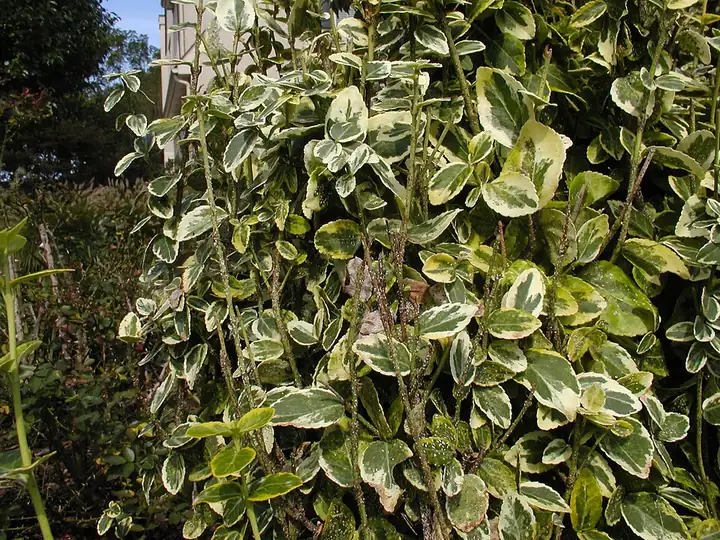
Euonymus scale
Unaspis euonymi
| Type | Insect |
|---|---|
| When | Present year-round; crawlers in late spring and late summer. |
| Pressure by region | Moderate: Northeast, Southeast, South Central, Midwest, Great Plains |
About
An armored scale from Japan and China that is a key pest of euonymus, pachysandra and bittersweet; vining euonymus is extremely susceptible (Penn State). White male scales crowd along stems and leaf veins like a dusting of snow, and heavy infestations can kill plants (Clemson).
Spotting it
Damage
Feeding causes yellow spots on the upper leaf surface, often along the veins, and weakens the plant; heavy infestations cause leaf drop, branch dieback and death (Clemson, Penn State).
How to find it early
Look for white flecks (males) and dark, oyster-shaped scales about 1/16 inch long (females) on stems and leaves, plus yellow spotting. Wrap double-sided tape around a twig or use yellow sticky cards in spring to catch the tiny orange crawlers (Clemson).
When
Present year-round; crawlers in late spring and late summer.
Life cycle
Mated females spend winter on the stems and lay eggs under their covers in late April and May. There are two generations a year, with crawlers in late May to June and again in late July to August (Penn State); in coastal South Carolina the generations overlap (Clemson).
What to do, gentlest first
Start at the top. Sprays are a last step; always read and follow the product label.
Keep plants healthy and pick resistant plants Prevent
Water weekly in drought, mulch, and fertilize only as recommended (Clemson). Clemson lists 'Compactus' winged euonymus and 'Acutus' wintercreeper as resistant, but winged euonymus (burning bush) is invasive in many states, so consider a different shrub.
Scrape and prune By hand
Scrape off light infestations by hand, and prune out and throw away heavily infested branches (Clemson, Penn State).
Protect lady beetles Natural enemies
A small black lady beetle with two red spots, Chilocorus kuwanae, was brought in to fight euonymus scale; avoid broad-spectrum sprays that kill it (Penn State, Clemson).
Horticultural oil Organic spray
Spray a 3 to 4% dormant oil from winter to early spring, or a 2% oil when crawlers appear in April, in the early evening when it is 45 to 85°F; repeat sprays may be needed (Clemson).
Oil can harm bees it hits (PNW 591); spray when bees are not working. Follow the label.
Systemic soil treatment or crawler sprays Conventional spray
A spring soil application of dinotefuran at the base of the plant improves control and can be combined with oil (Clemson). Contact insecticides work only after you confirm crawlers are out.
Soil-applied imidacloprid does not control this scale (Clemson). Dinotefuran is highly toxic to bees (PNW 591). Follow the label.
Plants it goes after
Pressure by region
Ratings are estimates. The guide has no page for evergreen or vining euonymus yet, which are its main hosts.
| Northeast | Moderate |
|---|---|
| Southeast | Moderate |
| South Central | Moderate |
| Midwest | Moderate |
| Great Plains | Moderate |
| Mountain West | Low |
| Southwest | Low |
| Pacific Northwest | Low |
| California | Low |
| Alaska | Low |
| Hawaii | Low |
Ratings come from extension sources where available; some are estimates, as noted above.
Sources
Photo: Photo: SB_Johnny / Wikimedia Commons, CC BY-SA 3.0 (CC BY-SA 3.0). Photo resized for the web.

Planting dates and advice are general guidance; check with your local Cooperative Extension office for your area.