
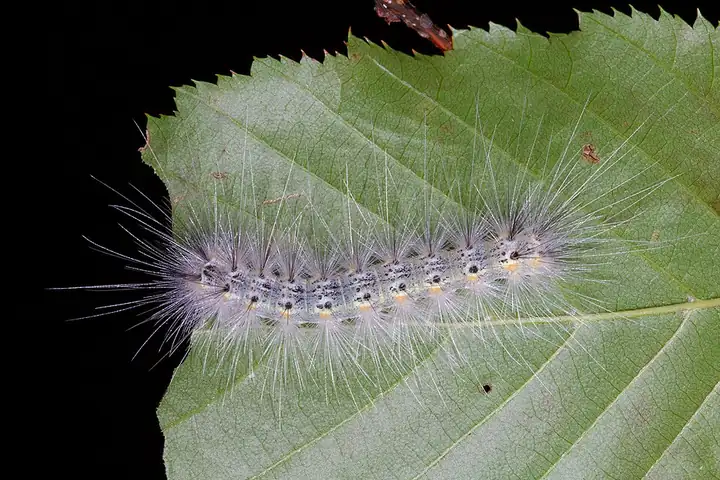
Fall webworm
Hyphantria cunea
| Type | Insect |
|---|---|
| When | July through September. |
| Pressure by region | Moderate: Northeast, Southeast, South Central, Midwest, Great Plains, Mountain West, Southwest, Pacific Northwest, California |
About
A native, hairy caterpillar, up to an inch long and pale yellow to gray, that feeds inside a silken web wrapped around the ends of branches. It feeds on about 90 to over 100 kinds of trees, including fruit and nut trees such as cherry.
Spotting it
Damage
Caterpillars skeletonize leaves inside webs that can cover 2 to 3 feet of branch. Trees rarely die; on fruit trees, severe defoliation can let fruit sunburn and drop early.
How to find it early
From midsummer on, look for webs at branch tips, full of caterpillars, leaves and droppings. Eastern tent caterpillar tents are in branch forks and appear in spring.
When
July through September.
Life cycle
It spends winter as a pupa in a cocoon on bark, in leaf litter or in soil. There are one or two generations a year, depending on location.
What to do, gentlest first
Start at the top. Sprays are a last step; always read and follow the product label.
Prune out or break open webs By hand
Cut out small webbed branches while infestations are small, or scrub webbing out with a brush on a telescoping pole (UC IPM).
Let natural enemies work Natural enemies
Birds and parasitic insects help keep fall webworm in check (Penn State).
Bt or spinosad Organic spray
Spray Bt or spinosad on the foliage around webs while caterpillars are small; repeat Bt about every 7 to 10 days (UC IPM).
Bt does not harm bees; spinosad is toxic to bees, so do not use it during flowering (UC IPM, PNW 591). Follow the label and pre-harvest interval on fruit trees.
Rarely needed Conventional spray
Penn State suggests a labeled insecticide in July only if webs are many and still small.
Read and follow the label, including the pre-harvest interval; many broad-spectrum insecticides are highly toxic to bees (PNW 591).
Plants it goes after
Beach plum, Black walnut, Cherry (sweet and tart), Pecan, Thornless honeylocust
Pressure by region
Penn State calls it widely distributed; sourced for Pennsylvania and California. Ratings for other regions, including Alaska and Hawaii, are estimates.
| Northeast | Moderate |
|---|---|
| Southeast | Moderate |
| South Central | Moderate |
| Midwest | Moderate |
| Great Plains | Moderate |
| Mountain West | Moderate |
| Southwest | Moderate |
| Pacific Northwest | Moderate |
| California | Moderate |
| Alaska | Low |
| Hawaii | Low |
Ratings come from extension sources where available; some are estimates, as noted above.
Sources
Photo: Photo: Kristof Zyskowski & Yulia Bereshpolova, CC BY 2.0, via Wikimedia Commons (CC BY 2.0). Photo resized for the web.

Planting dates and advice are general guidance; check with your local Cooperative Extension office for your area.