
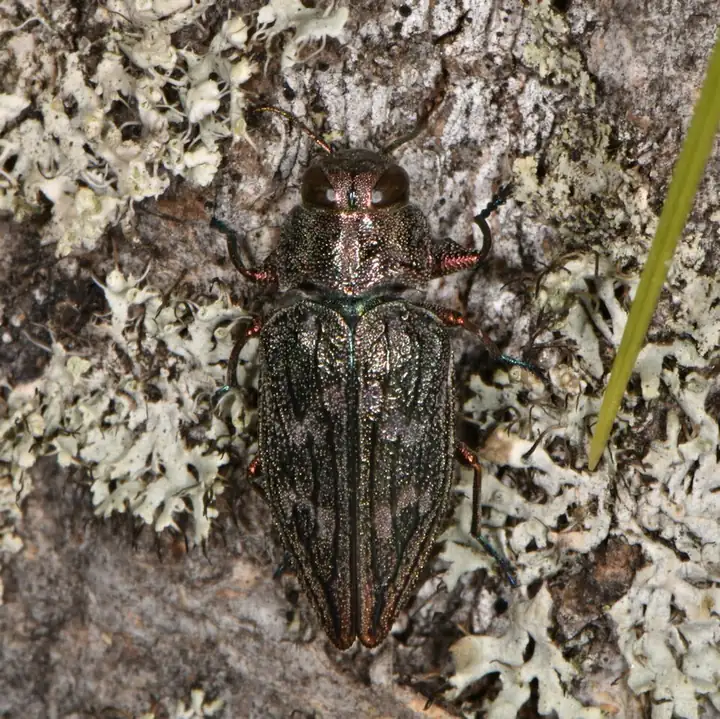
Flatheaded appletree borer
Chrysobothris femorata
| Type | Insect |
|---|---|
| Pressure by region | High pressure: Southeast |
About
A native metallic, greenish-bronze beetle about 1/2 inch long whose flat-headed grubs tunnel under the bark of many fruit, nut, shade and ornamental trees. It mostly attacks young, newly planted or stressed trees and can girdle and kill them.
Spotting it
Damage
Grubs tunnel just under the bark in winding galleries packed with fine sawdust. The bark above dies and may crack, peel, look water-soaked or ooze sap, and exit holes are oval or D-shaped. A single grub can girdle a young tree.
How to find it early
Check young trees in their first few years, especially on the sunny side of the trunk, for sunken, dark, cracked or oozing bark and fine sawdust under loose bark. Colorado State says trees are most at risk 2 to 3 years after transplanting.
When
Adults late spring through summer, peaking in June and July; grubs feed inside the tree year-round
Life cycle
There is one generation a year. Grubs spend winter in the wood and pupate in spring; adults are out from about May into September, peaking in June and July, and each female lays up to about 100 eggs in bark cracks, especially on the sunny side of the trunk.
What to do, gentlest first
Start at the top. Sprays are a last step; always read and follow the product label.
Keep young trees from getting stressed Prevent
Plant early in the dormant season and at the right depth. Water deeply, to about 2 feet, every two to four weeks in dry weather, mulch, avoid mower and equipment wounds, and brace leaning trees. Don't stack fresh firewood near young trees, since beetles breed in it.
Remove infested wood and dying trees By hand
Promptly remove and destroy infested wood and badly infested trees so new beetles don't emerge from them.
Wrap or paint thin-barked trunks Barrier
Wrap young, thin-barked trunks with white tree wrap in late fall to prevent sunscald, or paint the trunk with white latex paint. Missouri Extension suggests wrapping the trunk from the ground to the lower branches before adults come out in spring.
Use latex, not oil-based paint, which can harm the tree.
Pyrethroid trunk spray for new plantings Conventional spray
NC State suggests a pyrethroid trunk spray during the first one or two years after planting, while adults are laying eggs in summer.
Contact sprays don't reach grubs already under the bark. Pyrethroids are highly toxic to bees and should be kept out of water. Some guides list neonicotinoid soil drenches; skip them, because they are highly toxic to bees and turn up in pollen and nectar. Read and follow the label and the pre-harvest interval on fruit trees.
Plants it goes after
Pressure by region
It is native across North America (UGA) and found throughout the U.S. (Missouri), but Oregon State says it is most common in the eastern, central and southeastern states, while a close relative, the Pacific flatheaded borer, is the main one west of the Rockies. Utah and Colorado State both cover it. All ratings except the Southeast and mountain regions are estimates, as are Alaska and Hawaii.
| Northeast | Moderate |
|---|---|
| Southeast | High pressure |
| South Central | Moderate |
| Midwest | Moderate |
| Great Plains | Moderate |
| Mountain West | Moderate |
| Southwest | Low |
| Pacific Northwest | Low |
| California | Low |
| Alaska | Low |
| Hawaii | Low |
Ratings come from extension sources where available; some are estimates, as noted above.
Sources
- content.ces.ncsu.edu
- fieldreport.caes.uga.edu
- agsci.colostate.edu
- extension.usu.edu
- extension.oregonstate.edu
- extension.unh.edu
- extension.missouri.edu
- netreefruit.org
- s3.wp.wsu.edu
Photo: Photo: Reiner Jakubowski, CC BY-SA 4.0, via Wikimedia Commons (CC BY-SA 4.0). Photo resized for the web.

Planting dates and advice are general guidance; check with your local Cooperative Extension office for your area.