
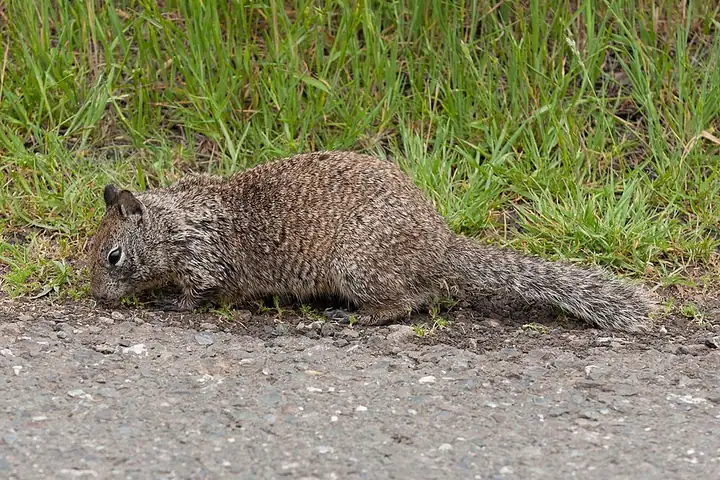
Ground squirrels
California ground squirrels (Otospermophilus beecheyi and O. douglasii); Richardson's, Columbian, Wyoming and golden-mantled ground squirrels and other western species
| Type | Animal |
|---|---|
| Pressure by region | High pressure: California |
About
Burrowing squirrels of the West. The California ground squirrel is mottled brown with a white ring around each eye and is 14 to 20 inches long counting its tail. Unlike tree squirrels, ground squirrels dive into burrows when frightened, and they eat garden seedlings, fruit and nuts, girdle young trees and chew irrigation lines.
Spotting it
Damage
Open burrow holes about 4 inches across, clipped seedlings, eaten fruit and nuts, bark gnawed from young trees, and chewed drip lines and sprinkler heads. Pocket gopher holes are plugged with soil, while ground squirrel burrows stay open.
How to find it early
Ground squirrels are active by day, mostly from midmorning to late afternoon, and usually feed within about 75 yards of their burrows. Unlike chipmunks, they have no stripes on the face.
When
In California, mid-January through October; in colder areas, early spring through late summer.
Life cycle
California ground squirrels have one litter a year, averaging 5 to 8 young, after mating in late winter or spring. Most hibernate in winter, and most adults also go dormant in the hottest part of summer; in drier parts of Montana, some ground squirrels go underground for the winter as early as August.
What to do, gentlest first
Start at the top. Sprays are a last step; always read and follow the product label.
Clear brush and debris Prevent
Remove brush piles, rock piles and other debris that give ground squirrels cover near the garden. Simply filling burrows does not keep them from coming back.
Wire cages for small plantings Barrier
Cover seedlings and small plants with wire cages built without gaps. UC IPM rates exclusion low in effectiveness against ground squirrels, so cages work best for a few prized plants.
Trapping rules vary Trap
California classes ground squirrels as nongame mammals that owners may control, but it is illegal to relocate them without a permit, so a live-caught squirrel must be released on the same property or humanely killed. Oregon requires a permit to trap native squirrels. Some ground squirrel species or local populations are protected, so confirm what you have first.
Ground squirrel fleas can carry plague. Do not touch dead squirrels, and wear protective gear when handling carcasses. Put box traps inside a covered box with a 3-inch entrance so pets and birds cannot get in. This guide does not recommend poison baits, which put pets, children and other wildlife at risk. UC IPM notes that anticoagulant baits are no longer sold to home users in California. Trapping and relocating wildlife is regulated by state law, and the rules differ from state to state. Check with your state wildlife agency or your county Extension office before you set a trap.
No repellents work Repellent
UC IPM reports no effective frightening devices or repellents, and Montana State found ultrasonic devices did not control them.
Predators help a little Natural enemies
Hawks, eagles, rattlesnakes and coyotes eat ground squirrels, but Montana State says predators do not control their numbers.
Plants it goes after
Apple (backyard tree), Apricot, Orange and blood orange, Peach, Plum
Pressure by region
California ground squirrels live through most of California and into western Nevada, western Oregon and south-central Washington; California is rated high because they live through most of the state and damage gardens, fruit and nut trees and young trees (UC IPM). Wyoming, Richardson's and Columbian ground squirrels live in the Rocky Mountain states, and the Arctic ground squirrel lives in Alaska. Ratings other than California are estimates.
| Northeast | Low |
|---|---|
| Southeast | Low |
| South Central | Low |
| Midwest | Low |
| Great Plains | Low |
| Mountain West | Moderate |
| Southwest | Low |
| Pacific Northwest | Moderate |
| California | High pressure |
| Alaska | Low |
| Hawaii | Low |
Ratings come from extension sources where available; some are estimates, as noted above.
Sources
- ipm.ucanr.edu
- animalrangeextension.montana.edu
- boulder.extension.colostate.edu
- solvepestproblems.oregonstate.edu
- ucanr.edu
- teller.extension.colostate.edu
- adfg.alaska.gov
Photo: Photo: King of Hearts, CC BY-SA 3.0, via Wikimedia Commons (CC BY-SA 3.0). Photo resized for the web.

Planting dates and advice are general guidance; check with your local Cooperative Extension office for your area.