
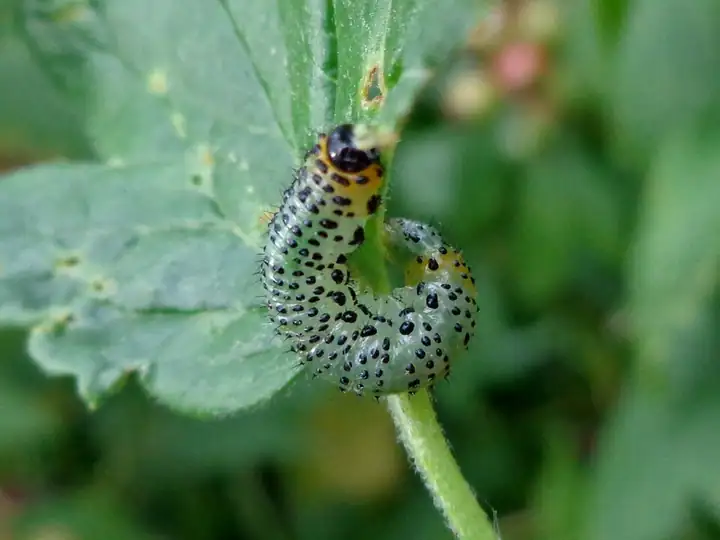
Imported currantworm
Nematus ribesii
| Type | Insect |
|---|---|
| Pressure by region | Moderate: Northeast, Midwest, Great Plains, Mountain West, Pacific Northwest |
About
An introduced sawfly whose green, black-spotted larvae look like caterpillars but are the young of a small, stout wasp. Groups of them can strip a currant or gooseberry bush in a few days.
Spotting it
Damage
Larvae start with small holes in leaves near the center of the bush, then eat from the edges in until only veins are left. Early defoliation cuts yields this year and next and lets berries sunscald.
How to find it early
As leaves emerge in spring, check leaf undersides near the center of the bush daily for eggs and small pinholes. Sawfly larvae have six or more pairs of fleshy legs on the belly; caterpillars have five or fewer.
When
Spring (April to June), with a second round around harvest where there are two generations.
Life cycle
It spends winter in a cocoon at or just below the soil surface, and adults emerge as leaves open in spring and lay eggs on the undersides of leaves. Colorado reports one generation a year; in Washington a second appears around harvest in June or July.
What to do, gentlest first
Start at the top. Sprays are a last step; always read and follow the product label.
Keep bushes healthy and disturb the soil Prevent
Water and fertilize properly, and lightly till under bushes in fall and spring so predators find the cocoons (WSU).
Handpick, shake or hose off By hand
Pick off infested leaves or larvae, shake bushes over a container, or knock larvae off with a strong jet of water, then drop them in soapy water.
Protect natural enemies Natural enemies
Parasitic wasps, lady beetles and lacewings feed on the larvae (WSU).
Bt (Bacillus thuringiensis kurstaki) does not work: it kills only true caterpillars, not sawfly larvae (UMN).
Insecticidal soap, pyrethrins, neem or spinosad Organic spray
Spray young larvae directly (UMN, CSU). Soap works only on contact.
Pyrethrins are highly toxic to bees and neem and spinosad are toxic for a few hours (PNW 591); spray in the evening and not on open flowers. The PNW Handbook says no products are registered for this pest in home gardens, so check that your product's label lists currants or gooseberries and follow its pre-harvest interval.
Plants it goes after
Pressure by region
Sourced for Colorado (likely widespread, CSU) and Washington (WSU, PNW Handbook). The Northeast, Midwest and Great Plains ratings, and the low ratings elsewhere, are estimates based on where currants and gooseberries are grown.
| Northeast | Moderate |
|---|---|
| Southeast | Low |
| South Central | Low |
| Midwest | Moderate |
| Great Plains | Moderate |
| Mountain West | Moderate |
| Southwest | Low |
| Pacific Northwest | Moderate |
| California | Low |
| Alaska | Low |
| Hawaii | Low |
Ratings come from extension sources where available; some are estimates, as noted above.
Sources
Photo: Photo: AfroBrazilian, CC BY-SA 3.0, via Wikimedia Commons (CC BY-SA 3.0). Photo resized for the web.

Planting dates and advice are general guidance; check with your local Cooperative Extension office for your area.