
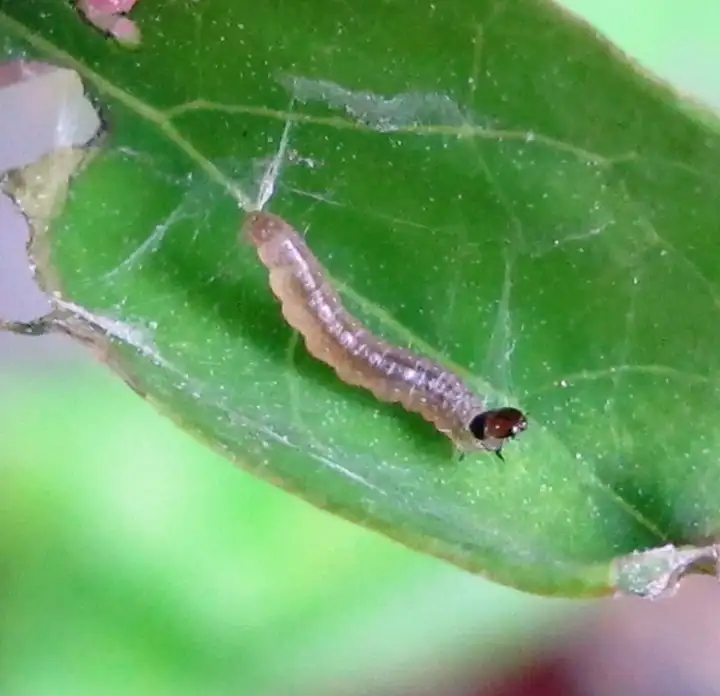
Obliquebanded leafroller
Choristoneura rosaceana
| Type | Insect |
|---|---|
| Pressure by region | High pressure: Northeast |
About
A native moth whose green caterpillar rolls and ties leaves with silk and feeds inside them. It is one of several leafrollers on fruit trees and prefers the rose family, including apple, pear, cherry and peach.
Spotting it
Damage
Caterpillars roll and web leaves and feed on buds, shoot tips and fruit. Spring feeding can leave deep, corky scars and dents in fruit and make young fruit drop, and summer caterpillars chew holes and shallow tunnels in the skin; Cornell says summer damage to fruit is usually the more serious.
How to find it early
From bloom to petal fall, look for rolled, webbed leaves with a green caterpillar (black or brown head, up to 1 inch long) inside. Check shoot tips and young fruit again in July. Pheromone traps show when the moths are flying.
When
Bud break through September, with caterpillars peaking in spring and again in July
Life cycle
There are two generations a year in most places and sometimes a third in warm areas. Small caterpillars spend winter in silk cocoons in bark cracks, start feeding at bud break, and become moths in late May or June; each female lays up to 900 eggs in flat green masses on leaves, which hatch in 10 to 12 days, and a second moth flight follows in August.
What to do, gentlest first
Start at the top. Sprays are a last step; always read and follow the product label.
Thin the fruit Prevent
Thin clusters to a single fruit. Utah State says this cuts down on leafroller feeding on fruit.
Pick off rolled leaves By hand
Pinch off rolled leaves with caterpillars or pupae inside and destroy them.
Natural enemies and Bt Natural enemies
Spiders, lacewings, parasitic wasps and flies help keep leafrollers down, so avoid broad-spectrum sprays. If needed, spray Bt (Bacillus thuringiensis) at the pre-pink bud stage and again at pink and petal fall, on days warmer than 60°F.
Bt works best on small caterpillars. Bee-hazard guides list no bee warning for Bt. Read and follow the label and the pre-harvest interval.
Spinosad Organic spray
Utah State suggests spinosad between the pre-pink bud stage and petal fall for home orchards.
Spinosad is toxic to bees for about 3 hours to a day, so don't spray open blossoms; use it before flowers open or after the petals fall, when bees are not active. Leafrollers become resistant quickly when the same type of insecticide is used again and again. Read and follow the label and the pre-harvest interval.
Plants it goes after
Apple (backyard tree), Apricot, Cherry (sweet and tart), Peach, Pear, Plum
Pressure by region
It is native and widespread across temperate North America (Cornell, Penn State). NC State says it is not a major apple pest in the Southeast, and Utah State notes it has hurt the state's tart cherry crop. Ratings other than the Northeast, Southeast and mountain regions are estimates, as are Alaska and Hawaii.
| Northeast | High pressure |
|---|---|
| Southeast | Low |
| South Central | Low |
| Midwest | Moderate |
| Great Plains | Low |
| Mountain West | Moderate |
| Southwest | Low |
| Pacific Northwest | Moderate |
| California | Moderate |
| Alaska | Low |
| Hawaii | Low |
Ratings come from extension sources where available; some are estimates, as noted above.
Sources
Photo: Photo: Jacy Lucier, CC BY-SA 4.0, via Wikimedia Commons (CC BY-SA 4.0). Photo resized for the web.

Planting dates and advice are general guidance; check with your local Cooperative Extension office for your area.