
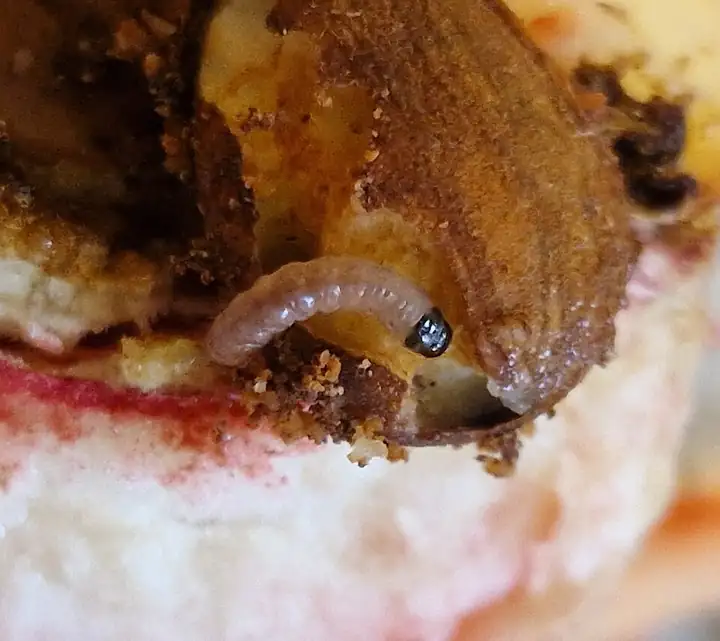
Oriental fruit moth
Grapholita molesta
| Type | Insect |
|---|---|
| When | Bloom through fall harvest; each generation overlaps the next. |
| Pressure by region | Moderate: Northeast, Southeast, South Central, Midwest, California |
About
A small gray moth, about half an inch across, whose grayish-white, black-headed caterpillars bore into shoots and fruit. Peaches and nectarines are hit hardest, but it also attacks apples and other stone fruits.
Spotting it
Damage
In spring, caterpillars bore into new shoots, so tips wilt and die back an inch or more ('flagging'). Later generations tunnel into fruit near the stem toward the pit or core and leave a gummy hole with frass.
How to find it early
In spring, look for wilted, dying shoot tips on peach trees. Pheromone traps hung in early April show when moths are flying; Clemson uses more than 10 moths per trap as the signal to act.
When
Bloom through fall harvest; each generation overlaps the next.
Life cycle
Full-grown caterpillars spend winter in silk cocoons on the tree or ground, and moths fly around bloom. There are four to five generations a year in Pennsylvania, five or six in California and six or more in South Carolina.
What to do, gentlest first
Start at the top. Sprays are a last step; always read and follow the product label.
Sanitation Prevent
Pick up dropped fruit and ground litter (Penn State).
Prune out wilted shoot tips By hand
Clip and destroy flagging shoots in spring while the caterpillar is still inside.
Encourage its parasitic wasp Natural enemies
On unsprayed trees in California, the wasp Macrocentrus ancylivorus commonly parasitizes 80 to 90% of caterpillars by late summer. UC IPM notes sunflowers nearby help the wasp get through winter.
Broad-spectrum sprays kill these wasps. Mating disruption works in big orchards but may fail on a lone backyard tree (UC IPM).
Spinosad Organic spray
Time sprays to egg hatch, about a week after each moth flight begins (Penn State timing), and repeat as the label allows.
UC IPM says many of the most effective products are sold only to licensed applicators. Spinosad is toxic to bees for a few hours to a day (PNW 591); do not spray during bloom. Follow the label and pre-harvest interval.
Permethrin or malathion Conventional spray
Clemson lists these for home peaches, sprayed about a week after a flight begins and again 7 to 10 days later.
Both are highly toxic to bees (PNW 591); never spray during bloom. Clemson: no malathion within 7 days of harvest, and no more than 8 permethrin applications a season. Follow the label.
Garden friends that go after it
Trichogramma wasps
Protect these helpers: skip broad sprays when they're around.
Plants it goes after
Pressure by region
Sourced for Pennsylvania, South Carolina and California; warmer areas get more generations. Ratings for South Central and the Midwest, and the low ratings elsewhere, are estimates.
| Northeast | Moderate |
|---|---|
| Southeast | Moderate |
| South Central | Moderate |
| Midwest | Moderate |
| Great Plains | Low |
| Mountain West | Low |
| Southwest | Low |
| Pacific Northwest | Low |
| California | Moderate |
| Alaska | Low |
| Hawaii | Low |
Ratings come from extension sources where available; some are estimates, as noted above.
Sources
Photo: Photo: Alfred Ruhfaß, CC0, via Wikimedia Commons (CC0). Photo resized for the web.

Planting dates and advice are general guidance; check with your local Cooperative Extension office for your area.