
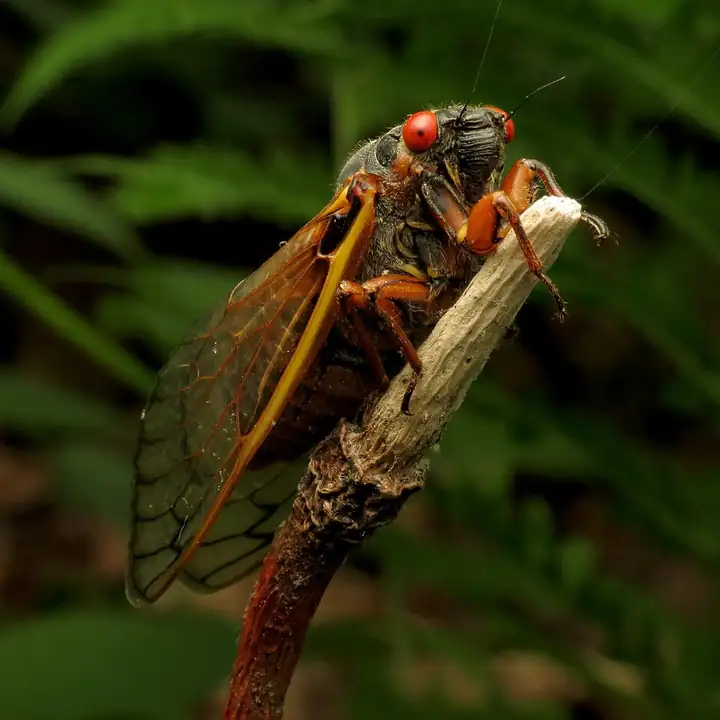
Periodical cicadas
Magicicada species (seven species with 13- or 17-year life cycles)
| Type | Insect |
|---|---|
| When | Emergence years only: mostly May and June, for about 6 to 8 weeks |
| Pressure by region | High pressure: Northeast, Southeast, Midwest |
About
Black cicadas about 1 1/2 inches long, with red eyes and orange-veined wings, that come out of the ground in huge numbers only once every 13 or 17 years in eastern North America. They don't bite or sting, but females slit young twigs to lay eggs, which can badly hurt young fruit trees.
Spotting it
Damage
Females cut slits 1/8 to 3/8 inch long in thin, smooth twigs and lay eggs inside. The weakened twigs break, and their leaves wilt and turn brown, which is called flagging. Mature trees take this as a natural pruning, but young or newly planted trees can be stunted or killed, and damage to young limbs meant to become main branches can hurt the tree for years.
How to find it early
Find out whether a brood is due in your county; Extension offices publish emergence years (for example, Maryland's Brood X returns in 2038). The loud chorus of singing males is your signal that egg laying will start within about 10 days. If you've lived in one place 13 or 17 years without cicadas, you're unlikely to get them this year.
When
Emergence years only: mostly May and June, for about 6 to 8 weeks
Life cycle
Nymphs live underground for 13 or 17 years, feeding on tree roots, then come out together in spring once soil 7 to 8 inches down reaches about 64°F. Adults live 2 to 6 weeks; egg laying starts 7 to 10 days after males begin singing, each female lays 400 to 500 eggs, and the eggs hatch about 6 weeks later and the young head underground.
What to do, gentlest first
Start at the top. Sprays are a last step; always read and follow the product label.
Time planting and pruning Prevent
If an emergence is coming, wait until it's over to plant new fruit trees. On trees under 4 years old, put off winter pruning until summer, after egg laying, so you can prune out damage at the same time.
Prune off flagged twigs By hand
Cut off and destroy damaged twig tips after most eggs are laid but before they hatch, within about 4 to 6 weeks after egg laying.
Net young trees Barrier
Cover young trees with netting that has holes 1/4 inch or smaller, such as mosquito netting, tulle or floating row cover, when the first males start singing. Tie it loosely around the trunk below the branches or pin the edges to the ground, and hold it off the branches with a frame. Remove it when the males stop calling, about 6 to 8 weeks after the cicadas come out.
Bird netting has holes too big to stop cicadas. Leaving netting on too long can slow growth, cut air flow and block pollination.
Insecticides (not recommended for home trees) Conventional spray
Maryland Extension says insecticides do little to cut cicada numbers or damage, and netting works better. Illinois Extension's spray guide is for commercial orchards only and says homeowners with a few trees should not spray.
Pyrethroids are highly toxic to bees and can set off mite outbreaks by killing the mites' predators. Some guides mention neonicotinoids; skip them, because they are highly toxic to bees and turn up in pollen and nectar. If you spray, read and follow the label and the pre-harvest interval.
Plants it goes after
Pressure by region
Periodical cicadas live only in eastern North America (UConn), and Colorado State says they don't occur in Colorado and are mostly east of the Mississippi River, so western regions, Alaska and Hawaii are rated absent. The 17-year broods are mostly northern and the 13-year broods mostly southern and midwestern. The south-central and Great Plains ratings are estimates. Even within the range, damage happens only in years when a local brood emerges.
| Northeast | High pressure |
|---|---|
| Southeast | High pressure |
| South Central | Moderate |
| Midwest | High pressure |
| Great Plains | Low |
| Mountain West | Not found here |
| Southwest | Not found here |
| Pacific Northwest | Not found here |
| California | Not found here |
| Alaska | Not found here |
| Hawaii | Not found here |
Ratings come from extension sources where available; some are estimates, as noted above.
Sources
- extension.psu.edu
- content.ces.ncsu.edu
- extension.umd.edu
- utianews.tennessee.edu
- extension.illinois.edu
- cicadas.uconn.edu
- extension.colostate.edu
- s3.wp.wsu.edu
Photo: Photo: Katja Schulz, CC BY 2.0, via Wikimedia Commons (CC BY 2.0). Photo resized for the web.

Planting dates and advice are general guidance; check with your local Cooperative Extension office for your area.