
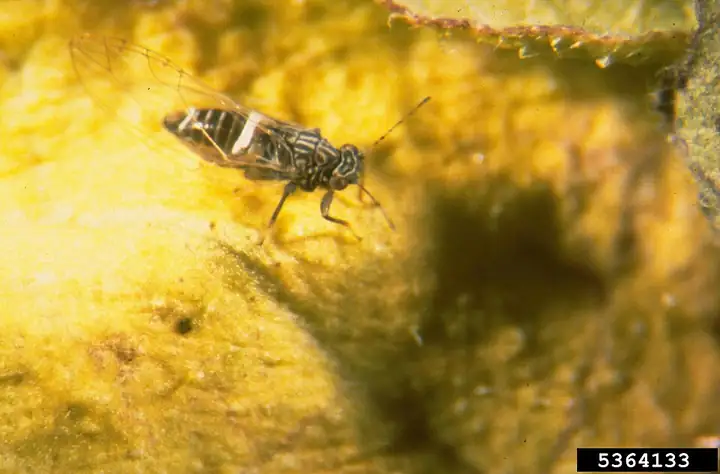
Potato psyllid (tomato psyllid)
Bactericera cockerelli
| Type | Insect |
|---|---|
| When | Late spring through fall; it usually reaches Colorado in May or early June. |
| Pressure by region | High pressure: South Central, Mountain West, Southwest, California |
About
A jumping insect about the size of an aphid (about 2 mm), dark gray to black with white bands (Colorado State, Texas A&M). Its flat, oval, scale-like young sit on leaf undersides of tomatoes, potatoes and their relatives.
Spotting it
Damage
Feeding by the young causes 'psyllid yellows': top leaves curl upward and turn yellow or purplish, plants are stunted, and tomato fruit quality drops (Colorado State, Texas A&M). It also spreads a bacterium that causes zebra chip disease in potatoes, which leaves dark streaks inside the tubers (OSU).
How to find it early
Put out yellow sticky cards early in the season, and use a hand lens to check the undersides of leaves for flat nymphs and eggs (Utah State). Look also for 'psyllid sugar,' tiny white grains that look like salt (Colorado State).
When
Late spring through fall; it usually reaches Colorado in May or early June.
Life cycle
It has four or more generations a season (Colorado State), and the young go through five stages in about two to three weeks. It overwinters in southern Texas and New Mexico and flies north each spring (Texas A&M), though a newer form now survives winter in California (UC IPM) and some survive on bittersweet nightshade in the Pacific Northwest (OSU).
What to do, gentlest first
Start at the top. Sprays are a last step; always read and follow the product label.
Check early Prevent
Start checking leaves and sticky cards early in the season, especially if you had psyllid yellows or zebra chip before.
Utah State says there are no effective non-chemical controls once psyllids are established.
Protect natural enemies Natural enemies
Damsel bugs and minute pirate bugs are the most important predators (Colorado State); spiders, lacewings and a tiny parasitic wasp also attack psyllids (UC IPM).
UC IPM notes that most parasites attack too late to stop crop loss, so protecting predators matters most.
Spinosad, or horticultural or neem oil Organic spray
Colorado State calls spinosad the most widely available insecticide that controls this psyllid well; oils give some control. Spray the undersides of leaves where the nymphs feed.
Spinosad is toxic to bees for about 3 hours to a day, and horticultural oil for up to about 3 hours (PNW 591); spray in the evening, away from open flowers. Read and follow the label and observe the pre-harvest interval.
Garden friends that go after it
Predatory mites
Protect these helpers: skip broad sprays when they're around.
Plants it goes after
Eggplant, Ground cherry, Pepper (sweet and chili), Potato, Tomatillo, Tomato
Pressure by region
This is a western pest. Zebra chip has been found in Arizona, California, Colorado, Idaho, Kansas, Nebraska, Nevada, New Mexico, Oregon, Utah, Washington and Wyoming (OSU), and Colorado State says northeastern Colorado sees serious damage in about half of years. It cannot survive long freezing winters, so most northern gardens get it only from spring migrants. Eastern, Midwest, Alaska and Hawaii ratings are estimates.
| Northeast | Low |
|---|---|
| Southeast | Low |
| South Central | High pressure |
| Midwest | Low |
| Great Plains | Moderate |
| Mountain West | High pressure |
| Southwest | High pressure |
| Pacific Northwest | Moderate |
| California | High pressure |
| Alaska | Low |
| Hawaii | Low |
Ratings come from extension sources where available; some are estimates, as noted above.
Sources
- extension.colostate.edu
- extension.usu.edu
- extension.oregonstate.edu
- ipm.ucanr.edu
- texasinsects.tamu.edu
- s3.wp.wsu.edu
Photo: Photo: Whitney Cranshaw, Colorado State University, Bugwood.org, CC BY 3.0 US, via Wikimedia Commons (CC BY 3.0 US). Photo resized for the web.

Planting dates and advice are general guidance; check with your local Cooperative Extension office for your area.