
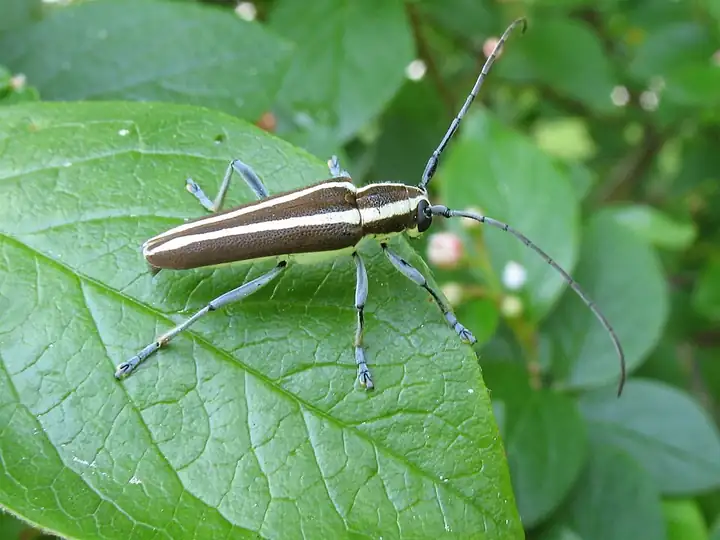
Roundheaded appletree borer
Saperda candida
| Type | Insect |
|---|---|
| When | Adults June through August; grubs feed inside the trunk year-round |
| Pressure by region | High pressure: Northeast, Midwest |
About
A native longhorned beetle about 3/4 inch long, with brown and white stripes down its back. Its grubs tunnel in the lower trunk of apple and its relatives, and one or two can kill a young tree.
Spotting it
Damage
Grubs tunnel in the trunk, mostly from about 6 inches above to 4 inches below the soil line. Signs are reddish-brown, stringy frass pushed out at the base, darkened or sap-stained bark, round exit holes about 1/4 inch across, and branch dieback. Trees 3 to 10 years old are most at risk, and damaged trees are more likely to break in the wind.
How to find it early
In August and September, check the lower 2 feet of the trunk for sap-stained spots where young grubs have just entered, and for frass piles at the base. Keep weeds and grass pulled back so you can see the bark.
When
Adults June through August; grubs feed inside the trunk year-round
Life cycle
One generation takes 2 to 3 years. Adults are out from about May into August, and each female lays about 40 eggs in the lower trunk; the grubs feed inside the trunk for 2 to 3 years and pupate in a chamber about 1/2 inch under the bark.
What to do, gentlest first
Start at the top. Sprays are a last step; always read and follow the product label.
Clear and paint the trunk base Prevent
Keep grass and weeds away from the trunk, and paint the lower 2 feet of young trunks with white latex paint mixed half and half with water. Before planting, remove neglected apple, crabapple and hawthorn trees within 100 to 200 yards if you can.
Use latex paint, not oil-based paint, which can harm the tree.
Worm out the grubs By hand
In August and September, make a shallow vertical cut through the bark at sap-stained spots to kill young grubs. For older grubs, push a flexible wire into active tunnels; April and early September are the best times.
Screen the lower trunk Barrier
Wrap the lower 2 to 3 feet of the trunk with insect screening or mosquito netting during June, July and August, when females are laying eggs.
Pyrethroid trunk spray Conventional spray
Missouri Extension lists trunk and lower-limb sprays of pyrethroids such as permethrin for home growers, applied in June and July.
Pyrethroids are highly toxic to bees, so spray only when bees are not active. Some guides also list neonicotinoids; skip them, because they are highly toxic to bees and turn up in pollen and nectar. Read and follow the label and the pre-harvest interval.
Plants it goes after
Apple (backyard tree), Flowering crabapple, Pear, Serviceberry (juneberry, saskatoon)
Pressure by region
Missouri Extension says it occurs throughout most of the U.S. and Canada, and UMass says it is found across the Northeast. UNH notes it is worst in backyard trees, young trees not yet bearing, and organic orchards. Ratings outside the Northeast are estimates.
| Northeast | High pressure |
|---|---|
| Southeast | Moderate |
| South Central | Low |
| Midwest | High pressure |
| Great Plains | Moderate |
| Mountain West | Low |
| Southwest | Low |
| Pacific Northwest | Low |
| California | Low |
| Alaska | Low |
| Hawaii | Low |
Ratings come from extension sources where available; some are estimates, as noted above.
Sources
- umass.edu
- extension.unh.edu
- extension.missouri.edu
- netreefruit.org
- extension.oregonstate.edu
- s3.wp.wsu.edu
Photo: Photo: Gilles Gonthier, CC BY 2.0, via Wikimedia Commons (CC BY 2.0). Photo resized for the web.

Planting dates and advice are general guidance; check with your local Cooperative Extension office for your area.