
Sweetpotato weevil
Cylas formicarius
| Type | Insect |
|---|---|
| When | Year-round in warm areas. |
| Pressure by region | High pressure: Southeast, South Central |
About
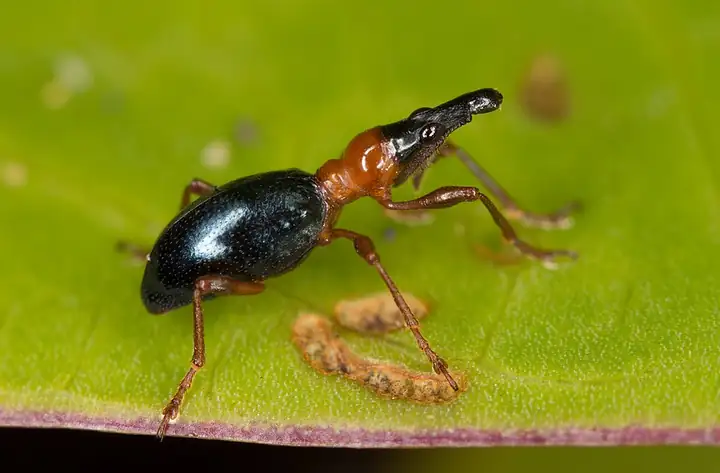
A slender, ant-like weevil about a quarter inch long, with a metallic blue-black body and an orange-red middle and legs. It is a serious sweet potato pest in the Gulf South and Hawaii, and several states regulate the movement of sweet potatoes to keep it from spreading.
Spotting it
Damage
Grubs tunnel through the stems and the roots, leaving them spongy and full of cavities, often followed by rot. Even light feeding makes the roots taste bitter and smell of terpenes, so they are not fit to eat.
How to find it early
Watch for small ant-like, blue-and-orange weevils on vines and roots, and cut open any roots with holes to look for tunnels and white, legless grubs.
When
Year-round in warm areas.
Life cycle
It does not go dormant in winter, so adults and grubs keep developing as long as there is food. A generation takes about 35 to 40 days in summer, giving about five generations a year in Texas and at least eight in Louisiana.
What to do, gentlest first
Start at the top. Sprays are a last step; always read and follow the product label.
Plant certified, weevil-free slips Prevent
Buy certified weevil-free slips, and do not bring sweet potatoes, vines or slips from infested areas; several states restrict moving them.
Check with your state department of agriculture before moving sweet potatoes or slips across state lines.
Rotate, clean up and keep soil moist Prevent
Plant away from last year's sweet potatoes, destroy volunteer plants and leftover roots after harvest, and water enough to keep the soil moist.
Try resistant varieties Prevent
LSU AgCenter suggests resistant varieties as an easy, low-cost step for home gardeners.
Pheromone traps Trap
Traps baited with the female sex pheromone catch males and show whether weevils are around. They are used for monitoring, not control.
Natural enemies Natural enemies
Parasitic wasps and ants take some weevils, and the fungus Beauveria bassiana kills many in humid weather. Insect-killing nematodes are another option.
Bifenthrin Conventional spray
Mississippi State lists bifenthrin for sweetpotato weevil in home gardens, with a 21-day wait before harvest.
Highly toxic to bees and it kills natural enemies. Follow the label and pre-harvest interval.
Plants it goes after
Pressure by region
Found along the coastal plain of the Southeast from North Carolina to Texas, and in Hawaii (UF/IFAS); in Texas it is mainly in the east. California keeps a quarantine against sweet potatoes, plants and slips from Alabama, Arkansas, Florida, Georgia, Hawaii, Louisiana, Mississippi, South Carolina, Tennessee, Texas and parts of North Carolina, and Louisiana, Mississippi and North Carolina run their own weevil-free certification programs. Regions outside the Southeast, South Central and Hawaii are rated low as estimates, not proof of absence.
| Northeast | Low |
|---|---|
| Southeast | High pressure |
| South Central | High pressure |
| Midwest | Low |
| Great Plains | Low |
| Mountain West | Low |
| Southwest | Low |
| Pacific Northwest | Low |
| California | Low |
| Alaska | Low |
| Hawaii | Moderate |
Ratings come from extension sources where available; some are estimates, as noted above.
Sources
- ask.ifas.ufl.edu
- lsuagcenter.com
- texasinsects.tamu.edu
- pi.cdfa.ca.gov
- ncagr.gov
- mdac.ms.gov
- extension.msstate.edu
- www3.ctahr.hawaii.edu
- s3.wp.wsu.edu
Photo: Photo: Graham Wise, CC BY 2.0, via Wikimedia Commons (CC BY 2.0). Photo resized for the web.

Planting dates and advice are general guidance; check with your local Cooperative Extension office for your area.