
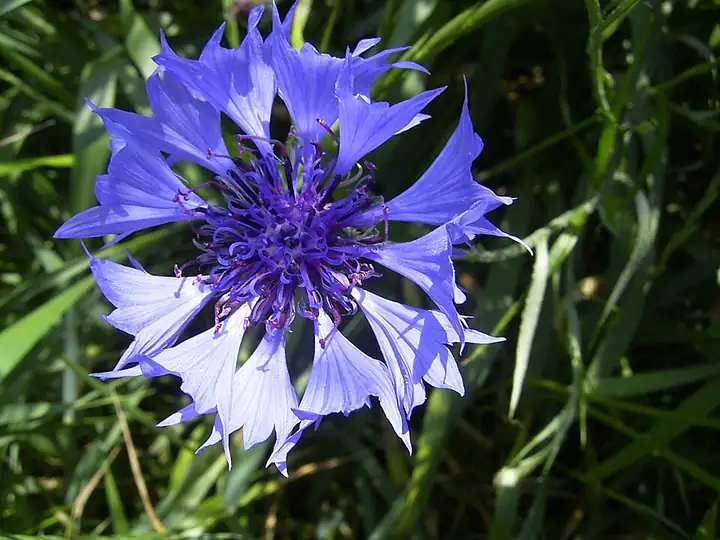
Bachelor's button (cornflower)
Centaurea cyanus · Daisy family (Asteraceae)
| Hardiness zones | 2 to 11 |
|---|---|
| Sun | full sun |
| Water | low |
| Life cycle | annual |
| Frost | Hardy: takes frost |
| Spacing | 6 to 12 inches |
About Bachelor's button (cornflower)
Bachelor's buttons are easy, cold-hardy annuals with fringed blue (also pink, white or maroon) flowers that are great for cutting and drying and draw butterflies and other pollinators. In Swiss field studies, cornflower nectar, including nectar from glands outside the flower, fed parasitic wasps that attack cabbage moth caterpillars. It reseeds freely and escapes into fields and roadsides: the Tennessee Invasive Plant Council and Georgia Exotic Pest Plant Council list it as invasive, so deadhead it and skip it near natural areas.
Grown as a hardy annual in every zone; in mild-winter areas it can be sown in fall (NC State). It is native to Europe and has naturalized across the US; Tennessee and Georgia invasive plant councils list it as invasive (Invasive Plant Atlas, TN-IPC).
When to plant
Timing is counted from your average last spring frost (and first fall frost). Sow & Tell works out the actual dates for your ZIP code.
- Start seeds indoors: 4 to 8 weeks before the last frost
Start indoors 4-8 weeks before the last frost (Purdue, NC State) or sow directly in spring; Cornell sows outdoors in late April in New York. In mild-winter climates, sow outdoors in fall (NC State). Too much shade makes stems flop.
Soil
Average, well-drained soil; it tolerates poor soil, clay and a wide pH range and needs no fertilizer (NC State, UF/IFAS).
Any well-drained soil works; it tolerates poor soil and needs no fertilizer (NC State).
Feeding
Rich soil and shade make stems flop; let too many flowers go to seed and it spreads beyond the garden (NC State).
Harvest
Deadhead or cut flowers often for more blooms and to keep plants from seeding everywhere (Illinois, NC State). Stems last well in a vase and dry nicely (Cornell, Purdue). Plants look tired by late season.
Good neighbors
Evidence is moderate but mixed: two years of Swiss field trials found cornflower strips raised parasitism of cabbage moth eggs and caterpillars and cut damage, but yield rose in only one year and the authors warn results vary (Balmer et al. 2014). No US extension trial we found tests it.
Pests to watch for
Aphids, Mealybugs
Diseases and problems
Rust, Root and crown rot
In the kitchen
The flowers are edible, with a mild spicy-sweet taste; use them fresh or dried for tea (UMN, NC State).
Keeping it: Pick edible flowers the day you use them; if you must hold them, keep them in a plastic bag in the fridge for a day or so.
Safety: Eat only flowers grown without pesticides, and try a little first, since some people react to edible flowers (UMN).
Pets: Non-toxic to dogs, cats and horses (ASPCA)
Sources
- plants.ces.ncsu.edu
- extension.illinois.edu
- purdue.edu
- hort.cornell.edu
- sfyl.ifas.ufl.edu
- extension.umn.edu
- aspca.org
- invasiveplantatlas.org
- tnipc.org
- gobotany.nativeplanttrust.org
- orgprints.org
- sciencedirect.com
Photo: Photo: TeunSpaans, CC BY-SA 3.0, via Wikimedia Commons (CC BY-SA 3.0). Photo resized for the web.

Planting dates and advice are general guidance; check with your local Cooperative Extension office for your area.