
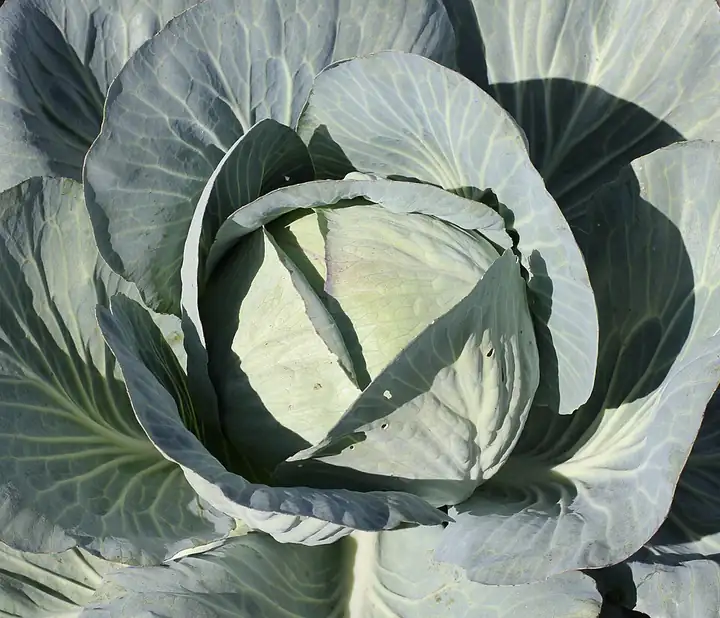
Cabbage
Brassica oleracea (Capitata group) · Cabbage family (Brassicaceae)
| Hardiness zones | 2 to 11 |
|---|---|
| Sun | full sun |
| Water | moderate |
| Life cycle | biennial |
| Frost | Hardy: takes frost |
| Soil pH | 6.0–7.0 |
| Spacing | 12 to 24 inches |
| Days to harvest | 60 to 100 days |
| Soil temperature to plant | at least 40°F |
About Cabbage
Cabbage forms a dense head of leaves and is one of the earliest crops you can set out in spring. A second crop started in midsummer heads up in the cool days of fall, often with better quality.
Grown as a cool-season annual in every zone; time it for the cool weather of spring or fall. Hardened plants take light frosts; protect them below about 25F.
When to plant
Timing is counted from your average last spring frost (and first fall frost). Sow & Tell works out the actual dates for your ZIP code.
- Start seeds indoors: 6 to 10 weeks before the last frost
- Set out plants: 2 to 4 weeks before the last frost
- Fall planting: 8 to 10 weeks before the first fall frost
Days count from transplanting; direct-seeded cabbage takes up to 3 weeks longer. The fall number is for setting out transplants, which are started 4 to 6 weeks earlier.
Soil
Fertile, well-drained soil that still holds moisture.
Work in compost or well-rotted manure and follow a soil test; without one, about 3 lb of 5-10-10 per 100 sq ft before planting, with soil pH about 5.8 to 6.5.
Feeding
- about 4 weeks after transplanting (or after thinning seeded plants): nitrogen fertilizer such as 21-0-0 or 46-0-0. Use about 1/2 cup of 21-0-0 per 10 ft of row (or 1/2 cup of 46-0-0 per 100 ft), spread in a band beside the row, scratch it in and water.
Do not add nitrogen once heads start to form; it causes loose heads and splitting.
Harvest
Cut heads when they are solid and firm to hand pressure, before they crack or split.
Cut the head above the outer leaves once it is firm and a usable size; the plant is then done.
Varieties (35)
| Variety | Type | Days | Notes |
|---|---|---|---|
| Tendersweet | Green | 71 days | Cabbage grown from transplants in Central Texas. |
| Blue Dynasty | Green (blue-green), hybrid | 75 days | Vigorous hybrid with round heads and good wrapper leaves. |
| Blue Vantage | Green (blue-green), hybrid | 75 days | Large heads with good wrapper leaves, short cores, and good holding ability. Resists black rot, yellows and tipburn. |
| Cheers | Green (blue-green), hybrid | Like Bravo but bluer and slightly flattened. Resists yellows and tolerates black rot, thrips and tipburn. | |
| Market Prize | Green (blue-green), hybrid | 76 days | Very uniform midseason blue-green heads. Resists fusarium yellows. |
| Rio Verde | Green (blue-green), hybrid | 85 days | Flattened head with somewhat wavy, blue-green leaves. |
| Greenboy | Green (gray-green), hybrid | 85 days | Mid-early, round heads for fresh use or sauerkraut. Tolerates yellows. |
| Charleston Wakefield | Green, pointed (conical) head | An heirloom with a cone-shaped head. | |
| Early Jersey Wakefield | Green, pointed (conical) head | 53 days | An heirloom with cone-shaped heads that matures early. |
| Caraflex | Green, pointed mini head, hybrid | 68 days | Small pointed heads that suit coleslaw, stir-fries and salads. |
| Danish Ballhead | Green, round head | 100 days | A late green cabbage. |
| Golden Acre | Green, round head | 58 days | An early green cabbage. A yellows-resistant strain is sold as Golden Acre YR. |
| Bravo | Green, round head, hybrid | 85 days | Large, uniform, round blue-green heads that have done well in winter in the southern U.S. Resists black rot and yellows. |
| Charmant | Green, round head, hybrid | Very early hybrid with a medium dark green, flattened round head. | |
| Early Thunder | Green, round head, hybrid | Mild texture and taste. Round, uniform heads that hold well in the field and are slow to bolt. | |
| Farao | Green, round head, hybrid | 62 to 64 days | Sweet. Early cabbage with dense heads that hold well in the field. Tolerates tipburn and thrips. |
| Heads Up | Green, round head, hybrid | 60 days | Early, uniform hybrid listed as resistant to fusarium yellows. |
| King Cole | Green, round head, hybrid | 78 days | Large 6 to 8 pound heads, round to slightly flat, with short cores and solid white interiors. Resists fusarium yellows. |
| Megaton | Green, round head, hybrid | High-yielding, vigorous processing-type cabbage with a large frame and short core. | |
| Quick Start | Green, round head, hybrid | Early, round, dark green hybrid with a short core that holds well in the field. | |
| Stonehead | Green, round head, hybrid | A hybrid green cabbage on Kansas State's recommended list. | |
| Dynamo | Green, small head, hybrid | 70 days | Early variety with small heads. Resists fusarium yellows. |
| Gonzales | Green, small head, hybrid | Very early hybrid with small (mini) heads. | |
| Mammoth Red Rock | Red | 100 days | A late red cabbage. |
| Red Acre | Red | Small, solid, round, dark red heads with good wrapper leaves. Stands well in the garden without splitting. | |
| Red Express | Red | A small red cabbage suited to home gardens. | |
| Red Dynasty | Red, hybrid | 75 to 76 days | Red hybrid with medium, round heads and good inside color. |
| Red Rookie | Red, hybrid | Medium-dark red hybrid with a flattened round head. | |
| Ruby Ball | Red, hybrid | 70 to 78 days | Early red hybrid with round, solid heads. Tolerates tipburn. |
| Ruby Perfection | Red, hybrid | Medium, round, dark red heads with nice wrapper leaves. Resists yellows and tolerates black rot and tipburn. | |
| Super Red 80 | Red, hybrid | 82 days | Medium dark red, midseason hybrid. |
| Famosa | Savoy | 75 days | Sweet, tender heart. Savoy cabbage with crinkled leaves. |
| Savoy Ace | Savoy, hybrid | 78 to 80 days | Medium-large, crinkled, blue-green heads. Has field resistance to yellows. |
| Savoy Express | Savoy, hybrid | 55 days | Small heads on compact plants with few wrapper leaves. |
| Savoy King | Savoy, hybrid | 90 days | Vigorous hybrid with semi-flat heads of about 4 pounds. Resists heat and black rot. |
Good neighbors
Onion, Marigold, Nasturtium, Lettuce
UMN Extension cites research where onion, marigold and nasturtium plantings reduced cabbage worm damage; results vary, and lettuce is simply a good space-filler.
Pests to watch for
Imported cabbageworm, Cabbage looper, Flea beetles, Aphids, Cutworms, Whiteflies, Slugs, Harlequin bug, Mole crickets, Red imported fire ant, Swede midge, Bagrada bug, Beet armyworm, Cabbage maggot, Seedcorn maggot, Diamondback moth, Fungus gnats, Rabbits, Voles
Diseases and problems
Black rot, Clubroot, Alternaria leaf spot, Fusarium yellows, Blackleg (Phoma), Edema (oedema), Transplant shock, Too little light (leggy plants), Bolting (going to seed), Nitrogen deficiency, Black walnut toxicity, Nutrient deficiency, Tipburn, Verticillium wilt, Downy mildew, Damping-off, White mold, White rust, Sooty mold, Curly top, Turnip mosaic
In the kitchen
Eaten raw in slaw, cooked in soups and stir-fries, or fermented into sauerkraut and kimchi.
Keeping it: Wrap heads tightly and keep them in the refrigerator crisper; in a cold, humid cellar, solid heads can last for months.
Pets: Not listed as toxic by the ASPCA
Sources
- extension.umn.edu
- extension.illinois.edu
- extension.unh.edu
- monroe.cce.cornell.edu
- extension.colostate.edu
- warren.cce.cornell.edu
- extension.umn.edu
- extension.umd.edu
- cochrane.org
- extension.usu.edu
- hgic.clemson.edu
Photo: Photo: George Chernilevsky, Public domain, via Wikimedia Commons. Photo resized for the web.

Planting dates and advice are general guidance; check with your local Cooperative Extension office for your area.