
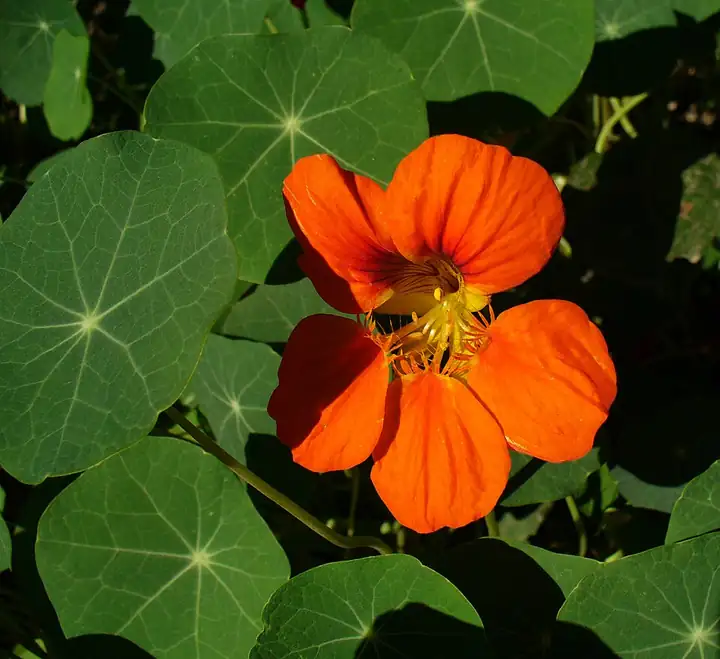
Nasturtium
Tropaeolum majus · Nasturtium family (Tropaeolaceae)
| Hardiness zones | 2 to 11 |
|---|---|
| Sun | full sun to part shade |
| Water | low |
| Life cycle | annual |
| Frost | Tender: killed by frost |
| Spacing | 10 to 12 inches |
About Nasturtium
Nasturtiums are fast, easy annuals with round leaves and bright orange, red or yellow flowers, in bushy or trailing forms. Leaves and flowers are edible with a peppery bite, and plants bloom best in lean soil.
Grown as a warm-season annual in every zone (NC State lists 2-11); frost kills it.
When to plant
Timing is counted from your average last spring frost (and first fall frost). Sow & Tell works out the actual dates for your ZIP code.
- Start seeds indoors: 4 to 6 weeks before the last frost
- Set out plants: up to 2 weeks after the last frost
- Sow seeds outdoors: up to 4 weeks after the last frost
Sow 1/2 inch deep outdoors in late spring once all danger of frost has passed, or start indoors 4-6 weeks earlier. Soaking seed a few hours or overnight helps; seedlings appear in 7-10 days and need darkness to sprout.
Soil
Well-drained, even poor soil; heavy feeding gives lots of leaves and fewer flowers.
Plant in full sun in well-drained soil; do not enrich it, since poor soil gives more flowers.
Feeding
Do not fertilize unless the soil is extremely poor: feeding gives more leaves but fewer flowers.
Harvest
Pick young leaves and flowers for eating; older leaves can be bitter.
Varieties (23)
| Variety | Type | Days | Notes |
|---|---|---|---|
| Alaska | Bush / dwarf | Edible. Nasturtium leaves and flowers have a peppery, watercress-like taste that gets spicier in hot, sunny weather (species-level note). About 12 in tall with leaves heavily marbled cream-white and single flowers in cherry, crimson, orange, salmon and yellow. | |
| Baby series | Bush / dwarf | Edible. Nasturtium leaves and flowers have a peppery, watercress-like taste that gets spicier in hot, sunny weather (species-level note). Dwarf plants with dark green leaves; gold, red, rose and yellow. | |
| Black Velvet | Bush / dwarf | Edible. Nasturtium leaves and flowers have a peppery, watercress-like taste that gets spicier in hot, sunny weather (species-level note). Compact, about 8 in, with deep maroon single flowers. | |
| Cherry Rose Jewel | Bush / dwarf | Edible. NC State says the leaves, flowers and seeds have a spicy, peppery taste (species-level note). Compact 12-18 in plants with rose, semi-double flowers. | |
| Empress of India | Bush / dwarf | Edible. Nasturtium leaves and flowers have a peppery, watercress-like taste that gets spicier in hot, sunny weather (species-level note). Compact, about 12 in, with dark foliage and bright crimson single flowers. | |
| Hermine Grasshof | Bush / dwarf | Edible. NC State says the leaves, flowers and seeds have a spicy, peppery taste (species-level note). Compact 9-12 in plants with double red flowers. | |
| Jewel series | Bush / dwarf | Edible. Nasturtium leaves and flowers have a peppery, watercress-like taste that gets spicier in hot, sunny weather (species-level note). Bushy dwarf plants with single, fluted flowers in red, pink, yellow and orange. | |
| Peach Melba | Bush / dwarf | Edible. Nasturtium leaves and flowers have a peppery, watercress-like taste that gets spicier in hot, sunny weather (species-level note). Dwarf plants with cream-yellow flowers blotched orange-red at the throat. | |
| Salmon Baby | Bush / dwarf | Edible. NC State says the leaves, flowers and seeds have a spicy, peppery taste (species-level note). Compact, about 12 in, with fringed salmon-pink flowers. | |
| Strawberries and Cream | Bush / dwarf | Edible. NC State says the leaves, flowers and seeds have a spicy, peppery taste (species-level note). Compact 9-12 in plants with yellow flowers blotched red. | |
| Strawberry Ice | Bush / dwarf | Edible. NC State says the leaves, flowers and seeds have a spicy, peppery taste (species-level note). Compact, about 9 in, with gold flowers blotched red over bluish leaves. | |
| Tip Top Alaska series | Bush / dwarf | Edible. Nasturtium leaves and flowers have a peppery, watercress-like taste that gets spicier in hot, sunny weather (species-level note). Early-blooming Alaska type with more even leaf variegation; salmon, scarlet and red shades. | |
| Tip Top series | Bush / dwarf | Edible. Nasturtium leaves and flowers have a peppery, watercress-like taste that gets spicier in hot, sunny weather (species-level note). Early-blooming, about 8-10 in tall; apricot, gold and scarlet. | |
| Tom Thumb | Bush / dwarf | Edible. Nasturtium leaves and flowers have a peppery, watercress-like taste that gets spicier in hot, sunny weather (species-level note). Very compact, 6-10 in, with large yellow, red and orange flowers. | |
| Vesuvius | Bush / dwarf | Edible. Nasturtium leaves and flowers have a peppery, watercress-like taste that gets spicier in hot, sunny weather (species-level note). Compact 10-12 in plants with salmon-orange flowers. | |
| Whirlybird series | Bush / dwarf | Edible. Nasturtium leaves and flowers have a peppery, watercress-like taste that gets spicier in hot, sunny weather (species-level note). Compact 9-18 in plants with semi-double flowers that lack the usual spur; mahogany, orange, rose, salmon, yellow and cream. | |
| Jewel of Africa | Climbing | Edible. Nasturtium leaves and flowers have a peppery, watercress-like taste that gets spicier in hot, sunny weather (species-level note). Climbing or trailing, up to about 8 ft, with white-marbled leaves and red, yellow, orange and cream flowers. | |
| Moonlight | Climbing | Edible. NC State says the leaves, flowers and seeds have a spicy, peppery taste (species-level note). Vining up to about 6 ft with pale yellow flowers. | |
| Canary creeper | Climbing (related species, Tropaeolum peregrinum) | Fast vine climbing 8-12 ft with fringed bright yellow flowers and five-lobed leaves. | |
| Double Gleam | Trailing / semi-trailing | Edible. NC State says the leaves, flowers and seeds have a spicy, peppery taste (species-level note). Semi-trailing plants with semi-double flowers in mixed colors. | |
| Kaleidoscope Mix | Trailing / semi-trailing | Edible. Nasturtium leaves and flowers have a peppery, watercress-like taste that gets spicier in hot, sunny weather (species-level note). Trailing to about 16 in with single flowers in cream, orange, red, rose and yellow. | |
| Troika series | Trailing / semi-trailing | Edible. Nasturtium leaves and flowers have a peppery, watercress-like taste that gets spicier in hot, sunny weather (species-level note). Trailing plants spreading 3-4 ft with variegated leaves and large single flowers in cream, orange, red, maroon and gold. | |
| Vintage | Trailing / semi-trailing | Edible. Nasturtium leaves and flowers have a peppery, watercress-like taste that gets spicier in hot, sunny weather (species-level note). About 1 ft tall and 3-4 ft wide with large double flowers in cherry, ivory, orange, red and bicolors. |
Good neighbors
Zucchini and summer squash, Winter squash and pumpkin, Broccoli
Research supports the old practice of planting nasturtium with squash to reduce squash bugs, and in an Iowa study nasturtium with thyme and onion reduced caterpillar damage on broccoli (University of Minnesota Extension).
Pests to watch for
Aphids, Imported cabbageworm, Whiteflies, Leafminers
Diseases and problems
Bacterial wilt
In the kitchen
All parts but the roots are edible; leaves and flowers add a peppery, watercress-like flavor to salads.
Keeping it: Pick flowers and leaves just before using; they wilt quickly.
Pets: Not toxic to dogs, cats or horses (ASPCA)
Sources
Photo: Photo: George Chernilevsky, Public domain, via Wikimedia Commons. Photo resized for the web.

Planting dates and advice are general guidance; check with your local Cooperative Extension office for your area.