
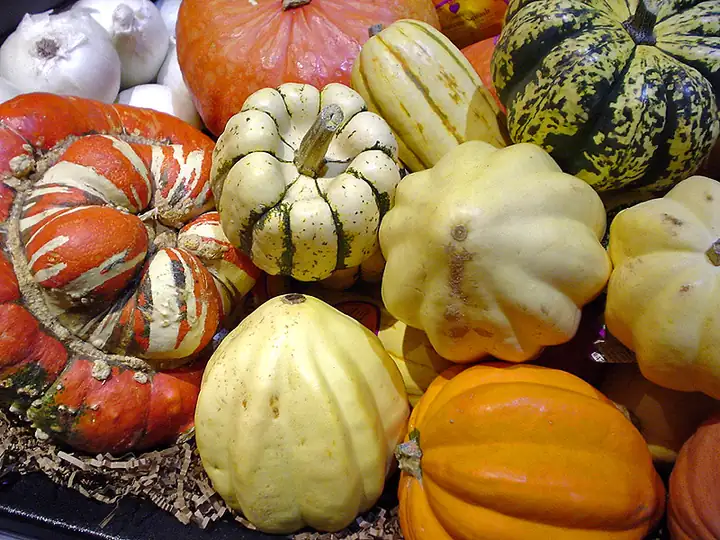
Winter squash and pumpkin
Cucurbita maxima, C. moschata and C. pepo · Gourd family (Cucurbitaceae)
| Hardiness zones | 3 to 11 |
|---|---|
| Sun | full sun |
| Water | moderate |
| Life cycle | annual |
| Frost | Tender: killed by frost |
| Soil pH | 6.0–6.5 |
| Spacing | 24 to 36 inches |
| Days to harvest | 80 to 100 days |
| Soil temperature to plant | at least 65°F |
About Winter squash and pumpkin
Winter squash, including pumpkins, butternut, acorn and Hubbard, are harvested mature with a hard rind and can be stored for months. Vining types need a lot of room and a long warm season.
Grown as a warm-season annual in every zone; it is killed by frost, so plant it out after the danger of frost has passed.
When to plant
Timing is counted from your average last spring frost (and first fall frost). Sow & Tell works out the actual dates for your ZIP code.
- Start seeds indoors: 2 to 4 weeks before the last frost
- Set out plants: 2 to 3 weeks after the last frost
- Sow seeds outdoors: 2 to 3 weeks after the last frost
Days count from seeding; many large pumpkins and some winter squash take over 100 days. Fruit matures about 45 to 55 days after its flower is pollinated. Allow 5 to 6 feet between rows for vining types.
Soil
Moisture-retentive but well-drained soil; they do well in heavier soils.
Follow a soil test and keep pH about 6.0 to 6.5; work in up to 2 inches of compost, or without a test about 4 to 6 cups of balanced fertilizer such as 10-10-10 per 100 sq ft.
Feeding
- when the vines start to run and spread out: nitrogen fertilizer such as 21-0-0 or 46-0-0. Use about 3 to 4 Tbsp of 21-0-0 per plant (or 1/2 cup of 46-0-0 per 100 ft of row) beside the plants and water it in.
- when the first blooms appear: nitrogen fertilizer such as calcium nitrate (15.5-0-0). Use about 2 lb per 100 ft of row, 6 to 8 inches from the plants on both sides, and water it in.
- about 3 weeks after flowering starts: nitrogen fertilizer such as 21-0-0. Use about 1 1/2 lb per 100 ft of row beside the plants and water it in.
Too much nitrogen gives long vines and fewer squash; skip extra phosphorus unless a soil test calls for it.
Harvest
Harvest before a hard freeze once the rind has a deep, solid color and your fingernail cannot scratch it, leaving a few inches of stem. Cure 1 to 2 weeks in dry, sunny weather (or indoors near 80F), then store around 50 to 55F.
Harvest the fruit once at the end of the season, before a hard freeze; a light frost that kills the vines usually doesn't hurt the squash.
Varieties (64)
| Variety | Type | Days | Notes |
|---|---|---|---|
| Royal Acorn | Acorn | 70 days | |
| Cream of the Crop | Acorn (C. pepo) | Mild flavor. Bush plant with cream-colored rind that turns bright yellow in storage and cream flesh; stores 4 to 5 months. | |
| Ebony | Acorn (C. pepo) | 100 days | Glossy, dark green acorn squash, sized between Table Queen and Royal Acorn. |
| Table King | Acorn (C. pepo) | 75 days | Early, bush-type acorn with regular-size fruit and a small seed cavity. |
| Table Queen | Acorn (C. pepo) | 80 to 90 days | Tender, sweet and dry, with pale orange flesh. Grooved, dark greenish-black acorn squash on vigorous, heavy-producing vines. |
| Honey Bear | Acorn (C. pepo), hybrid | 85 to 100 days | Sweet when cooked. Compact bush about 2 to 3 feet tall with dark green fruit around 1 pound each. Tolerates powdery mildew. |
| Table Ace | Acorn (C. pepo), hybrid | Very productive semi-bush plant that sends out short runners later in the season. | |
| Carnival | Acorn type (C. pepo) | 95 days | Semi-bush plant with striped, multicolored acorn-type fruit. |
| Burpee's Butterbush | Bush butternut (C. moschata) | Deep reddish-orange flesh of high quality. Small butternut-shaped fruit on a compact plant with very short stems between leaves. | |
| Sweet Mama | Buttercup | ||
| Burgess Buttercup | Buttercup (C. maxima) | 95 days | |
| Bonbon | Buttercup (C. maxima), hybrid | 95 days | Bred for improved taste over other buttercups. Fruit averages 4 to 5 pounds, about four per plant. |
| Butterbaby | Butternut | 100 days | Cornell lists powdery mildew resistance. |
| Ponca | Butternut | Butternut with uniform fruit, similar to Waltham. | |
| Early Butternut | Butternut (C. moschata), hybrid | Early butternut without a crooked neck on a medium-length vine; an All-America Selections winner. | |
| Honeynut | Butternut (C. moschata), hybrid | Cornell lists powdery mildew resistance. | |
| Waltham Butternut | Butternut (Cucurbita moschata) | 95 to 105 days | Bred for better flavor than older butternuts. Uniform butternut with large fruit and a small seed cavity. An All-America Selections winner. |
| Autumn Gold | Carving pumpkin (C. pepo) | Medium fruit of about 7 to 10 pounds that turns orange early. | |
| Jack O'Lantern | Carving pumpkin (C. pepo) | 110 days | Medium-size pumpkin, a bit taller than round. |
| Magic Lantern | Carving pumpkin (C. pepo), hybrid | Round, dark orange fruit around 18 pounds on a semi-vining plant. Resists powdery mildew. | |
| Spirit | Carving pumpkin (C. pepo), hybrid | Semi-bush plant with fruit of about 10 to 15 pounds. | |
| Cornell's Bush Delicata | Delicata (C. pepo) | 80 days | Sweet and nutty, fine-textured flesh without coarse strings. Compact, open-pollinated plant with cream fruit striped in green. Resists powdery mildew; keeps about 100 days. |
| Delicata | Delicata (C. pepo) | 98 to 100 days | Very sweet orange flesh. Cream fruit with dark green stripes, about 7 to 8 inches long and 1.5 to 2 pounds, on short vines. |
| Sweet Dumpling | Dumpling/delicata type (C. pepo) | 100 days | Very sweet, tender orange flesh. Small, round, flat-topped fruit about 4 inches across, ivory with dark green stripes, on medium vines. Stores 3 to 4 months. |
| Rouge Vif d'Etampes | French heirloom pumpkin (C. maxima) | 115 days | Flattened, bright red-orange fruit of about 10 to 15 pounds. |
| Dill's Atlantic Giant | Giant (contest) pumpkin (C. maxima) | 115 days | Grown for size; fruit commonly reaches 50 to 100 pounds and can get much larger. |
| Big Max | Giant pumpkin (C. maxima) | 120 days | Good for cooking. Pinkish-orange fruit that can pass 100 pounds. |
| Blue Hubbard | Hubbard (C. maxima) | Large, hard-rinded Hubbard squash. | |
| Golden Hubbard | Hubbard (C. maxima) | 105 days | Tasty, dry, deep orange flesh; good for pies. Large, red-orange, warty fruit about 10 pounds. Stores a long time. |
| Connecticut Field | Jack-o'-lantern pumpkin (C. pepo) | 105 to 120 days | Large, round, orange-yellow fruit of 15 to 25 pounds, flattened at the ends. |
| Howden | Jack-o'-lantern pumpkin (C. pepo) | 115 days | Uniformly large, deep orange fruit on long vines. Cornell lists resistance to black rot. |
| Sunshine | Kabocha (C. maxima), hybrid | 95 days | Vigorous plant with short vines. Cornell lists resistance to black rot. |
| Black Forest | Kabocha/buttercup type (C. maxima) | 95 days | Sweet, medium-dry, deep orange flesh; good for baking. Dark green, flat-round fruit without the button on the bottom; smaller than typical kabocha. |
| Jack Be Little | Miniature pumpkin (C. pepo) | 90 to 95 days | Tiny fruit of 3 to 4 ounces; each plant bears 8 to 10. |
| Munchkin | Miniature pumpkin (C. pepo) | 100 days | Small, light orange fruit about 2 to 3 inches across. |
| Wee-B-Little | Miniature pumpkin (C. pepo) | Small, round fruit about 3 inches across. | |
| Baby Boo | Miniature white pumpkin (C. pepo) | Flat, white fruit under 1 pound and 2 to 3 inches across; mostly ornamental. | |
| New England Pie | Pie pumpkin (C. pepo) | 105 days | Dark orange fruit of about 4 to 7 pounds. |
| Small Sugar | Pie pumpkin (C. pepo) | 95 to 110 days | Round, deep orange fruit of about 6 to 8 pounds, flattened at the ends. |
| Triple Treat | Pie pumpkin with hull-less seeds (C. pepo) | 110 days | Deep round, dark orange fruit of 8 to 10 pounds with seeds that have no hulls. |
| Big Moon | Pumpkin (giant) | Giant type that can produce fruit over 200 pounds. | |
| Prizewinner | Pumpkin (giant) | Late, round, reddish-orange pumpkin grown for contest size, 80 to 120 pounds. | |
| Aspen | Pumpkin (large carving) | Semi-bush vine with rich orange fruit around 20 pounds and large, sturdy handles. Stores and ships well. | |
| Gold Rush | Pumpkin (large) | 100 days | Deep orange, thick-walled, globe-shaped fruit of 30 to 40 pounds with large handles, on a big vine. |
| Aladdin | Pumpkin (large, hybrid) | Large, round-to-tall fruit about 12 inches wide and 15 inches tall, weighing 30 to 50 pounds. Tolerates powdery mildew. | |
| Merlin | Pumpkin (large, hybrid) | Semi-vining plant with dark orange fruit around 22 pounds and a large, dark green stem. Powdery mildew resistant. | |
| Jack of All Trades | Pumpkin (medium) | 90 days | Dark orange fruit of 9 to 12 pounds with good handles, on a very vigorous semi-bush plant. |
| Racer | Pumpkin (medium, hybrid) | 85 days | Blocky, ribbed, dark orange fruit of 12 to 18 pounds with big handles, on a short, vigorous vine. |
| Mystic | Pumpkin (medium-large) | Dark orange, thick-walled fruit of 15 to 25 pounds with sturdy handles. | |
| Lil' Ironsides | Pumpkin (mini, hybrid) | Small orange fruit about 2 pounds with a thick, hard shell. Resists Fusarium and Phytophthora fruit rots. | |
| Spookie | Pumpkin (small pie) | Small pumpkin bred to yield more and have a deeper shape than Small Sugar types. Used for pies and Halloween. | |
| Orange Smoothie | Pumpkin (small) | 90 days | Small, smooth pumpkin 8 to 10 inches across, good for painting. |
| Casper | Pumpkin (white) | Smooth, waxy white skin over dark orange flesh up to 1.5 inches thick; fruit 8 to 15 pounds. Cornell lists powdery mildew resistance. | |
| Cotton Candy | Pumpkin (white) | Round white pumpkin 5 to 12 pounds and 8 to 10 inches across, with a strong stem. | |
| Silver Moon | Pumpkin (white) | Flat-round white fruit of 10 to 15 pounds, 9 to 10 inches across. Cornell lists powdery mildew and zucchini yellow mosaic virus resistance. | |
| Valenciano | Pumpkin (white) | Flat-round white fruit with slight ribs, 8 to 10 pounds. | |
| Full Moon | Pumpkin (white, giant) | Round white pumpkin that can reach 60 to 90 pounds. | |
| Red Kuri | Red kuri (C. maxima) | 92 days | Open-pollinated, teardrop-shaped fruit of 4 to 7 pounds with a scarlet-orange rind and smooth flesh. |
| Baby Bear | Small pie pumpkin (C. pepo) | Deep orange, flattened fruit about 5 to 6 inches across and 1.5 to 2 pounds. | |
| Small Wonder | Spaghetti (hybrid) | 70 to 80 days | Single-serving spaghetti squash about 4 by 5 inches with orange skin. |
| Vegetable Spaghetti | Spaghetti squash (C. pepo) | 100 days | Open-pollinated; fruit turns from white to yellow when ripe and keeps well. The cooked flesh pulls apart into spaghetti-like strands. |
| Tivoli | Spaghetti squash (C. pepo), bush | Spaghetti squash on a bush-habit plant that may form short runners. | |
| Seminole | Tropical pumpkin | ||
| Lumina | White pumpkin (C. pepo) | White-skinned, flat-round fruit of about 10 to 15 pounds. |
Good neighbors
Sweet corn, Green beans (snap beans), Nasturtium, Marigold, Sweet alyssum
Squash is one of the Three Sisters with corn and beans; UMN Extension cites research that nasturtiums and marigolds reduce squash bugs and cucumber beetles, and that marigolds with sweet alyssum draw in aphid enemies.
Pests to watch for
Squash vine borer, Squash bug, Cucumber beetles, Aphids, Pickleworm, Corn earworm (tomato fruitworm), Whiteflies, Squash beetle, Corn rootworms, Garden symphylan, Seedcorn maggot, Melonworm, Groundhog (woodchuck)
Diseases and problems
Powdery mildew, Cucurbit viruses, Anthracnose, Angular leaf spot, Poor pollination, Ozone injury, Blossom end rot, Frost and freeze injury, Gummy stem blight, Verticillium wilt, Downy mildew, Bacterial wilt, Damping-off, White mold, Sooty mold, Cucumber mosaic, Zucchini yellow mosaic, Squash mosaic, Watermelon mosaic, Curly top, Tomato and tobacco ringspot
In the kitchen
Roasted, pureed into soups and pies, or stuffed; pumpkin seeds can be roasted as a snack.
Keeping it: Once cured, keep winter squash and pumpkins somewhere dry and airy at 50 to 55F, away from apples and pears. Acorn types keep about 1 to 2 months, butternut 2 to 3 months and Hubbard up to 6 months.
Pets: Listed as non-toxic to dogs, cats and horses (ASPCA, 'Acorn Squash', Cucurbita pepo, which also names pumpkin and zucchini).
Sources
- extension.umn.edu
- extension.illinois.edu
- extension.usu.edu
- extension.unh.edu
- extension.colostate.edu
- extension.umn.edu
- extension.umd.edu
- aspca.org
- ask.ifas.ufl.edu
- extension.usu.edu
- hgic.clemson.edu
- riley.k-state.edu
Photo: Photo: Californiacondor, CC BY-SA 3.0, via Wikimedia Commons (CC BY-SA 3.0). Photo resized for the web.

Planting dates and advice are general guidance; check with your local Cooperative Extension office for your area.