
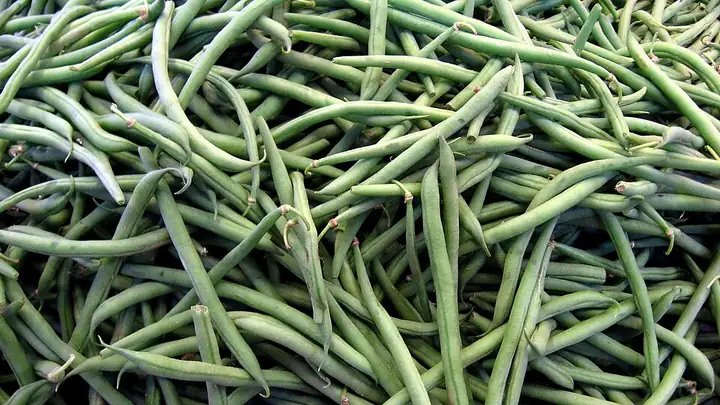
Green beans (snap beans)
Phaseolus vulgaris · Pea family (Fabaceae)
| Hardiness zones | 3 to 11 |
|---|---|
| Sun | full sun |
| Water | moderate |
| Life cycle | annual |
| Frost | Tender: killed by frost |
| Soil pH | 6.0–7.0 |
| Spacing | 4 to 6 inches |
| Days to harvest | 50 to 70 days |
| Soil temperature to plant | at least 60°F |
About Green beans (snap beans)
Snap beans are easy, productive warm-season crops that come as compact bush types or climbing pole types. Like other legumes they fix their own nitrogen, so they need little fertilizer.
Grown as a warm-season annual in every zone; it is killed by frost, so plant it out after the danger of frost has passed.
When to plant
Timing is counted from your average last spring frost (and first fall frost). Sow & Tell works out the actual dates for your ZIP code.
- Sow seeds outdoors: up to 2 weeks after the last frost
- Fall planting: 10 to 12 weeks before the first fall frost
Days count from seeding: bush types about 50 to 60 days, pole types longer. Sow bush beans every 2 weeks until early August for a steady supply.
Soil
Well-drained clay or silt loam; seed rots in cold, wet soil.
Follow a soil test, keep pH about 6 to 7, and work compost (up to 1 inch) and any fertilizer into the top 6 inches; without a test, about 3 lb of 5-10-10 per 100 sq ft.
Feeding
- just before the first flowers, only if needed (sandy soil or after heavy rains): nitrogen fertilizer such as 34-0-0 or calcium nitrate (15.5-0-0). Use about 1 lb of 34-0-0 or 2 lb of calcium nitrate per 100 ft of row beside the plants and water it in; beds fed at planting usually need nothing more.
Too much nitrogen gives lots of leaves, delays flowering and cuts pod set.
Harvest
Pick when pods snap cleanly and before the seeds bulge through the pod. Avoid picking when leaves are wet, which spreads disease.
Pole beans keep flowering and bearing until frost; bush beans set most of their crop in a shorter burst but keep going longer if picked regularly. Pick often while pods are tender, and sow bush beans every 2 weeks until early August for a longer harvest.
Varieties (48)
| Variety | Type | Days | Notes |
|---|---|---|---|
| Dragon Tongue (Dragon's Tongue) | Bush | 57 days | A bush bean on Kentucky's recommended list. |
| Compass | Bush, filet (French) | 54 days | Good flavor. Slim, smooth, attractive filet pods. |
| Maxibel | Bush, filet (French) | 60 days | Long, thin French-style filet pods on a bush plant. |
| Blue Lake 274 | Bush, green | 58 days | High-yielding bush bean with pods like the pole Blue Lake types. Resists bean common mosaic virus. |
| Bronco | Bush, green | 53 days | Open-pollinated bean with straight, slender, dark, shiny pods. Resists bean common mosaic virus. |
| Bush Blue Lake 47 | Bush, green | Upright bush with Blue Lake-type pods and good yields. | |
| Caprice | Bush, green | 56 days | Upright plants set many medium dark green pods about 5.5 inches long. Pods are straight, smooth and slow to get seedy. |
| Contender | Bush, green | 55 days | Very early bush bean with long, round to slightly oval pods, from the USDA Southeastern Vegetable Breeding Laboratory. Resists bean common mosaic and powdery mildew. |
| Derby | Bush, green | 57 days | Strong, upright plants with long pods. An All-America Selections winner with bean mosaic virus resistance. |
| Harvester | Bush, green | Erect plant with long, slender, smooth pods and high yields. | |
| Improved Tendergreen | Bush, green | A taller plant with slightly longer pods than Tendergreen. Resists bean mosaic. | |
| Jade | Bush, green | 53 days | Large upright bush with round green pods about 6 to 7 inches long. Resists bean common mosaic and curly top virus. |
| Labrador | Bush, green | Very dark green pods that are fairly straight and smooth. Germinates well. | |
| Lewis | Bush, green | 53 days | Dark green pods on upright plants. Heavy yielding and easy to pick. |
| Podsquad | Bush, green | Open-pollinated, very high-yielding bean with long, slender pods. | |
| Provider | Bush, green | Very early, high-yielding bush bean from the USDA lab in Charleston, S.C. Resists bean common mosaic and bean pod mottle viruses. | |
| Strike | Bush, green | 45 days | Smooth, slender pods. Resists bean mosaic viruses. |
| Tendercrop | Bush, green | 54 days | Straight, slender, dark green pods. A USDA release that resists common mosaic and pod mottle virus. |
| Topcrop | Bush, green | 50 days | Early, high-yielding bush bean that sets pods over a short window. A USDA release with mosaic and pod mottle virus resistance. |
| Valentino | Bush, green | Medium dark green, round pods about 5 to 6 inches long. | |
| Xera | Bush, green | Heat-tolerant bush bean with large, attractive pods about 5 to 6 inches long. | |
| Greencrop | Bush, green (flat pod) | 50 days | Long, flat green pods that mature at about the same time. |
| Slenderette | Bush, green (slim pod) | 53 days | Slim, straight, dark green pods. Resists bean common mosaic. |
| Royal Burgundy | Bush, purple | Purple-podded bush bean, a stronger grower than Royalty. Resists bean mosaic viruses. | |
| Royalty Purple Pod | Bush, purple | Stringless purple pods that turn green when cooked, from the University of New Hampshire. Resists Mexican bean beetle. | |
| Roma II | Bush, Romano (flat pod) | 59 to 60 days | A bush Romano bean with wide, flat pods. Resists bean common mosaic and rust. |
| Romano (Bush Romano) | Bush, Romano (flat pod) | 50 days | Wide, flat Romano-type pods on a bush plant. Tolerates bean common mosaic. |
| Borsalino | Bush, yellow filet | 60 days | Sturdy, compact plants give good yields of tender, straight yellow pods. |
| Cherokee Wax | Bush, yellow wax | High-yielding wax bean with well-colored pods. | |
| Custard | Bush, yellow wax | 55 days | Slender, bright yellow pods produced over a long period on upright plants. |
| Gold Rush | Bush, yellow wax | Open-pollinated early to midseason wax bean with long pods. | |
| Goldcrop | Bush, yellow wax | 55 days | Upright bush that holds its long, straight, slender yellow pods high. Resists bean common mosaic and curly top virus. |
| Goldkist | Bush, yellow wax | 55 to 59 days | Full-season slender wax bean with pods about 5.5 to 6 inches long on a large, upright bush. |
| Improved Golden Wax | Bush, yellow wax | 52 days | A yellow wax bean recommended by Texas A&M. |
| Pencil Pod Black Wax | Bush, yellow wax | 53 days | A yellow wax bean recommended by Texas A&M. |
| State Half Runner | Half-runner (semi-pole) | 52 days | A half-runner (semi-pole) bean on Kentucky, LSU and UGA lists. |
| Volunteer | Half-runner (semi-pole) | 60 days | A vigorous half-runner. Resists rust and bean common mosaic. |
| White Half Runner | Half-runner (semi-pole) | Very prolific. Vines reach 20 to 30 inches with short runners and pods about 3.5 to 4 inches long. | |
| Blue Lake (pole) | Pole, green | 63 days | Long, straight pods on climbing vines. |
| Dade | Pole, green | 65 days | Vigorous, high-yielding pole bean with long, straight pods. |
| Fortex | Pole, green | 60 days | Nutty flavor. Stringless pods grow over 10 inches long. Vigorous vines keep producing through summer. |
| Kentucky Blue | Pole, green | 58 to 65 days | Round green pods about 6 to 8 inches long. Resists bean common mosaic virus; a 1991 All-America Selections winner. |
| Kentucky Wonder | Pole, green | 60 days | A classic pole snap bean recommended by many southern and plains states. |
| McCaslan | Pole, green | 61 days | Heirloom pole bean recommended for Texas and Louisiana gardens. |
| Rattlesnake | Pole, green with purple streaks | An heirloom pole bean with purple-streaked green pods about 7 inches long that curl; seeds are buff with dark stripes. | |
| Carminat | Pole, purple | 62 days | Slightly sweet. Velvety purple pods about 8 inches long, slender and tender. |
| Louisiana Purple Pod | Pole, purple | 75 days | Heirloom purple-podded pole bean recommended for Central Texas. |
| Romano Gold | Pole, Romano, yellow | 60 days | A yellow, flat-podded Romano pole bean. |
Good neighbors
Sweet corn, Winter squash and pumpkin
The Three Sisters planting of corn, beans and squash is an Indigenous practice described by UMN and UMD Extension; beans climb the corn and add nitrogen.
Pests to watch for
Mexican bean beetle, Japanese beetle, Aphids, Twospotted spider mite, Cutworms, Stink bugs, Root-knot nematodes, Corn earworm (tomato fruitworm), Cabbage looper, Flea beetles, Whiteflies, Leafminers, Grasshoppers, Harlequin bug, Tarnished plant bug, Potato leafhopper, Pillbugs and sowbugs, Leafhoppers, Mice (house mice and deer mice), Red imported fire ant, Broad mite, Cowpea curculio, Rose chafer, Beet armyworm, European corn borer, Bean leaf beetle, Seedcorn maggot, Leaffooted bugs, Blister beetles, Deer, Groundhog (woodchuck)
Diseases and problems
Bacterial blight, White mold, Bean viruses, Rust, Heat stress (blossom drop), Ozone injury, Herbicide injury, Frost and freeze injury, Tomato yellow leaf curl, Bean common mosaic, Powdery mildew, Gray mold (Botrytis), Southern blight, Sooty mold, Cucumber mosaic, Curly top, Tomato and tobacco ringspot, Alfalfa mosaic
In the kitchen
Steamed, sauteed, roasted or pickled; they also freeze and can well.
Keeping it: Refrigerate unwashed beans in an open bag and use within about 3 to 5 days.
Pets: Not listed as toxic by the ASPCA; its garden-safety tips name beans as fine snacks for pets in moderation.
Sources
- extension.umn.edu
- hgic.clemson.edu
- extension.unh.edu
- extension.colostate.edu
- yardandgarden.extension.iastate.edu
- warren.cce.cornell.edu
- extension.umn.edu
- extension.umd.edu
- extension.umd.edu
- extension.umn.edu
- aspca.org
- extension.usu.edu
Photo: Photo: 16:9clue, CC BY 2.0, via Wikimedia Commons (CC BY 2.0). Photo resized for the web.

Planting dates and advice are general guidance; check with your local Cooperative Extension office for your area.