
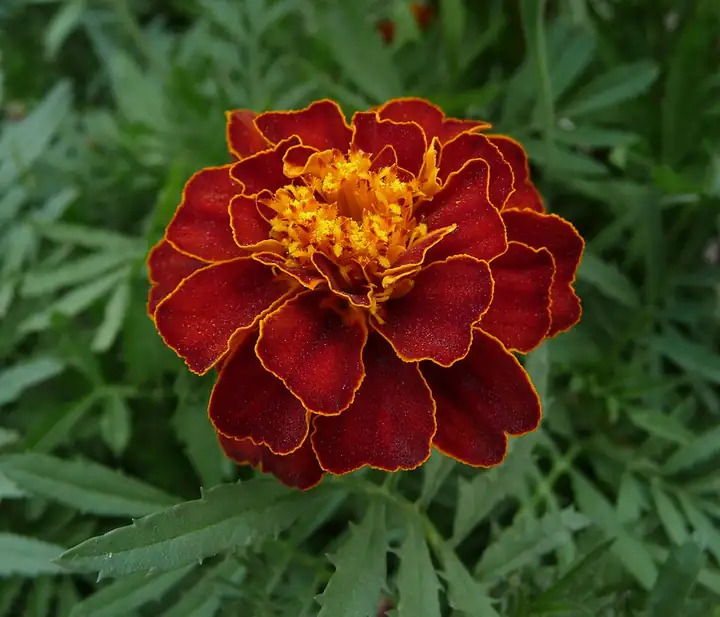
Marigold
Tagetes patula (French marigold) and T. erecta (African marigold) · Daisy family (Asteraceae)
| Hardiness zones | 2 to 11 |
|---|---|
| Sun | full sun |
| Water | moderate |
| Life cycle | annual |
| Frost | Tender: killed by frost |
| Spacing | 8 to 16 inches |
| Soil temperature to plant | at least 70°F |
About Marigold
Marigolds are cheerful, easy annuals from Mexico and Central America that bloom from early summer until frost. Their best-documented garden benefit is underground: a solid stand of living French marigold roots suppresses root-knot nematodes.
Grown as a summer annual in every zone; the first hard frost ends it.
When to plant
Timing is counted from your average last spring frost (and first fall frost). Sow & Tell works out the actual dates for your ZIP code.
- Start seeds indoors: 4 to 6 weeks before the last frost
- Set out plants: up to 2 weeks after the last frost
- Sow seeds outdoors: up to 2 weeks after the last frost
Seed sprouts in 7-14 days in soil around 70-75 F. To fight nematodes, grow a solid block of French marigolds for at least two months where next year's tomatoes or carrots will go; a few plants dotted among vegetables do not work.
Soil
Well-drained, evenly moist clay, loam or sandy soil.
Follow a soil test; work compost or other organic matter 6 inches deep, and aim for a pH of about 6 to 7 (below 5.5 can bronze the leaves).
Feeding
Marigolds are light feeders; too much fertilizer gives lots of leaves and fewer flowers.
Harvest
Deadhead spent flowers to keep plants blooming from late spring through fall.
Varieties (26)
| Variety | Type | Days | Notes |
|---|---|---|---|
| Antigua series | African marigold (Tagetes erecta) | Compact, mounded 12-16 in plants with 3 in double flowers in gold, orange, primrose and yellow. | |
| Big Duck Gold | African marigold (Tagetes erecta) | Compact 11-15 in plants with full, 3 in golden-yellow flowers; deep green leaves. | |
| BigTop series | African marigold (Tagetes erecta) | African marigold series; 'BigTop Yellow' was pictured among top trial performers. | |
| Crackerjack | African marigold (Tagetes erecta) | Open-pollinated mix about 3 ft tall with large gold, orange, primrose or yellow flowers; less uniform than hybrids. | |
| First Lady | African marigold (Tagetes erecta) | ||
| Inca II series | African marigold (Tagetes erecta) | Stocky 12-14 in hybrids with large, double flowers in gold, orange, primrose and yellow. | |
| Marvel II series | African marigold (Tagetes erecta) | Large flowers on well-branched, weather-resistant hybrid plants in gold, orange and yellow. | |
| Primrose Lady | African marigold (Tagetes erecta) | ||
| Proud Mari series | African marigold (Tagetes erecta) | African marigold series, including 'Proud Mari Gold'. | |
| Vanilla | African marigold (Tagetes erecta) | Hybrid African marigold with creamy-white flowers about 3 in across. | |
| Bonanza Bolero | French marigold (Tagetes patula) | ||
| Bonanza series | French marigold (Tagetes patula) | Compact 10-12 in plants with double, crested flowers; colors include 'Bee', 'Bolero', 'Harmony' and 'Flame'. | |
| Durango series | French marigold (Tagetes patula) | Well-branched 10-12 in plants with anemone-type flowers in gold, orange, red, tangerine and yellow. | |
| Hot Pak series | French marigold (Tagetes patula) | Very short plants, about 7 in tall, with gold, orange or yellow flowers. | |
| Janie series | French marigold (Tagetes patula) | Dwarf French marigold; NC State lists 'Janie Deep Orange' and 'Janie Spry'. | |
| Naughty Marietta | French marigold (Tagetes patula) | Open-pollinated French marigold with single yellow flowers marked with mahogany in the center. | |
| Queen Sophia | French marigold (Tagetes patula) | ||
| Safari series | French marigold (Tagetes patula) | About 14 in tall with 3 in anemone-type flowers in gold, orange, red, scarlet, tangerine and yellow. | |
| Single Gold | French marigold (Tagetes patula) | French marigold that builds a lot of plant mass, similar to 'Crackerjack'. | |
| Super Hero Spry | French marigold (Tagetes patula) | Bushy, mounded plants 10-12 in tall; crested flowers with dark maroon lower petals and golden upper petals. | |
| Tangerine | French marigold (Tagetes patula) | French marigold used in nematode studies rather than for its looks; sources give no size or flower details. | |
| Golden Gem | Signet marigold (Tagetes tenuifolia) | Edible flowers. NC State says some signet marigold cultivars have a pleasant, citrus-like flavor; use sparingly as a garnish. About 8 in tall with small, single golden flowers over fine, lemon-scented foliage. | |
| Lemon Gem | Signet marigold (Tagetes tenuifolia) | Edible flowers. NC State says some signet marigold cultivars have a pleasant, citrus-like flavor; use sparingly as a garnish. Low plants about 8 in tall with small single yellow flowers and ferny, lemon-scented leaves. | |
| Tangerine Gem | Signet marigold (Tagetes tenuifolia) | Edible flowers. NC State says some signet marigold cultivars have a pleasant, citrus-like flavor; use sparingly as a garnish. Signet marigold; sources give no size or color details. | |
| Polynema | Triploid hybrid (French x African) | Hybrid marigold selected for nematode work; sources give no size or color details. | |
| Zenith series | Triploid hybrid (French x African) | About 14 in tall with 2-3 in double flowers in deep orange, golden yellow, lemon yellow, red, and red-and-gold. |
Good neighbors
Tomato, Zucchini and summer squash, Winter squash and pumpkin
Studies found marigolds reduced thrips on tomatoes and squash bug and cucumber beetle damage on squash, but multiple studies show they do NOT deter Colorado potato beetles, and there is little support for deterring flea beetles (University of Minnesota Extension).
Pests to watch for
Twospotted spider mite, Thrips, Tarnished plant bug, Tobacco budworm (geranium or petunia budworm), Rabbits
Diseases and problems
Gray mold (Botrytis blight), Leaf spots, Stem and root rots, Powdery mildew, Crown gall, Aster yellows, Verticillium wilt, Bacterial wilt, White mold, Lettuce mosaic
In the kitchen
Safety: Sap on broken skin plus sunlight can cause redness, burning and blisters, and the scent can irritate the nose and eyes (NC State).
Pets: Not listed by the ASPCA (its 'marigold' entries are pot marigold, Calendula, which is non-toxic). Pet Poison Helpline rates Tagetes marigolds mildly toxic to dogs and cats: eating them may mildly upset the stomach, and the sap can irritate skin.
Sources
- plants.ces.ncsu.edu
- gardening.cornell.edu
- ask.ifas.ufl.edu
- extension.umn.edu
- aspca.org
- petpoisonhelpline.com
- hgic.clemson.edu
- extension.umn.edu
Photo: Photo: George Chernilevsky, Public domain, via Wikimedia Commons. Photo resized for the web.

Planting dates and advice are general guidance; check with your local Cooperative Extension office for your area.