
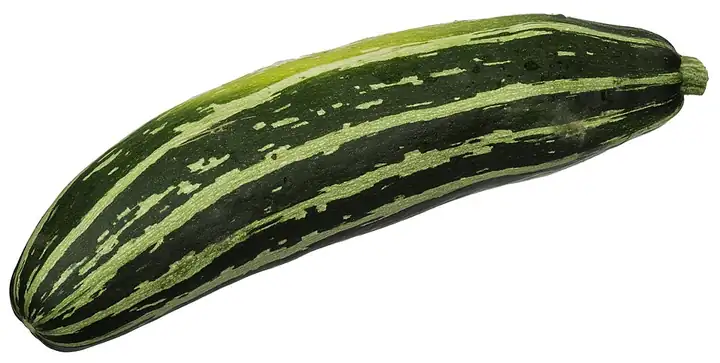
Zucchini and summer squash
Cucurbita pepo · Gourd family (Cucurbitaceae)
| Hardiness zones | 3 to 11 |
|---|---|
| Sun | full sun |
| Water | moderate |
| Life cycle | annual |
| Frost | Tender: killed by frost |
| Soil pH | 6.0–6.5 |
| Spacing | 24 to 36 inches |
| Days to harvest | 50 to 60 days |
| Soil temperature to plant | at least 70°F |
About Zucchini and summer squash
Zucchini and other summer squash, like yellow crookneck and pattypan, are picked young while the skin is still tender. A few plants produce plenty, as long as you keep picking.
Grown as a warm-season annual in every zone; it is killed by frost, so plant it out after the danger of frost has passed.
When to plant
Timing is counted from your average last spring frost (and first fall frost). Sow & Tell works out the actual dates for your ZIP code.
- Start seeds indoors: 2 to 4 weeks before the last frost
- Set out plants: 2 to 3 weeks after the last frost
- Sow seeds outdoors: 1 to 2 weeks after the last frost
- Fall planting: 11 to 12 weeks before the first fall frost
Days count from seeding. Sow about 1/2 inch deep once soil reaches 70F at 2 inches deep.
Soil
Moisture-retentive but well-drained soil; raised beds help drainage.
Have the soil tested and keep pH 6.0 to 6.5; work in compost or well-rotted manure, and add phosphorus and potassium only as the soil test says.
Feeding
- when plants begin to spread out their vines: nitrogen fertilizer such as 46-0-0 or 27-3-3. Use about 1/2 cup of 46-0-0 or 1 cup of 27-3-3 per 100 ft of row beside the plants and water it in.
- after plants flower and small fruits form: fertilizer as your soil test advises, such as a nitrogen fertilizer. Side-dress beside the plants and water it in.
Never use weed-and-feed products on vegetables, and skip extra phosphorus unless a soil test calls for it.
Harvest
Pick while small, before the seeds get large and the skin hardens; small 'baby' fruits are the most tender.
Pick often; leaving oversized fruit on the plant cuts yield, so remove big ones even if you won't use them. Plant again about 3 weeks later to extend the harvest.
Varieties (44)
| Variety | Type | Days | Notes |
|---|---|---|---|
| Zephyr | Bicolor yellow straightneck, hybrid | 54 days | Noted for good taste. Two-toned yellow fruit; high yielding on an open plant. |
| Goldfinger | Golden zucchini (hybrid) | 51 days | Golden, cylinder-shaped zucchini with a firm seed cavity. Leaves have light flecking. |
| Gold Rush | Golden zucchini, hybrid | 52 days | Early, uniform, productive zucchini with golden-yellow fruit. |
| Tromboncino | Green vining summer squash | 60 days | |
| Magda | Middle Eastern (cousa) type, hybrid | 48 days | Nutty and sweet. Pale green, blocky, tapered fruit, picked at 3 to 4 inches long. |
| Benning's Green Tint | Pattypan (scallop) | 55 days | |
| Peter Pan | Pattypan (scallop), green | Green, scalloped pattypan fruit. | |
| White Bush Scallop (Early White Bush) | Pattypan (scallop), white | 47 days | White, scalloped pattypan on a bush plant. |
| Sunburst | Pattypan (scallop), yellow, hybrid | 52 days | Yellow, scalloped pattypan fruit. Cornell lists powdery mildew resistance. |
| Costata Romanesco | Ribbed Italian zucchini (heirloom) | 52 days | Open-pollinated, strongly ribbed fruit in medium gray-green. Cornell lists powdery mildew resistance. |
| Eight Ball | Round zucchini, hybrid | 40 days | Round, dark green fruit about 2 to 3 inches across. Cornell lists resistance to powdery mildew and two mosaic viruses; an All-America Selections winner. |
| St. Patrick | Scallop (pattypan) | 55 days | |
| Cocozelle | Striped zucchini (heirloom) | Early and prolific, with light green fruit striped in dark green. | |
| Tatume | Summer squash (listed with zucchini) | 55 to 60 days | |
| Early Summer Crookneck | Yellow crookneck | Very early, productive bush with smooth, light lemon-yellow fruit. | |
| Horn of Plenty | Yellow crookneck (hybrid) | 43 to 45 days | Erect bush plant with smooth, bright yellow crookneck fruit. |
| Pavo | Yellow crookneck (hybrid) | 49 days | Early crookneck, a smoother-skinned version of Dixie. |
| Dixie | Yellow crookneck, hybrid | 45 to 50 days | Early, compact, prolific plants with lemon-yellow crookneck fruit. |
| Burpee's Butterstick | Yellow straightneck | 50 days | |
| Early Prolific Straightneck | Yellow straightneck | Very early, productive bush type with smooth, straight, light lemon-yellow fruit. | |
| Butterbar | Yellow straightneck (hybrid) | 49 days | Long, cylinder-shaped yellow fruit shaped like a zucchini; even the first fruits stay slim instead of bulging. |
| Lemondrop | Yellow straightneck (hybrid) | Early, uniform and productive straightneck. | |
| Smoothie | Yellow straightneck (hybrid) | 60 days | Deep lemon-yellow fruit that is very smooth and evenly cylinder-shaped. |
| Goldbar | Yellow straightneck, hybrid | Smooth, uniform, golden-yellow straight fruit on an upright, open bush. | |
| Multipik | Yellow straightneck, hybrid | 50 days | Heavy-yielding plant with mostly female flowers; the yellow fruit resists the green streaking caused by cucumber mosaic virus. |
| Supersett | Yellow summer squash (hybrid) | 50 days | Cornell lists resistance to CMV and watermelon mosaic virus 2. |
| Black Beauty | Zucchini (dark green) | 45 days | Early, productive zucchini with very dark green fruit. |
| Fordhook Zucchini | Zucchini (dark green) | Long, slender, blackish-green fruit borne heavily on bush plants. | |
| Ambassador | Zucchini (hybrid) | Very early zucchini with straight, cylinder-shaped fruit on an open, productive plant. Cornell lists powdery mildew resistance. | |
| Aristocrat | Zucchini (hybrid) | 53 days | Early hybrid with long, straight, medium green fruit on an open, heavy-bearing bush. |
| Cashflow | Zucchini (hybrid) | Medium green, high-yielding zucchini with tolerance to some strains of zucchini yellow mosaic virus. | |
| Elite | Zucchini (hybrid) | Long, straight, medium green fruit. Early and heavy-bearing on an open bush. | |
| Green Machine | Zucchini (hybrid) | Cornell lists resistance to CMV, downy and powdery mildew, watermelon mosaic virus and zucchini yellow mosaic virus. | |
| Hyzini | Zucchini (hybrid) | 45 days | Straight, blocky, dark green fruit on a plant a bit more open than Dark Green Zucchini. |
| Onyx | Zucchini (hybrid) | Early, open plant with shiny, very dark green fruit that looks almost black. | |
| President | Zucchini (hybrid) | Single-stem plant with smooth, dark green fruit about 8 inches long with light green flecks. | |
| Spineless Beauty | Zucchini (hybrid) | Medium green hybrid zucchini bred to be spineless. | |
| Storr's Green | Zucchini (hybrid) | 51 days | Dark green, cylinder-shaped fruit on a single-stem, open plant. |
| Sure Thing | Zucchini (hybrid) | 48 to 49 days | Medium-sized fruit that can set without pollination, so it keeps bearing in cool, cloudy weather. |
| Tigress | Zucchini (hybrid) | Long, cylinder-shaped, medium green fruit with high yields. Resistant to watermelon mosaic virus 2, papaya ringspot virus and zucchini yellow mosaic virus. | |
| Dunja | Zucchini, hybrid | Cornell lists resistance to powdery mildew and three viruses (papaya ringspot, watermelon mosaic and zucchini yellow mosaic). | |
| Raven | Zucchini, hybrid | 48 to 50 days | Very dark, glossy green, cylinder-shaped fruit about 7 to 8 inches long on an open plant. Cornell lists resistance to watermelon mosaic and zucchini yellow mosaic viruses. |
| Senator | Zucchini, hybrid | 41 days | Medium-size, open bush with glossy, light green, cylinder-shaped fruit; productive. |
| Blondie | Zucchini, pale yellow (hybrid) | 50 days | Hybrid with unusual pale yellow, long, cylinder-shaped fruit on an open bush. |
Good neighbors
Nasturtium, Marigold, Sweet alyssum
UMN Extension says research supports nasturtiums for fewer squash bugs, an Iowa study found nasturtiums and marigolds reduced squash bug and cucumber beetle damage, and marigolds with sweet alyssum drew in aphid enemies.
Pests to watch for
Squash vine borer, Squash bug, Cucumber beetles, Pickleworm, Aphids, Corn earworm (tomato fruitworm), Flea beetles, Whiteflies, Leafminers, Harlequin bug, Squash beetle, Corn rootworms, Garden symphylan, Seedcorn maggot, Melonworm, Groundhog (woodchuck)
Diseases and problems
Powdery mildew, Cucurbit viruses, Anthracnose, Angular leaf spot, Choanephora fruit rot, Poor pollination, Hail and wind damage, Ozone injury, Blossom end rot, Sunscald, Frost and freeze injury, Gummy stem blight, Verticillium wilt, Downy mildew, Bacterial wilt, Damping-off, White mold, Sooty mold, Cucumber mosaic, Zucchini yellow mosaic, Squash mosaic, Watermelon mosaic, Curly top
In the kitchen
Grilled, sauteed, roasted, grated into breads, or spiralized; the blossoms are edible too.
Keeping it: Refrigerate unwashed zucchini and summer squash in the crisper and use within about a week. Smaller, fresher squash keep and cook best.
Pets: Listed as non-toxic to dogs, cats and horses (ASPCA).
Sources
- extension.umn.edu
- extension.unh.edu
- extension.colostate.edu
- yardandgarden.extension.iastate.edu
- warren.cce.cornell.edu
- extension.umn.edu
- aspca.org
- ask.ifas.ufl.edu
- fieldreport.caes.uga.edu
- clay.ces.ncsu.edu
Photo: Photo: Evan-Amos, Public domain, via Wikimedia Commons. Photo resized for the web.

Planting dates and advice are general guidance; check with your local Cooperative Extension office for your area.