
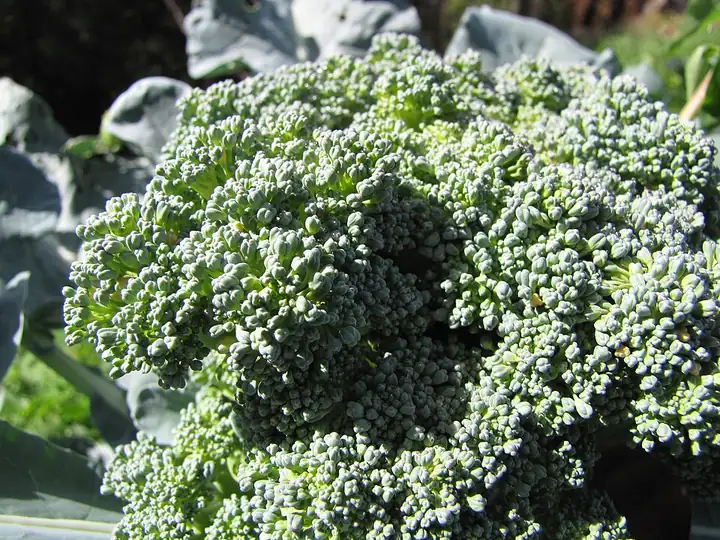
Broccoli
Brassica oleracea (Italica group) · Cabbage family (Brassicaceae)
| Hardiness zones | 2 to 11 |
|---|---|
| Sun | full sun |
| Water | moderate |
| Life cycle | annual |
| Frost | Hardy: takes frost |
| Soil pH | 6.0–7.0 |
| Spacing | 18 to 24 inches |
| Days to harvest | 50 to 85 days |
| Soil temperature to plant | at least 40°F |
About Broccoli
Broccoli is grown for its tight green heads of flower buds and keeps producing smaller side shoots after the main head is cut. It develops best in cool weather, so it is grown as a spring or fall crop.
Grown as a cool-season annual in every zone; time it for the cool weather of spring or fall. Plants keep growing after the first light fall frosts.
When to plant
Timing is counted from your average last spring frost (and first fall frost). Sow & Tell works out the actual dates for your ZIP code.
- Start seeds indoors: 6 to 8 weeks before the last frost
- Set out plants: 2 to 4 weeks before the last frost
- Fall planting: 8 to 10 weeks before the first fall frost
Days count from transplanting: about 50 to 60 for spring varieties and 60 to 85 for fall ones. The fall number is for setting out transplants started in midsummer; plants held too long in pots may form tiny 'button' heads.
Soil
Fertile, well-drained soil that holds moisture; plants must never go short of water as heads form.
Work in compost or well-rotted manure and follow a soil test; without one, about 2.5 lb of balanced fertilizer such as 10-10-10 per 100 sq ft before planting, with soil pH about 5.8 to 6.5.
Feeding
- 3 to 4 weeks after transplanting, once plants are established (direct-seeded plants: when about 6 inches tall): nitrogen fertilizer such as calcium nitrate (15.5-0-0) or 21-0-0. Use about 2 lb of calcium nitrate per 100 ft of row, or 1/2 cup of 21-0-0 per 10 ft of row, beside the plants and water it in.
- when the main head is about the size of a quarter: nitrogen fertilizer such as 21-0-0. Add about 1/4 cup per 10 ft of row beside the plants and water it in.
- after cutting the main head: nitrogen fertilizer such as 21-0-0. A little more nitrogen helps the side shoots grow; water it in.
Do not use fresh manure or weed-and-feed products, and skip extra phosphorus unless a soil test calls for it.
Harvest
Cut the central head, with 5 to 6 inches of stem, while the buds are still tight and before any yellow flowers open. Keep picking the side shoots that follow.
After you cut the main head, many smaller side shoots form; keep cutting them as they reach usable size.
Varieties (32)
| Variety | Type | Days | Notes |
|---|---|---|---|
| Arcadia | Hybrid, heading | Deeply domed heads with small, fine beads and good cold tolerance. | |
| Avenger | Hybrid, heading | 102 days | Tight, heavy, attractive heads. |
| Belstar | Hybrid, heading | 65 to 66 days | Full-season broccoli with good quality. |
| Bonanza | Hybrid, heading | Large, tight central heads, followed by many side shoots after the main head is cut. | |
| Brigadier | Hybrid, heading | Medium-size plant with lightly domed, heavy heads of medium beads. Good for fresh use or freezing. | |
| Coronado Crown | Hybrid, heading | Extra-large, blue-green heads with many side shoots. | |
| Diplomat | Hybrid, heading | 67 days | A hybrid that Kentucky recommends for fall crops. |
| Early Dividend | Hybrid, heading | 45 days | Very early broccoli with strong side-shoot production. |
| Eastern Crown | Hybrid, heading | Showed good heat tolerance in University of Delaware trials cited by Maryland Extension. | |
| Emerald Crown | Hybrid, heading | 60 days | A reliable midseason broccoli. |
| Emperor | Hybrid, heading | 60 days | Compact, early-season broccoli. Resists black rot, downy mildew and hollow stem. |
| Everest | Hybrid, heading | 83 days | Domed heads with mildew tolerance. |
| Galaxy | Hybrid, heading | Very high-yielding early hybrid, similar to Premium Crop. Suited to spring and fall. | |
| Galleon | Hybrid, heading | 75 days | Semi-domed, dark green heads with even, medium beads. |
| Green Belt | Hybrid, heading | 70 days | A hybrid that Kentucky recommends for fall crops. |
| Green Comet | Hybrid, heading | 40 to 55 days | Very early, deep green, semi-domed heads. Gives a good second cutting of side shoots; an All-America Selections winner. |
| Green Magic | Hybrid, heading | 57 to 60 days | Full-season broccoli that Clemson recommends for avoiding disease and bolting problems. Resists downy mildew and handled heat well in University of Delaware trials. |
| Green Valiant | Hybrid, heading | Midseason broccoli with high-domed heads of small beads that hold well. | |
| Gypsy | Hybrid, heading | Smooth, domed heads that hold well in warm weather. Tolerates downy mildew. | |
| Heritage | Hybrid, heading | Vigorous, widely adapted hybrid with some downy mildew resistance. Best for winter and spring harvests. | |
| Imperial | Hybrid, heading | 66 days | Tight, domed heads with small, dark green beads. |
| Lieutenant | Hybrid, heading | 60 days | Full-season broccoli with good quality. |
| Marathon | Hybrid, heading | 68 days | Cold-tolerant broccoli with large domed heads of small beads; it can overwinter. |
| Mariner | Hybrid, heading | Medium, compact heads with medium-fine beads. Tolerates heat well. | |
| Packman | Hybrid, heading | 50 to 55 days | Early hybrid with large heads (up to about 8 inches) that tend to be ready at the same time, followed by many side shoots. Widely adapted, with some heat tolerance. |
| Pinnacle | Hybrid, heading | 64 days | High-domed heads with small to fine beads that hold well in the field. Listed with downy mildew resistance. |
| Premium Crop | Hybrid, heading | 55 to 65 days | Early, dome-shaped heads with medium beads and some heat tolerance. |
| Southern Comet | Hybrid, heading | 50 days | Early, low-domed heads with few side shoots. |
| Windsor | Hybrid, heading | Semi-domed heads with medium beads. Its open plant shape suits humid areas. | |
| Calabrese | Open-pollinated, heading | 57 days | Heirloom broccoli recommended for Central Texas. |
| Waltham 29 | Open-pollinated, heading | Released by the University of Massachusetts in 1950. Uniform with small buds, good color, cold tolerance and large side shoots. | |
| De Cicco (Di Cicco) | Open-pollinated, sprouting | An older Italian-type broccoli on Oklahoma State's home garden list. |
Good neighbors
Thyme, Onion, Nasturtium, Radish
An Iowa study cited by UMN Extension found thyme, onion and nasturtium helped reduce cabbage looper damage on broccoli; radishes at the base are a space-saver.
Pests to watch for
Imported cabbageworm, Cabbage looper, Flea beetles, Aphids, Whiteflies, Slugs, Harlequin bug, Swede midge, Bagrada bug, Garden symphylan, Beet armyworm, Cabbage maggot, Diamondback moth, Fungus gnats
Diseases and problems
Black rot, Clubroot, Alternaria leaf spot, Edema (oedema), Transplant shock, Too little light (leggy plants), Bolting (going to seed), Boron deficiency, Nutrient deficiency, Tipburn, Downy mildew, Damping-off, White mold, Sooty mold, Turnip mosaic
In the kitchen
Steamed, roasted, stir-fried or eaten raw; the peeled stems are tender too.
Keeping it: Refrigerate unwashed heads in a loose, open bag and use within 3-5 days; with cold, humid storage it can last about 2 weeks.
Safety: If you take the blood thinner warfarin, keep the amount of vegetables like broccoli about the same from day to day, because they are rich in vitamin K (NIH Office of Dietary Supplements).
Pets: Not listed as toxic by the ASPCA
Sources
- extension.umn.edu
- extension.illinois.edu
- extension.unh.edu
- monroe.cce.cornell.edu
- extension.colostate.edu
- warren.cce.cornell.edu
- extension.umn.edu
- extension.umd.edu
- ods.od.nih.gov
- hgic.clemson.edu
- extension.usu.edu
Photo: Photo: Forest & Kim Starr, CC BY 3.0 US, via Wikimedia Commons (CC BY 3.0 US). Photo resized for the web.

Planting dates and advice are general guidance; check with your local Cooperative Extension office for your area.