
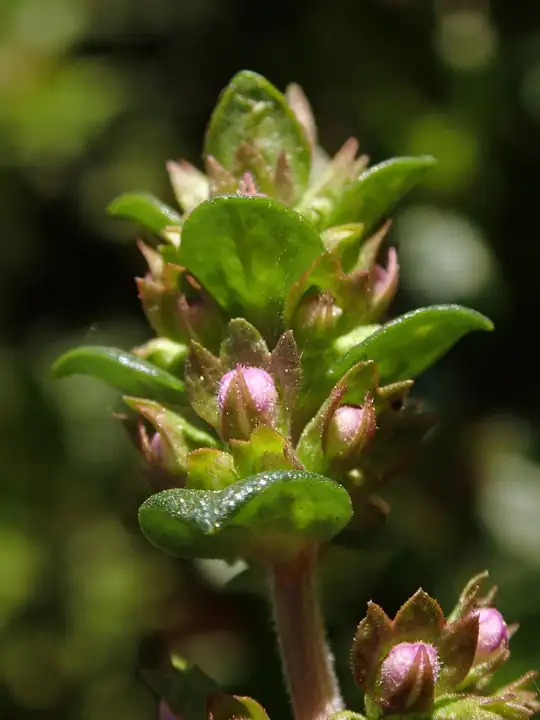
Thyme
Thymus vulgaris · Mint family (Lamiaceae)
| Hardiness zones | 5 to 9 |
|---|---|
| Sun | full sun |
| Water | low |
| Life cycle | perennial |
| Frost | Hardy: takes frost |
| Soil pH | 6.0–8.0 |
| Spacing | 12 inches |
About Thyme
Common thyme is a small, woody perennial with tiny aromatic leaves used in almost every cuisine. It is drought tolerant, low maintenance, deer resistant and loved by pollinators.
NC State lists common thyme as hardy in zones 5-9.
When to plant
Timing is counted from your average last spring frost (and first fall frost). Sow & Tell works out the actual dates for your ZIP code.
Seed sprouts unevenly, so thyme is best started from stem cuttings, layering, division or nursery plants set out in spring. Trim plants when they get leggy.
Soil
Loam, sandy or rocky soil with good drainage; it tolerates dry spells.
Plant in full sun in light, dry, well-drained soil with a pH near 6.3.
Feeding
Once established, thyme needs no fertilizer. Rich soil or heavy feeding gives fast, lush growth with less essential oil, so leaves have weaker flavor and scent.
Harvest
Cut stems just before the plant flowers, when the leaves have the most oil; use them fresh or dried.
Cut 5 to 6 inches off the top growth, leaving about 5 inches and the woody stems; best flavor is just before it flowers. Trim whenever it gets leggy.
Varieties (21)
| Variety | Type | Days | Notes |
|---|---|---|---|
| Broadleaf English | Common thyme | Sweeter fragrance. Broad small leaves and white flowers; Penn State calls it the most robust. | |
| German Winter | Common thyme | Good cooking quality. Dense grower; very winter hardy. | |
| Gray Hill | Common thyme | Narrow gray leaves and pale lavender flowers. | |
| Narrow Leaf French | Common thyme | Lighter, sweeter taste that many chefs prefer. Fine, narrow gray leaves and white flowers. | |
| Orange Balsam | Common thyme | Orange-scented leaves. Narrow leaves and lavender flowers. | |
| Provencial | Common thyme | Strong citrus aroma. Tiny, narrow gray-green leaves and white flowers. | |
| Tabor | Common thyme | Pungent. Dark green leaves and pink flowers. | |
| Common thyme | Common thyme (Thymus vulgaris) | The standard cooking thyme. Small, shrubby plant about 12 inches tall with gray-green leaves. | |
| Argenteus | Common thyme (variegated) | Green leaves marked with creamy white. | |
| Silver Posie | Common thyme (variegated) | Larger leaves with white edges. | |
| Coccineus | Creeping thyme (T. serpyllum) | Dark green leaves and reddish-pink flowers. | |
| Elfin | Creeping thyme (T. serpyllum) | Tiny, only 1-2 inches tall, with gray-green leaves and lavender-pink flowers. | |
| Magic Carpet | Creeping thyme (T. serpyllum) | Dark green leaves and magenta-pink flowers. | |
| Pink Chintz | Creeping thyme (T. serpyllum) | Fuzzy dark green leaves and salmon-pink flowers. | |
| Creeping thyme | Creeping thyme (Thymus praecox) | Only 2-3 inches tall; an excellent groundcover. | |
| Wild thyme (mother-of-thyme) | Creeping thyme (Thymus serpyllum) | Dense, creeping evergreen mat 2-3 inches tall with flowers from red to purple; good between stepping stones and along paths. | |
| Archer's Gold | Lemon thyme | Variegated gold foliage. | |
| Doone Valley | Lemon thyme | Leaves turn gold-tipped in fall and winter. | |
| Silver Queen | Lemon thyme | Lemon fragrance. Silvery variegated leaves. | |
| Lemon thyme | Lemon thyme (Thymus x citriodorus) | Light lemon scent and taste. Low evergreen plant 6-12 inches tall, spreading about a foot. | |
| Woolly thyme | Woolly thyme (Thymus pseudolanuginosus) | Flat mat 2-6 inches tall of tiny, soft, hairy gray-green leaves with pale pink flowers; takes light foot traffic. |
Good neighbors
In an Iowa study, thyme planted with onion and nasturtium reduced cabbage looper and cabbageworm damage on broccoli, and a greenhouse study found less diamondback moth on Brussels sprouts; evidence is limited to a few studies (University of Minnesota Extension).
Pests to watch for
Four-lined plant bug
In the kitchen
Leaves flavor soups, stews, sauces, meats and fish; the flowers are edible too.
Keeping it: Stand fresh sprigs in a glass with an inch of water in the fridge, loosely covered, and change the water daily; use within about a week or freeze them. Dried leaves keep best airtight in a cool, dark cupboard.
Safety: People allergic to thyme or other mint-family plants should avoid medicinal thyme, and it can upset the stomach; the European Medicines Agency limits most thyme medicines to ages 12 and up.
Pets: Not listed as toxic by the ASPCA
Sources
- plants.ces.ncsu.edu
- extension.umn.edu
- ema.europa.eu
- aspca.org
- aspca.org
- aspca.org
- aggie-hort.tamu.edu
- extension.psu.edu
- extension.umn.edu
- hgic.clemson.edu
Photo: Photo: Salicyna, CC BY-SA 4.0, via Wikimedia Commons (CC BY-SA 4.0). Photo resized for the web.

Planting dates and advice are general guidance; check with your local Cooperative Extension office for your area.