
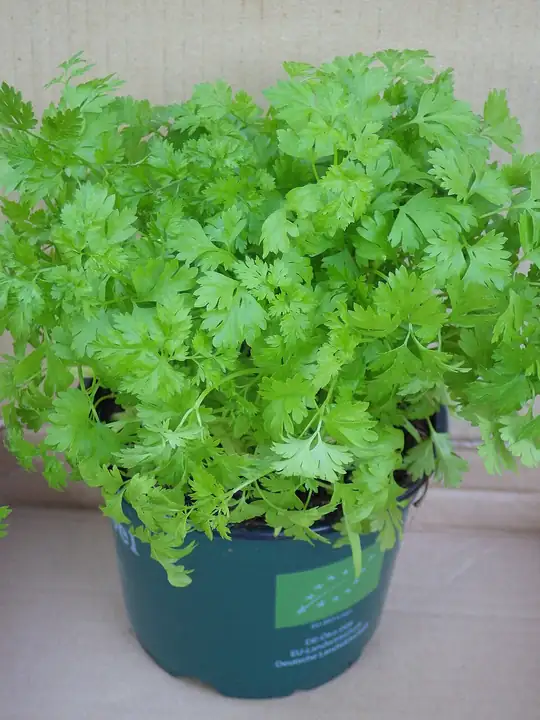
Chervil
Anthriscus cerefolium · Carrot family (Apiaceae)
| Hardiness zones | 2 to 11 |
|---|---|
| Sun | full sun to part shade |
| Water | moderate |
| Life cycle | annual |
| Frost | Hardy: takes frost |
| Soil pH | 6.0–8.0 |
| Spacing | 3 to 6 inches |
About Chervil
Chervil is a small, cool-weather herb with lacy, light green leaves that taste like a mild parsley with a hint of anise. Also called French parsley, it grows quickly from seed, and is happy in light shade. Wild chervil (Anthriscus sylvestris), a roadside weed in parts of the Northeast, is a different plant.
Grown as a cool-season annual in spring or fall in every zone; NC State gives no hardiness zones for it, and in mild areas it can live into a second year.
When to plant
Timing is counted from your average last spring frost (and first fall frost). Sow & Tell works out the actual dates for your ZIP code.
Sow seed where it will grow in early spring, and again in late summer or fall, because seedlings don't transplant well. Barely cover the seed, since light helps it sprout, and keep the soil moist. Sow again every 3 to 4 weeks for a steady supply; fall-sown seed often waits and comes up the next spring.
Soil
Well-drained soil that stays moist; it tolerates clay, loam or sand (NC State).
Use well-drained soil that holds moisture (pH about 6.0 to 8.0); work in compost and base any lime or fertilizer on a soil test.
Feeding
Don't try to transplant chervil, and don't bury the seed deeply: it needs light to sprout and seedlings move badly.
Harvest
Pick the tender leaves once they are fully open, before the flower buds open. Cutting off flower stems keeps plants leafy, but chervil bolts quickly in warm weather.
Pick tender leaves through the season and cut off flower stems to keep it leafy. It bolts quickly, so sow a little more every 3 to 4 weeks for a steady supply.
Varieties (2)
Illinois Extension names only two chervil varieties besides plain flat-leaf chervil; most seed is sold simply as chervil.
| Variety | Type | Days | Notes |
|---|---|---|---|
| Crispum | Curled | Subtle flavor. Curled green leaves. | |
| Vertissimo | Flat-leaf | Shiny, dark green flat leaves on a dense, compact plant. |
Good neighbors
NC State calls chervil a good companion for radishes and lettuce, but that is garden lore; we found no trials testing it.
Pests to watch for
Slugs
In the kitchen
Use the leaves fresh like parsley in salads, soups, sauces, egg and cheese dishes, herb butter and on fish, chicken and vegetables; the small white flowers and the seeds are edible too.
Safety: Leaves, flowers and seeds are eaten (NC State). Chervil is in the carrot family, whose deadly poison hemlock is easy to confuse with garden herbs in the wild (NC State), so only eat chervil you sowed yourself.
Pets: Not listed by the ASPCA; NC State tags chervil as non-toxic to cats, dogs and horses.
Sources
- plants.ces.ncsu.edu
- extension.illinois.edu
- extension.umd.edu
- extension.missouri.edu
- class.ucanr.edu
- plants.ces.ncsu.edu
- maine.gov
- aspca.org
- aspca.org
- aspca.org
- hgic.clemson.edu
Photo: Photo: Josef Schlaghecken / Wikimedia Commons, CC BY-SA 4.0 (CC BY-SA 4.0). Photo resized for the web.

Planting dates and advice are general guidance; check with your local Cooperative Extension office for your area.