
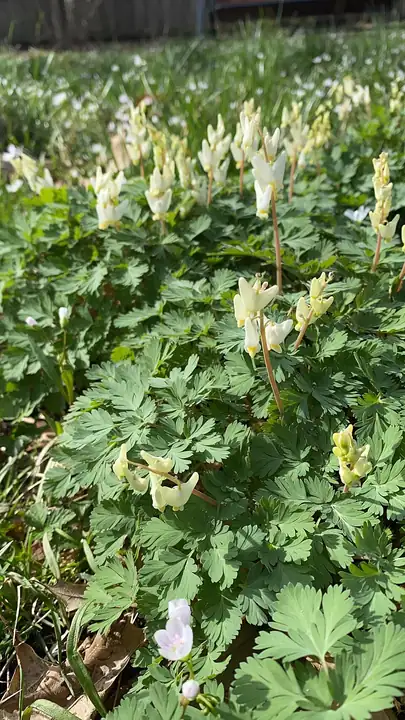
Dutchman's breeches
Dicentra cucullaria · Poppy family (Papaveraceae; formerly Fumariaceae)
| Hardiness zones | 3 to 7 |
|---|---|
| Sun | part shade |
| Water | high |
| Life cycle | perennial |
| Frost | Hardy: takes frost |
| Soil pH | 6.8–7.2 |
About Dutchman's breeches
Dutchman's breeches is a woodland wildflower whose white flowers look like tiny pairs of pants hung upside down on an arching stem above lacy, blue-green leaves (NC State, USDA Forest Service). Queen bumblebees just out of winter are its main pollinators (Iowa State). It is native to rich woods of the eastern U.S. from Maine and Minnesota south to Georgia, Alabama and eastern Kansas, with separate stands along the Columbia River in Washington, Oregon and Idaho (wildflower.org). It is poisonous: grazing cattle stagger after eating it, which earned it the name 'little blue staggers' (USDA Forest Service). Plants go dormant by early summer. Buy nursery-grown plants; never dig them from the wild (Missouri Extension).
Hardy in zones 3-7 (NC State). Native and not invasive; it spreads by small tubers and ant-carried seeds.
When to plant
Timing is counted from your average last spring frost (and first fall frost). Sow & Tell works out the actual dates for your ZIP code.
Plant or divide the crowns and small tubers in summer or fall as the plant goes dormant, or in early spring (Iowa State, wildflower.org). Set large tubers about 1 inch deep and small ones 1/2 inch deep, replant them quickly so they don't dry out, and water well. Divisions often don't bloom well the first year; expect a good show 2-3 years after planting. Seed needs 2-3 months of moist cold before it sprouts, so we give no day count to first bloom.
Soil
Moist, humus-rich soil that drains well and never dries out in spring, acid to neutral (about pH 6.8-7.2); it tolerates limestone (wildflower.org, Missouri Extension, NC State).
Work in leaf compost or other organic matter for moist, humus-rich soil (Missouri Extension, NC State).
Feeding
- Fall, after tree leaves drop: a mulch of shredded leaves or leaf compost. Missouri Extension recommends mulch for Dutchman's breeches to keep the soil cool and evenly moist; no fertilizer schedule is given.
Don't let the soil dry out in spring; it needs constant moisture (Missouri Extension). Don't dig in the spot after it goes dormant in early summer.
Harvest
Blooms in early spring (about March-May) on 5-10 inch arching stems (NC State, wildflower.org). No deadheading is needed. Don't pick it for the vase: the flowers wilt almost right away (USDA Forest Service). The leaves vanish by early summer, so mark the spot.
Good neighbors
A design pairing, not a pest-control companion: Wisconsin Extension names Dutchman's breeches among hepatica's native neighbors, and NC State suggests planting it with later-emerging perennials that cover the gap when it goes dormant.
In the kitchen
Safety: All parts are poisonous, though it usually takes a large amount: eating it can cause trembling, staggering, vomiting, diarrhea, convulsions and labored breathing (NC State, wildflower.org). The sap can briefly irritate skin. Never eat it.
Pets: Not listed by the ASPCA (no Dutchman's breeches or Dicentra entry on its plant lists that we could check). It is toxic to livestock: grazing cattle stagger after eating it (USDA Forest Service), and all parts are poisonous (NC State), so keep pets and livestock from eating it.
Sources
- plants.ces.ncsu.edu
- wildflower.org
- fs.usda.gov
- understory.nrem.iastate.edu
- yardandgarden.extension.iastate.edu
- yardandgarden.extension.iastate.edu
- extension.missouri.edu
- aspca.org
- aspca.org
- aspca.org
- aspca.org
Photo: Photo: Abigail Staffelbach, CC0, via Wikimedia Commons (CC0). Photo resized for the web.

Planting dates and advice are general guidance; check with your local Cooperative Extension office for your area.