
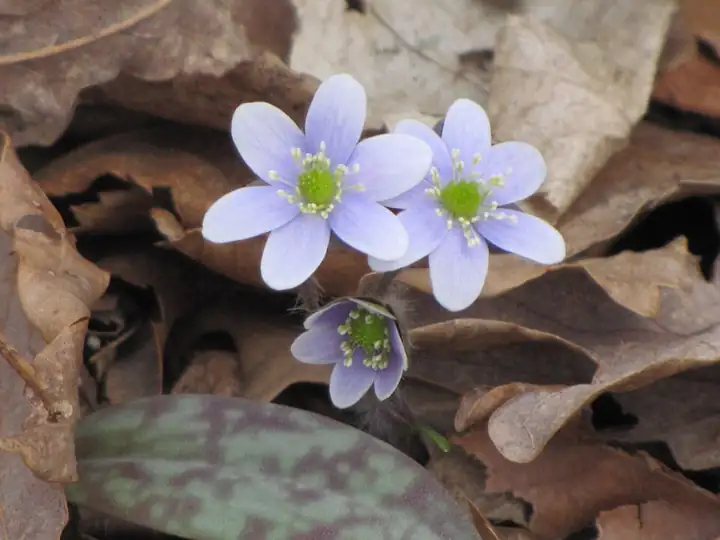
Hepatica
Hepatica americana (round-lobed hepatica) and H. acutiloba (sharp-lobed hepatica, also listed as H. americana var. acuta); also filed under Anemone · Buttercup family (Ranunculaceae)
| Hardiness zones | 3 to 8 |
|---|---|
| Sun | part shade |
| Water | moderate |
| Life cycle | perennial |
| Frost | Hardy: takes frost |
About Hepatica
Hepatica, or liverleaf, is one of the earliest woodland wildflowers: small star-shaped blooms in white, pink, lavender or blue open in early spring before the trees leaf out (Wisconsin Extension, NC State). Its leathery three-lobed leaves stay green through winter and turn russet to purple. Both kinds are native to the eastern U.S. from Maine and Minnesota south to northern Florida, Alabama and Arkansas (NC State, wildflower.org). Wisconsin Extension says never dig it from intact woods; buy nursery-grown plants (Missouri Extension).
Round-lobed hepatica is hardy in zones 3-8 and sharp-lobed in zones 3-7 (NC State). Native and not invasive; ants slowly spread its seeds.
When to plant
Timing is counted from your average last spring frost (and first fall frost). Sow & Tell works out the actual dates for your ZIP code.
Plant nursery-grown plants in clumps of two or three in a shady spot with rich soil (Wisconsin Extension). Divide in fall, keeping 2-3 buds on each piece, though clumps grow slowly and are best left alone for years (wildflower.org, Wisconsin Extension). Sow seed outdoors right after you collect it in late spring; first-year seedlings have only two leaves. We found no sourced day count to first bloom.
Soil
Rich, humus-filled soil that drains well but stays evenly moist; round-lobed hepatica leans to acid soil, while sharp-lobed hepatica likes neutral to slightly alkaline soil (NC State, Wisconsin Extension).
Work leaf compost or other organic matter into the bed for rich, moist, well-drained soil (Missouri Extension, NC State).
Feeding
- Fall, after tree leaves drop: a light mulch of shredded leaves or leaf compost. Missouri Extension says woodland wildflowers do best with leaf mulch instead of bare soil; no fertilizer schedule is given.
Don't disturb the roots once planted (NC State), and don't rake away the leaves the plant keeps over winter.
Harvest
Blooms in early spring (about March to mid-May) for up to a month; flowers close at night and on cloudy days (Wisconsin Extension, NC State). No deadheading is needed. Leave last year's leaves until the new ones come up after bloom.
Varieties (2)
Extension sources describe the two native kinds; Wisconsin Extension notes Japanese gardeners have bred double-flowered forms since the 1700s, but we found no sourced named cultivars.
| Variety | Type | Days | Notes |
|---|---|---|---|
| Sharp-lobed hepatica | Native kind (H. acutiloba, also H. americana var. acuta) | Leaves with pointed lobes; white, pink or lavender flowers; 4-6 in tall. Likes neutral to slightly alkaline soil. | |
| Round-lobed hepatica | Native kind (H. americana, also H. nobilis var. obtusa) | Leaves with rounded lobes; white, pink, blue or lavender flowers; 3-9 in tall. Prefers acid soil. |
Good neighbors
Bleeding heart, Wild geranium (spotted cranesbill), Dutchman's breeches, Trillium
These are design pairings, not pest-control companions: Wisconsin Extension suggests bleeding hearts, wild geranium, Dutchman's breeches, trilliums and woodland phlox as native neighbors.
Pests to watch for
Slugs, Brown garden snail
In the kitchen
Safety: The leaves can irritate skin and may be poisonous if eaten (Wisconsin Extension), so wear gloves if your skin is sensitive and don't eat it or make tea from it.
Pets: Not listed by the ASPCA (no hepatica or liverleaf entry on its plant lists that we could check). Wisconsin Extension says the leaves may be poisonous if eaten, so keep pets from chewing them.
Sources
- plants.ces.ncsu.edu
- plants.ces.ncsu.edu
- hort.extension.wisc.edu
- wildflower.org
- extension.missouri.edu
- aspca.org
- aspca.org
- aspca.org
- aspca.org
Photo: Photo: Linda M Morgan, CC BY-SA 3.0, via Wikimedia Commons (CC BY-SA 3.0). Photo resized for the web.

Planting dates and advice are general guidance; check with your local Cooperative Extension office for your area.