
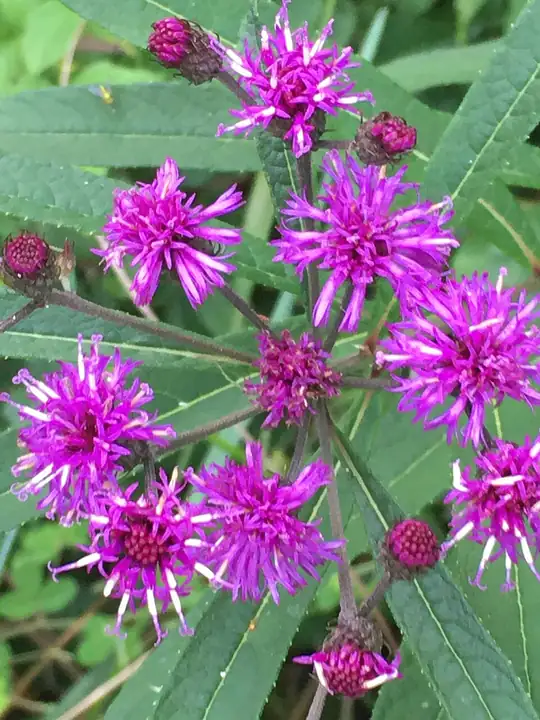
Ironweed
Vernonia noveboracensis (New York ironweed), V. fasciculata (prairie ironweed) and V. lettermannii (narrowleaf or Letterman's ironweed, incl. 'Iron Butterfly'), plus hybrids such as 'Summer's Swan Song' · Aster family (Asteraceae)
| Hardiness zones | 4 to 9 |
|---|---|
| Sun | full sun |
| Water | moderate |
| Life cycle | perennial |
| Frost | Hardy: takes frost |
| Spacing | 36 to 72 inches |
About Ironweed
Ironweeds are late-summer native perennials with flat clusters of fuzzy, deep-purple flowers that feed bees and butterflies, followed by rusty seed heads that may give them their name and seeds for songbirds (NC State, NYBG, Wildflower Center). New York ironweed is a 5-8 ft giant of moist meadows from Massachusetts to Ohio and south to Georgia and Mississippi; prairie ironweed grows in damp prairies and streambanks across the northern plains, such as South Dakota; and narrowleaf ironweed, native only to Arkansas and Oklahoma, gives the compact, fine-leaved 'Iron Butterfly' (Wildflower Center, SDSU, NC State). Deer and other browsers leave them alone (Mt. Cuba Center).
New York ironweed is hardy in zones 5-9; narrowleaf ironweed and 'Iron Butterfly' in 4-9 (NC State, NYBG). Not listed as invasive anywhere we checked, though it self-seeds in moist spots (NYBG).
When to plant
Timing is counted from your average last spring frost (and first fall frost). Sow & Tell works out the actual dates for your ZIP code.
Set out plants in spring or fall. For seed, sow outdoors in fall or give it about 2-3 months of cold, moist treatment in the refrigerator before spring sowing (Wildflower Center, SDSU). Clumps can also be divided, or softwood cuttings taken in late spring (Wildflower Center). No sourced day count to first bloom.
Soil
New York and prairie ironweed like rich, moist to wet, slightly acid soil and suit rain gardens and pond edges; narrowleaf ironweed and 'Iron Butterfly' want average, well-drained soil and handle drought and poor soil (NC State, SDSU, NYBG).
New York ironweed likes moist soil with organic matter; narrowleaf ironweed and 'Iron Butterfly' do fine in average or poor, well-drained soil (NC State).
Feeding
Avoid over-fertilizing: rich soil makes stems bend and flop (NC State on 'Iron Butterfly' and narrowleaf ironweed). Follow a soil test if you feed at all (Penn State).
Harvest
Blooms from July into September (NC State, Wildflower Center); some southern forms run into October (Mt. Cuba Center). Good cut flowers (NC State). To keep tall kinds shorter, cut them to the ground when about 2 ft tall (flowers come about 3 weeks later) or prune to about 2 ft in spring (NYBG, NC State); cut 'Iron Butterfly' back in late May or early June if it splays (Mt. Cuba Center). Trim spent flowers to limit seedlings.
Varieties (7)
NC State and Mt. Cuba Center's 2020-2023 ironweed trial document these 7 named ironweeds; two are selections of related species (tall and giant ironweed).
| Variety | Type | Days | Notes |
|---|---|---|---|
| Jonesboro Giant | Giant ironweed (V. gigantea) | A selection of giant ironweed, the tallest species (reportedly up to 10 ft). | |
| Summer's End | Hybrid ironweed ('Iron Butterfly' x V. larseniae) | Mounding, about 4.5 ft, with fine green leaves and stems. | |
| Summer's Swan Song | Hybrid ironweed (V. lettermannii x V. angustifolia 'Plum Peachy') | Compact, mounding, about 3.5 ft, with threadlike leaves on purple-flushed stems and violet flowers. | |
| Summer's Surrender | Hybrid ironweed (V. lettermannii x V. arkansana) | Mounding, 4.5-5 ft, with fine leaves and lots of purple flowers. | |
| Iron Butterfly | Narrowleaf ironweed (V. lettermannii) | Compact, 2-3 ft tall and 1.5-2 ft wide, with fine, threadlike leaves and bright purple-violet flowers; foliage stayed nearly disease-free at Mt. Cuba. | |
| White Lightning | New York ironweed (V. noveboracensis) | A white-flowered form. | |
| Plum Peachy | Tall ironweed (V. angustifolia) | A selection of a related southeastern ironweed; the top-rated plant in Mt. Cuba Center's 2020-2023 ironweed trial (4.5 of 5). |
Good neighbors
NC State notes that ironweed's late purple flowers look great against yellow goldenrods; this is a design pairing, not a pest-control claim.
Diseases and problems
Rust, Powdery mildew
In the kitchen
Safety: The sources we checked list no toxic parts and no research-based guidance on eating it, pregnancy or allergies; treat it as an ornamental.
Pets: Not listed by the ASPCA (no ironweed or Vernonia entry on its dog, cat or horse lists).
Sources
- plants.ces.ncsu.edu
- plants.ces.ncsu.edu
- plants.ces.ncsu.edu
- wildflower.org
- openprairie.sdstate.edu
- libanswers.nybg.org
- mtcubacenter.org
- mtcubacenter.org
- mtcubacenter.org
- aspca.org
- aspca.org
- aspca.org
- aspca.org
- aspca.org
- aspca.org
- extension.psu.edu
Photo: Photo: Becky, CC0, via Wikimedia Commons (CC0). Photo resized for the web.

Planting dates and advice are general guidance; check with your local Cooperative Extension office for your area.