
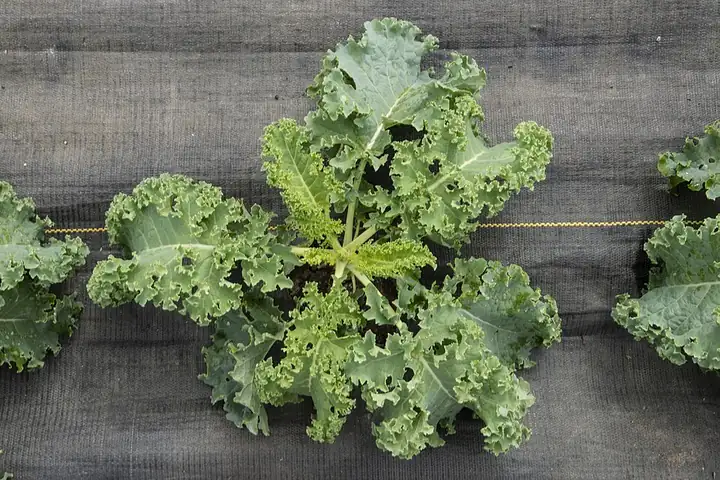
Kale
Brassica oleracea (Acephala group) · Cabbage family (Brassicaceae)
| Hardiness zones | 2 to 11 |
|---|---|
| Sun | full sun |
| Water | moderate |
| Life cycle | biennial |
| Frost | Hardy: takes frost |
| Soil pH | 6.0–7.5 |
| Spacing | 8 to 12 inches |
| Days to harvest | 55 to 75 days |
| Soil temperature to plant | at least 40°F |
About Kale
Kale is a hardy leafy green in the cabbage family that you can pick leaf by leaf for months. It keeps growing well past the first fall frosts, and cool weather makes its flavor sweeter.
Grown as a cool-season annual in every zone; time it for the cool weather of spring or fall. Leaves can be harvested even after they have frozen.
When to plant
Timing is counted from your average last spring frost (and first fall frost). Sow & Tell works out the actual dates for your ZIP code.
- Start seeds indoors: 6 to 8 weeks before the last frost
- Set out plants: 2 to 4 weeks before the last frost
- Sow seeds outdoors: 2 to 4 weeks before the last frost
- Fall planting: 6 to 11 weeks before the first fall frost
Days count from seeding or transplanting. For fall, sow seed 6 to 11 weeks before the first frost or set out transplants 8 to 10 weeks before it; the cooler the weather, the better the flavor.
Soil
Loamy, well-drained soil high in organic matter; heavier or sandier soils work if kept watered.
Work in compost or well-rotted manure (up to about 1 inch), follow a soil test, and aim for soil pH 6.0 to 7.5.
Feeding
- 4 weeks after transplanting, or after thinning seeded plants (about 4 inches tall): nitrogen fertilizer such as 21-0-0 or 46-0-0. Use about 1/2 cup of 21-0-0 per 10 ft of row (or 1/2 cup of 46-0-0 per 100 ft), 6 inches from the plants, scratch it in and water.
- after a big picking of leaves: nitrogen fertilizer. A light side-dressing, watered in, helps new leaves grow.
Do not use fresh manure or weed-and-feed products.
Harvest
Pick single leaves as soon as they reach usable size, working from the bottom up. Summer heat makes leaves tough and strong-flavored.
Pick individual leaves, leaving the small center leaves, and the plant keeps making new ones for many harvests. It keeps producing well past the first fall frosts, and even frozen leaves can be picked and cooked.
Varieties (25)
| Variety | Type | Days | Notes |
|---|---|---|---|
| Green Curled | Curly | 75 days | Green curly kale on Texas A&M's list for East Texas. |
| Starbor | Curly | 55 days | Finely curled green kale with good production and cold hardiness. Can be harvested with one cut. |
| Squire | Curly (Scotch) | Short-stemmed kale from the Virginia Agricultural Experiment Station. Very long-standing and among the least likely to bolt after overwintering. | |
| Dwarf Blue Curled Scotch | Curly (Scotch), dwarf | 55 days | Tender leaves. Sturdy, compact kale with dark green curled leaves. |
| Vates (Dwarf Blue Curled Vates) | Curly (Scotch), dwarf | 55 days | Hardy, compact plants 1 to 2 feet tall with blue-green, finely curled leaves. Released by the Virginia Agricultural Experiment Station in 1950. |
| Blue Armor | Curly (Scotch), hybrid | High-yielding hybrid with deep blue-green, heavily curled and fringed leaves. | |
| Blue Knight | Curly (Scotch), hybrid | 45 to 55 days | Uniform hybrid with deep blue-green, firm, curly leaves that hold up well after cutting. Slow to bolt. |
| Winterbor | Curly (Scotch), hybrid | Hybrid curly kale, a bit less curly than Vates. New leaves are bright green and turn bluer with age, and it is slow to bolt in spring. | |
| Blue Ridge | Curly, hybrid | Dark blue-green leaves with a full curl. Slow to bolt. | |
| Darkibor | Curly, hybrid | A curly kale that UGA recommends for Georgia gardens. | |
| Prizm | Curly, hybrid | ||
| Redbor | Curly, red, hybrid | 55 to 65 days | Frilly burgundy-red leaves that darken to nearly black after frost. Plants can reach 4 to 5 feet tall. |
| Verdura | Green | Green kale recommended for Oklahoma gardens. | |
| Scarlet | Red leaf | 55 to 70 days | Red-leaf kale with good yields, eating quality and cold hardiness. |
| Red Russian | Russian (Siberian-type) | 50 days | Tender; good raw in salads or in stir-fries. Flat, lobed leaves with purple veins and stems. More tender than frilly kales and good as a salad kale. |
| Red Ursa | Russian (Siberian-type) | Siberian-type kale trialed in North Dakota home gardens. | |
| Russian Frills | Russian (Siberian-type) | Looks like Red Russian when young, then develops frilly leaves. Very hardy. | |
| White Russian | Russian (Siberian-type) | 60 days | A salad-type Russian kale. |
| Improved Dwarf Siberian | Siberian | 50 days | Dark green, frilly leaves on a very cold-tolerant plant. |
| Premier | Siberian | Smooth, serrated, deep green to blue-green leaves from the Virginia Agricultural Experiment Station. Slow to bolt. | |
| Siberian | Siberian | 60 days | Broad, lobed leaves. Clemson calls it the most cold-hardy kale. |
| Black Magic | Tuscan (lacinato) | A Tuscan-type kale that UGA recommends for Georgia gardens. | |
| Dazzling Blue | Tuscan (lacinato) | Tuscan-type kale recommended after North Dakota home garden trials. | |
| Lacinato (Toscano, Tuscan, dinosaur kale) | Tuscan (lacinato) | 30 to 65 days | Tender leaves with good flavor. Long, narrow, puckered, dark blue-green leaves on upright plants. Tolerates both heat and cold. |
| Rainbow Candy Crush | Kale on the University of Georgia's list of recommended garden varieties. |
Good neighbors
UMN Extension says trap crops like mustard or arugula are well documented for drawing flea beetles away from cabbage-family crops; arugula is in this guide, so see its page for using it as a flea beetle trap crop.
Pests to watch for
Flea beetles, Imported cabbageworm, Cabbage looper, Aphids, Whiteflies, Harlequin bug, Swede midge, Bagrada bug, Cabbage maggot, Diamondback moth, Deer
Diseases and problems
Black rot, Alternaria leaf spot, Clubroot, Nitrogen deficiency, Nutrient deficiency, Downy mildew, Sooty mold, Turnip mosaic
In the kitchen
Cooked in soups and sautes, baked into chips, or eaten raw in salads when young.
Keeping it: Store unwashed kale in the fridge and use it within about 5 days.
Safety: If you take the blood thinner warfarin, keep the amount of greens like kale about the same from day to day, because they are rich in vitamin K (NIH Office of Dietary Supplements).
Pets: Not listed as toxic by the ASPCA
Sources
- extension.umn.edu
- extension.unh.edu
- monroe.cce.cornell.edu
- extension.colostate.edu
- yardandgarden.extension.iastate.edu
- warren.cce.cornell.edu
- extension.umn.edu
- extension.umd.edu
- ods.od.nih.gov
- extension.usu.edu
- hgic.clemson.edu
Photo: Photo: Lance Cheung, USDA, Public domain (USDA), via Wikimedia Commons. Photo resized for the web.

Planting dates and advice are general guidance; check with your local Cooperative Extension office for your area.