
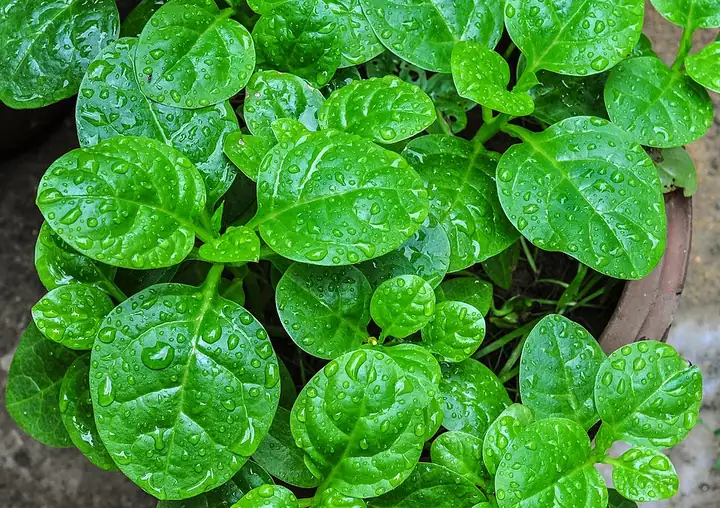
Malabar spinach
Basella alba (including the red form 'Rubra', sold as B. rubra) · Basella family (Basellaceae)
| Hardiness zones | 3 to 11 |
|---|---|
| Sun | full sun |
| Water | high |
| Life cycle | tender perennial (grown as an annual) |
| Frost | Tender: killed by frost |
| Soil pH | 5.5–7.0 |
| Spacing | 6 to 12 inches |
| Days to harvest | 70 to 85 days |
| Soil temperature to plant | at least 65°F |
About Malabar spinach
Malabar spinach is a heat-loving, twining vine from tropical Asia with thick, glossy leaves that cook like spinach. It isn't related to true spinach, and it shines in summer heat, when spinach has long since bolted. The leaves are a little slippery, like okra, which makes them good for thickening soups. In Hawaii it has escaped into the wild on Kauai, Oahu and the Big Island, and the Hawaii-Pacific Weed Risk Assessment rates it high risk (advisory).
Grown as a summer annual nearly everywhere; it grows slowly until nights stay above 60F and dies at the first frost. It lives as a perennial only in frost-free areas (zone 10 and warmer, such as south Florida). In Hawaii it is rated high risk for invasiveness, so gardeners there are advised not to plant it.
When to plant
Timing is counted from your average last spring frost (and first fall frost). Sow & Tell works out the actual dates for your ZIP code.
- Start seeds indoors: 6 to 8 weeks before the last frost
- Set out plants: 2 to 3 weeks after the last frost
- Sow seeds outdoors: 2 to 3 weeks after the last frost
Days count from seeding (about 70 to 85 days to a full harvest). The hard seed sprouts slowly (10 days to 3 weeks); soak it overnight or nick the coat. Direct sow 2 to 3 weeks after the last frost in zone 7 and warmer; elsewhere start indoors and set out once soil is warm (65-75F). Stem cuttings root easily.
Soil
Fertile, moist, well-drained soil high in organic matter; dry soil makes it flower and turn bitter.
Work compost into fertile, well-drained soil (best pH about 5.5 to 7.0) and set up a trellis or fence.
Feeding
Don't let the soil dry out: dry soil pushes the vine to flower and the leaves turn bitter. UF/IFAS advises only modest fertilizer, even on poor sandy soil.
Harvest
Cut young leaves and tender shoot tips with scissors as needed all summer; regular cutting keeps the vine bushy. Leaves turn bitter once the plant flowers in late summer or fall. Two plants give a small family plenty of greens for summer and fall.
Snip young leaves and tender shoot tips all summer; cutting keeps the vine compact and leafy. Leaves get bitter once it flowers in late summer or fall.
Varieties (2)
Seed is sold mostly by species; sources describe only the green form and the red 'Rubra'.
| Variety | Type | Days | Notes |
|---|---|---|---|
| Green Malabar spinach | Basella alba | Mild and slightly peppery with a hint of citrus. Dark green, glossy, oval to heart-shaped leaves on green stems; UF/IFAS says this is the form preferred for eating. | |
| Rubra | Red-stemmed (often sold as Basella rubra) | Burgundy stems and red-tinged leaves with pink veins; especially ornamental on a trellis. |
Good neighbors
Cornell suggests letting it share a trellis with peas (peas in spring, Malabar spinach in summer); that's a space-sharing tip, not a proven pest benefit.
Pests to watch for
Brown garden snail
Diseases and problems
Cercospora leaf spot
In the kitchen
Eat young leaves raw in salads, or steam, boil or stir-fry them like spinach; the leaves thicken soups, stews and curries.
Keeping it: Keep leaves cool but not cold: UF/IFAS found they hold about 12 to 14 days at 50-60F, while 30-40F (refrigerator temperatures) causes chilling injury and warm rooms make them yellow.
Safety: The extension sources we checked note no safety problems with the leaves. The purple-black berries are tasteless and their juice stains hands and clothes.
Pets: Not listed by the ASPCA
Sources
- hort.extension.wisc.edu
- plants.ces.ncsu.edu
- ask.ifas.ufl.edu
- gardening.cornell.edu
- gardeningsolutions.ifas.ufl.edu
- uaex.uada.edu
- blogs.ifas.ufl.edu
- site.extension.uga.edu
- pvamu.edu
- plantpono.org
- aspca.org
- aspca.org
- aspca.org
Photo: Photo: Joydeep / Wikimedia Commons, CC BY-SA 3.0 (CC BY-SA 3.0). Photo resized for the web.

Planting dates and advice are general guidance; check with your local Cooperative Extension office for your area.